

Introduction: The Overlooked “Connector”
Have you experienced this frustration?
You evaluate each machine individually—the VFFS bagger, the Multihead Weigher, the Case Packer—and their performance is flawless. High speeds, low failure rates. Yet, when these “star machines” are connected into a complete line, problems arise immediately:
- Speed mismatches cause products to pile up at transfer points.
- A minor stop downstream forces the entire line to halt due to lack of buffering.
- Chaotic layouts make routine maintenance a nightmare for operators.
The problem is rarely the individual machines. The problem lies in the “vessels” connecting them: the Conveyor System.
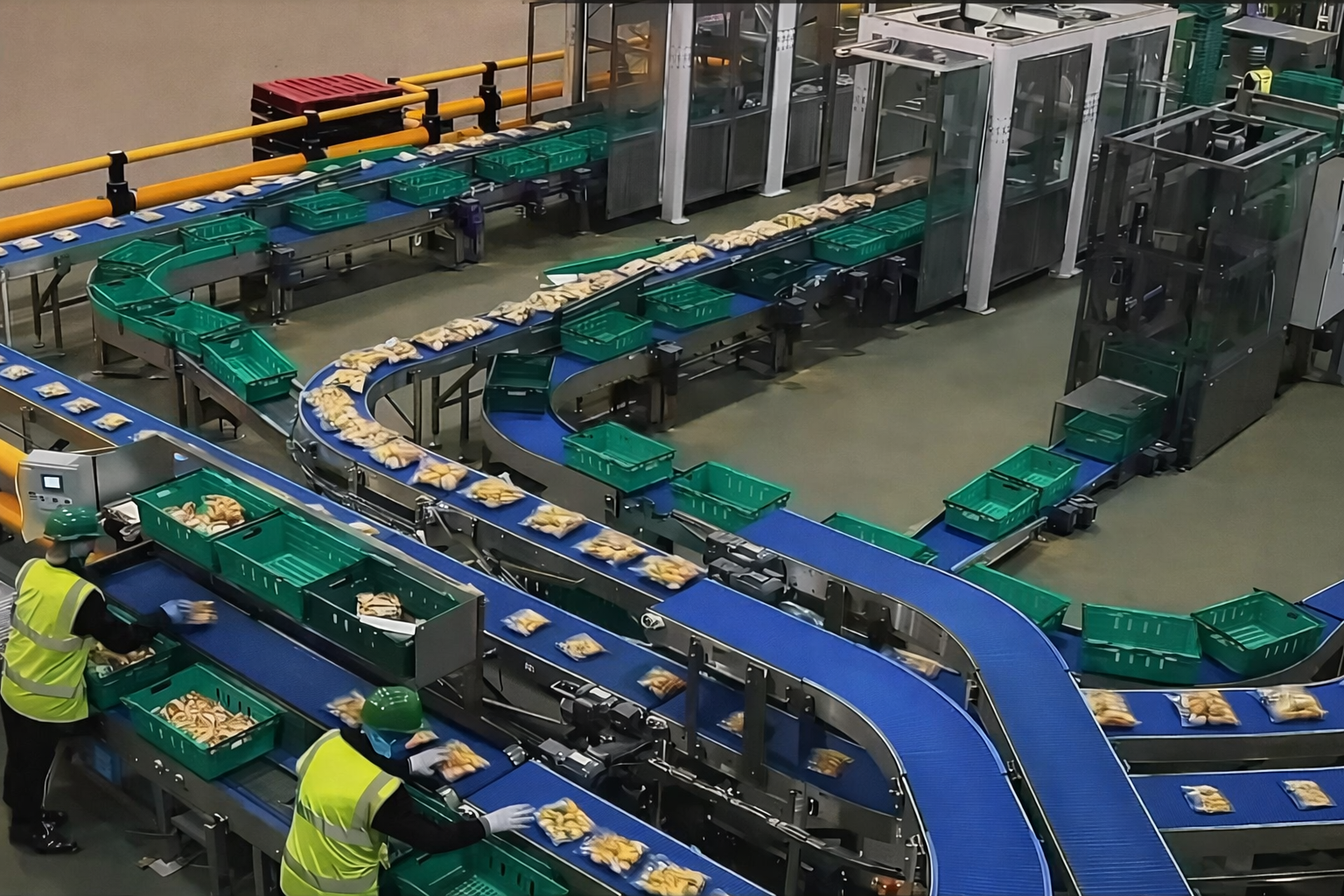
As a specialized conveyor manufacturer, we work daily with machine distributors, OEMs, and food factory managers. We see a common pattern: in early packaging line planning, conveyor systems are often treated as “accessories” or “afterthoughts” rather than core systems. This mindset is the root cause of packaging line bottlenecks and poor Overall Equipment Effectiveness (OEE).
The 3 Hidden Killers: Why “Good Machines” Make a “Bad Line”
1. Speed Mismatch: The Rhythm Breaker
The Scenario: Your high-speed labeler outputs 200 bottles/minute, but the connecting conveyor—due to incorrect motor sizing or friction issues—can only stably transport 180 bottles/minute.
The Consequence: The result is inevitable. You either force your expensive core machine to run slower, or you face severe product blockage and damage on the belt. The efficiency of the entire line is forever limited by its slowest link.
The Solution: Integrate Dynamic Speed Synchronization. A conveyor system should not run at a fixed speed; it must intelligently adjust its flow rate via VFDs (Variable Frequency Drives) and sensors based on real-time upstream and downstream throughput.
2. Lack of Accumulation: The Missing Flexibility
The Scenario: The downstream case packer needs to stop for 30 seconds to replace a tape roll.
The Consequence: Without a properly designed buffer zone, this 30-second pause instantly propagates upstream, forcing your high-speed Multihead Weigher to perform an emergency stop. This frequent “Stop-and-Go” cycle not only drastically reduces OEE but also accelerates wear and tear on your expensive motors.
The Solution: Smart Accumulation Design. We engineer “reservoirs” (accumulation tables or buffering conveyors) at critical points to temporarily hold products during downstream micro-stops, isolating the fault and keeping the upstream process running.
3. Poor Layout: The Invisible Efficiency Drain
The Scenario: To save on initial investment (CAPEX), a simple straight-line layout is chosen, leaving narrow workspaces where maintenance staff cannot easily access motors for service.
The Consequence: Operational efficiency drops, sanitation time increases, and complex, unnatural product paths increase the risk of collision and breakage.
The Solution: System layouts based on Ergonomics and Lean Manufacturing principles. We use 3D simulation during the engineering phase to balance efficiency, safety, and maintainability.
Engineering Decision Guide: Advice for Different Roles
To solve these problems, intervention must happen during the engineering design phase. Here is our specific advice for our partners:
👉 For Machine Distributors
Sales Advantage: Don’t just sell standalone machines. Offering a “Turnkey Solution” that includes an optimized conveying plan significantly boosts your proposal’s competitiveness.
Client Value: Professional conveyor planning reduces integration issues during on-site commissioning, directly improving client satisfaction and retention.
Action: Involve conveyor system experts early and include connection plans in your preliminary design.
👉 For Machine Manufacturers (OEMs)
System Thinking: View your equipment as “part of a system,” not an isolated island.
Standardized Interfaces: Provide clear mechanical and electrical interface specifications (e.g., handshake signals) to facilitate seamless integration with our conveyors.
Partnership: Establish a strategic partnership with a specialized manufacturer like Fill Package to develop standardized connection kits.
👉 For Factory Managers
TCO Perspective: Look beyond the initial purchase price. A cheap conveyor that frequently jams will cause long-term downtime losses (OPEX) that far exceed its procurement cost.
Flexibility: Ensure your conveyor system is modular, capable of adapting to product changes or capacity expansions over the next 3-5 years.
Hygiene Standards: Choose Open Frame designs that are easy to disassemble and clean, strictly complying with food safety standards.
Case Study: When the Conveyor Becomes the “Coordinator”
We recently collaborated with a dairy plant where the yogurt packaging line efficiency was stuck at 68% of its design capacity. The Diagnosis: The bottleneck wasn’t the filler or the sealer. It was the intermediate conveyor system lacking buffering capacity—any minor fault stopped the whole line.
The Fill Package Solution: We redesigned the conveying path, adding three Smart Accumulation Zones and implementing Dynamic Speed Control.
The Results:
- ✅ Overall Line Efficiency (OEE) increased to 89%
- ✅ Product changeover time reduced by 40%
- ✅ Unplanned downtime reduced by 60%
- 💰 ROI (Return on Investment): Just 7 months
The Time to Act is Now
If you are in any of the following stages, now is the best time to rethink the role of your conveyor system:
- 📅 Planning a new packaging line
- 🛠 Upgrading an existing line
- 🔄 Redesigning equipment layout
- 📈 Planning for capacity expansion
Early integration of conveyor planning helps you:
- Avoid expensive retrofits and on-site welding later.
- Shorten project startup and commissioning time.
- Ensure the line actually hits its design capacity.
Your Next Step: Get a Custom Layout Proposal
Every packaging line is unique—product characteristics, space constraints, and production goals vary. Generic conveyors only bring generic problems.
Fill Package provides professional conveyor system assessment and 3D planning services to help you make the right decisions at the engineering stage.
👉 Explore Our Integrated Conveyor System Solutions (Discover how we optimize material flow with Belt, Screw, and Vibratory systems)