

Introduction
Packaged water in sachets — small sealed pouches typically ranging from 150ml to 500ml — is one of the highest-volume consumer products in West Africa, South Asia, and Southeast Asia. In Ghana, Nigeria, and similar markets, water sachets (locally called ‘pure water’ or ‘iced water’) are the primary source of affordable, portable drinking water for hundreds of millions of people. In South Asian and Southeast Asian markets, the same format is used for mineral water, flavoured drinks, and oral rehydration solutions.
For entrepreneurs and small manufacturers looking at this market, the business logic is simple: high volume, consistent daily demand, low product cost, and a machine that runs the same film and format every day without complex changeovers. The question is not whether the market exists — it does, demonstrably — but whether the numbers work at entry scale.
This guide gives you a realistic, ground-level ROI analysis for a water sachet machine startup in 2026: what the machine costs, what the consumables cost, what your daily output and revenue potential looks like, what the common failure points are, and how to think about scaling once the first machine is running profitably.
The machine at the centre of this analysis is the BY-JLB160Y Liquid Sachet Packing Machine — the same platform that handles honey, ketchup, shampoo, and medical gel, which gives you meaningful product diversification options once the water line is established.
A. The Water Sachet Market: Why the Demand Is Structural, Not Cyclical
Water sachets are not a trend product. The demand is structural — driven by urbanisation, infrastructure gaps in municipal water quality, and the economics of unit pricing that make a 500ml sachet accessible to consumers who cannot afford a 1.5-litre bottled water.
The market characteristics that make this attractive for a small manufacturer:
- Daily repurchase — water sachets are consumed and repurchased every day. Unlike a food product with seasonal demand or a shelf life measured in months, your output sells continuously
- Low consumer price sensitivity to quality upgrades — a sachet that is 10% more expensive but reliably sealed and properly printed commands the premium without meaningful volume loss
- Fragmented supply — in most emerging markets, the water sachet category is served by hundreds of small local producers rather than a few large national brands. A new entrant with a clean, well-sealed sachet and reliable local distribution can take market share quickly
- Institutional demand — schools, offices, construction sites, and event catering all purchase water sachets in bulk. A single institutional account can absorb a significant percentage of a small machine’s daily output
The risk factors are equally structural: water quality regulation (most markets require a minimum treatment standard for packaged water), local competition on price, and logistics cost if your market is dispersed. None of these are machine-related — they are business model decisions you need to make before the machine arrives.
B. The Cost Model: What Does It Actually Cost to Start?
Capital expenditure: the machine
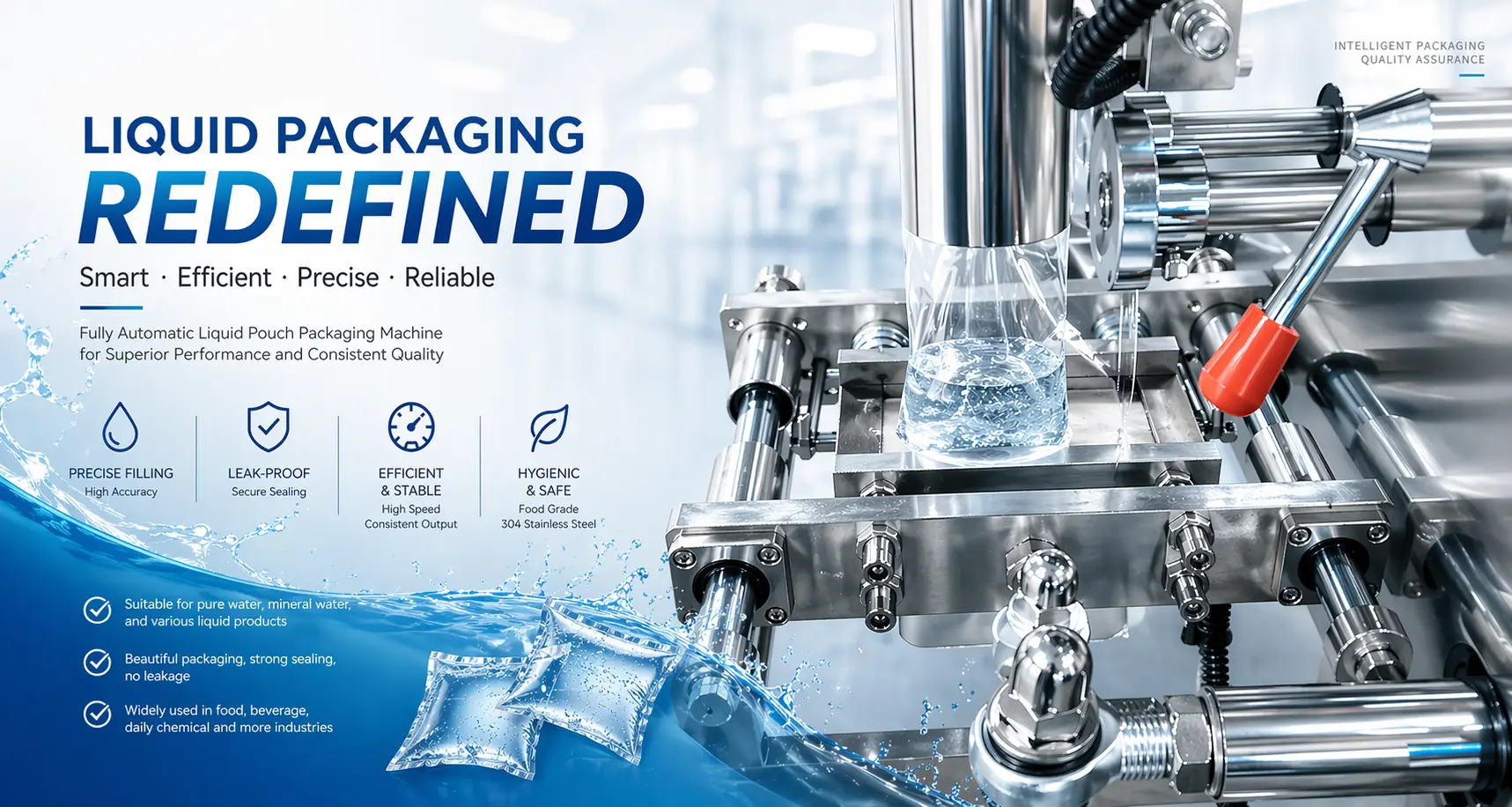
The BY-JLB160Y is a back-seal liquid sachet packing machine designed for water, beverages, sauces, honey, and similar products. It runs at 10–50 sachets per minute depending on fill volume and product viscosity. For water sachets at 150–500ml fill volume, the practical production rate is 30–45 sachets per minute on a calibrated line.
Machine price range: contact us directly for a current quotation, as pricing varies with configuration, optional features (date coder, round-corner punch, easy-tear notch), and shipping destination. As a general frame of reference for planning purposes, entry-level sachet liquid filling machines in this class from Chinese manufacturers are typically priced in a range that allows payback within 6–18 months on a single-shift water sachet operation in an emerging market — we provide a full quotation and payback model for your specific market on request.
Operating cost: film and water
The two primary consumable costs in water sachet production are packaging film and water (source water plus treatment, if applicable). Both are highly location-dependent, but the structure is consistent:
| Cost Component | Typical Range | Notes |
| Packaging film (PE laminate, per kg) | Market rate | Film cost per sachet depends on sachet size and film weight per m². A 500ml sachet at standard film weight uses approximately 10–14g of film. |
| Water (source + treatment) | Very low per litre | Borehole, municipal, or filtered water. Treatment cost (UV, RO, or chlorination) varies by source quality and local regulation. |
| Electricity | Low | The BY-JLB160Y runs on standard single-phase or three-phase power. Energy consumption is modest — the primary power draw is the sealing jaw heating elements. |
| Labour | 1–2 operators | One operator to monitor the machine and top up film rolls; one helper for carton packing if output is high. |
| Packaging (cartons) | Market rate | Water sachets are typically packed 20–50 per carton for distribution. |
Revenue and margin: a realistic 8-hour shift model
The following model uses conservative assumptions. Adjust the selling price and cost inputs for your specific market:
| Parameter | Conservative | Moderate | Notes |
| Machine speed | 30 sachets/min | 40 sachets/min | Accounting for film changes, minor stops, and operator breaks |
| Effective run time (8hr shift) | 6.5 hours | 7 hours | Realistic with film roll changes and maintenance |
| Daily output | 11,700 sachets | 16,800 sachets | At respective speeds and run times |
| Selling price per sachet | Local market rate | Local market rate | Varies significantly by market — this is your key variable |
| Film cost per sachet | Derived from film kg price | Derived from film kg price | Typically 15–25% of selling price in most markets |
| Water + treatment cost | Very low | Very low | Typically 5–10% of selling price |
| Labour (2 operators) | Fixed daily cost | Fixed daily cost |
Key insight: The water sachet business is a volume business. Margin per sachet is thin — typically 20–40% gross depending on your market — but the volume compensates. At 12,000–16,000 sachets per shift, even a modest margin per sachet generates meaningful daily revenue. The machine pays for itself not through high margin but through consistent, high-volume output running 6–7 days per week.
C. Beyond Water: Why the Honey Sachet Packing Machine Opportunity Is Different
Once a water sachet line is running and cash-flow positive, the most common question from operators is: what else can this machine run?
The BY-JLB160Y is not a single-product machine. It handles the full viscosity spectrum from water (1 centipoise) to honey and thick gel-consistency products (up to approximately 50,000 cP). This means the same machine that runs your water line can, with a product changeover, run honey sachets, ketchup sachets, shampoo sachets, or medical gel sachets — all products with significantly higher margin per sachet than water.
Why honey sachet packaging is a high-margin opportunity
A honey sachet — typically 10–30g of pure honey in an aluminum foil composite sachet — retails at a price point that is 5–15 times the material cost in most markets. Honey is positioned as a premium, natural product. The sachet format makes it accessible for single-serve use in cafes, hotels, airlines, and healthcare facilities — all institutional buyers who purchase in volume and pay a premium for consistent, professional packaging.
The engineering challenges in honey sachet packaging are well-documented:
- Drip-after-fill contamination — honey’s high viscosity and surface tension create a string of product (‘angel hair’) after the fill valve closes, which drips onto the film in the seal zone and causes seal failure. The BY-JLB160Y uses an anti-drip nozzle with a positive cutoff mechanism that eliminates this problem.
- Viscosity variation with temperature — honey behaves significantly differently at 15°C versus 35°C. At low temperature it becomes so viscous that it barely flows; at high temperature it thins and the fill weight drifts. The machine’s temperature-controlled product pathway maintains honey at a consistent working temperature throughout the production run, stabilising fill weight to within ±1%.
- Seal integrity under compression — a filled honey sachet under pallet pressure exerts continuous force against the seal line. The BY-JLB160Y’s back-seal jaw geometry creates a hermetic seal that resists this sustained pressure — verified through standard transport simulation testing.
For detailed specifications on honey sachet packaging configuration, see our BY-JLB160Y Liquid Sachet Packing Machine page.
The diversification logic
Running a single product on a sachet machine is a viable business. Running two or three products on the same machine — water during peak demand periods, honey for institutional buyers, ketchup or shampoo for consumer brands — is a more resilient business. The capital cost of the machine is spread across multiple revenue streams, and the machine’s utilisation rate increases, improving your return on the asset.
The product changeover on the BY-JLB160Y is designed for operators without engineering backgrounds: drain the previous product, rinse the filling system and nozzle, load the new product, adjust the fill volume setting, and run a short calibration batch. For a switch from water to honey, the additional step is heating the product pathway to working temperature — typically 15–20 minutes total changeover time.
D. What to Look for in a Water Sachet Machine: Technical Checklist
Not all sachet liquid filling machines are equivalent. The features below are the ones that matter most for a water sachet startup — and where cheaper machines typically cut corners:
| Feature | Why It Matters for Water Sachets | BY-JLB160Y Specification |
| Back-seal architecture | The back seal on a liquid sachet must withstand liquid pressure in all directions, including the compressive force of stacking in cartons and pallets | Optimised jaw geometry with consistent pressure across full seal width; PID temperature and dwell-time control |
| Production speed | Higher speed = lower cost per sachet and faster payback | 10–50 sachets/min; 30–45 practical for 150–500ml water sachets |
| Film width compatibility | Determines the range of sachet sizes you can produce | Supports standard liquid sachet film widths; contact for specific range |
| Date coding integration | Mandatory for most packaged water regulations | Integrated date coder option — ink jet or hot stamp |
| Easy-tear notch | Required for consumer convenience; expected by institutional buyers | Standard option — added at the cutting station |
| Round-corner punch | Differentiates your product visually; signals premium quality | Optional upgrade — adds perceived quality without speed penalty |
| Anti-drip nozzle | Critical for honey and high-viscosity products; good practice even for water | Standard on BY-JLB160Y |
| Stainless steel contact parts | Food safety and cleaning compliance | All product-contact parts in 304 stainless steel as standard |
E. Common Startup Mistakes (and How to Avoid Them)
Mistake 1: Buying on machine price alone
The cheapest water sachet machine on the market is not the lowest-cost option when you factor in seal failure rate, film wastage, and downtime. A machine that runs at 95% uptime with a 0.5% seal rejection rate outperforms a cheaper machine running at 80% uptime with a 3% rejection rate within the first month — the film waste and lost production cost more than the price difference.
Ask any supplier for a realistic seal rejection rate specification and a reference customer you can contact. If they cannot provide either, that tells you something.
Mistake 2: Underestimating film cost and quality
The packaging film is your second-largest consumable cost after water, and it directly determines seal quality and shelf life. Cheap film with inconsistent thickness or poor laminate adhesion will cause seal failures regardless of machine quality. Source film from a supplier with consistent batch quality, and ask for a film compatibility test on the machine before committing to a bulk order.
For water sachets, low-density polyethylene (LDPE) laminate is the standard material — it seals cleanly at relatively low jaw temperatures and is food-grade. The film specifications (thickness, seal layer composition) should match the machine’s jaw temperature range.
Mistake 3: Not accounting for water treatment in the ROI model
In most markets with strong water sachet demand, municipal water quality is insufficient for packaged water without treatment. The cost and complexity of treatment — UV sterilisation, reverse osmosis, or chlorination depending on source water quality and local regulation — is a significant startup cost that many first-time operators underestimate. Factor in the treatment equipment capital cost and ongoing consumable cost (filters, UV bulbs, chemicals) in your full startup budget.
Mistake 4: Single-shift thinking
A water sachet machine running one shift per day has a payback period that may be acceptable — but a machine running two shifts has approximately half the payback period with incremental additional labour cost. Most water sachet markets have predictable peak demand (morning and midday for retail; events and institutions for bulk orders) that makes two-shift or extended-shift operation both feasible and financially compelling once the line is established.
F. Scaling: From One Machine to a Production Line
A single BY-JLB160Y is a viable standalone operation for a startup or a small-scale producer serving a local market. As volume grows, the scaling path is straightforward:
- Add a second machine — running in parallel on the same product, or on a second product (honey, ketchup) to diversify revenue
- Add a sachet sorting and counting machine — if you are supplying retailers or institutional buyers who require counted quantities per carton, an automatic sachet counter eliminates the manual counting step that becomes a bottleneck at higher volumes
- Add a date coder if not already integrated — mandatory for regulatory compliance in most markets as you scale
- Consider a multi-lane configuration — for very high volumes, a dual-lane sachet machine can double output from a single machine footprint
For the full range of sachet filling and sealing machine options across liquids, powders, and granules, see our professional sachet packing machines overview.
Conclusion
A water sachet machine startup is one of the more straightforward manufacturing businesses to model and execute, because the product, the market, and the machine are all well-understood. The demand is structural and daily. The machine runs one product format consistently. The consumables are predictable. The regulatory requirements, while real, are manageable with the right water treatment setup.
The BY-JLB160Y gives you a machine that starts on water and grows with you — into honey sachets, ketchup, shampoo, or any liquid or paste product you identify as a margin opportunity in your market. The capital cost is a single, bounded investment. The payback depends on your market selling price and volume — which is why we always recommend working through the numbers for your specific location before committing.
Request a Full ROI Model for Your Market. Tell us your target market (location and product), expected selling price per sachet, and daily output target. Our sales team will build a customised payback model based on the BY-JLB160Y specifications and realistic film cost estimates for your region. Request ROI Analysis →
Ready to see the machine specifications? Visit the BY-JLB160Y Liquid Sachet Packing Machine page for full technical specifications, viscosity range, film compatibility, and available options (date coder, easy-tear notch, round-corner punch). Or explore all sachet machine types on our sachet packing machines overview.
Related reading:
How to Choose the Most Cost-Effective Dhana Dal Packing Machine — Granule Series
Ensuring Seal Integrity: 3 Keys to Pesticide Powder Packaging Safety — Powder Series