

Most sachet filling machine buyers compare fill speed and seal strength. Almost none ask about corner geometry — yet it is the single structural decision that determines which export markets your product can enter and which buyers will never return your email.
TL;DR
Round-corner sachets are not a design preference on your sachet packing machine — they are a structural specification that determines transport safety, channel eligibility, and brand positioning. For coffee beans, nuts, probiotics, and all dal varieties, the corner geometry your sachet filling machine produces is the single most overlooked lever for unlocking premium markets worth 15–20% more per unit..
Why does corner geometry matter more than seal strength?
Ask most exporters what they look for in a sachet packing machine and they will say: bags per minute, fill accuracy, seal strength, film compatibility. Corner geometry is almost never on the list. Yet it is the one specification that determines whether a hotel F&B director in Dubai, an airline caterer in Singapore, or a specialty buyer in Tokyo will accept your product onto their approved vendor list.
The reason is both physical and commercial. Physically, corners are where packaging fails during shipping. Commercially, corners are where packaging signals quality — or the absence of it — on a retail shelf.
“In premium export markets, packaging is evaluated before the product is tasted. The corner geometry, surface feel, and structural consistency of your sachet filling machine’s output signal whether a supplier belongs in the conversation at all.
The physics your current sachet packing machine may be getting wrong
When a sachet is compressed — under stacked cartons, in a shipping container, or squeezed in a consumer’s hand — force concentrates at the points of lowest radius. On a square-corner sachet packing machine, all compressive energy focuses at four sharp points. Under ocean freight load, those four points act as needles against every adjacent bag in the stack.
On a round-corner sachet filling machine, the same force is distributed across a continuous curve. There is no pressure concentration point. The stab-point failure mode is physically eliminated — not reduced, eliminated.
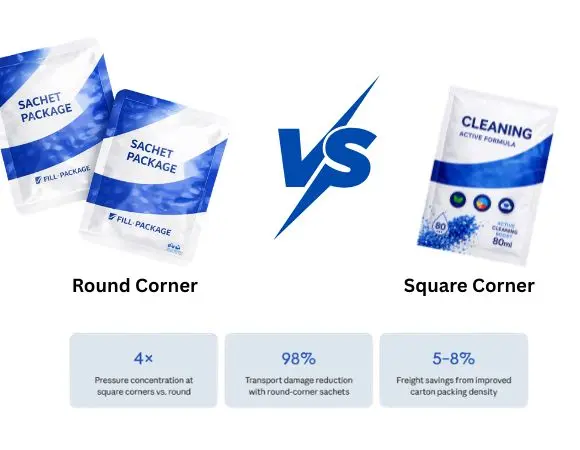
Round corner vs. square corner sachet packing machine: every dimension compared
Square corner sachet machine
- Pressure at 4 sharp points
- 3–5% container leakage rate
- Lower carton density
- Commodity shelf appearance
- Consumer scratch risk
- Fails premium channel spec
- Higher damage claim rate
Round corner sachet filling machine ✓
- Force distributed across curve
- Up to 98% less transport damage
- 5–8% better container utilization
- Premium brand shelf presence
- Soft, safe consumer handling
- Airline, hotel, foodservice eligible
- Fewer claims and returns
Dimension-by-dimension breakdown for export buyers
| Dimension | Square corner sachet machine | Round corner sachet filling machine |
|---|---|---|
| Transport integrity | Corner piercing risk | 98% damage reduction |
| Packing density | Air gaps at corners | 5–8% more units per carton |
| Shelf positioning | Commodity appearance | Premium, brand-forward |
| Channel eligibility | Retail & bulk only | Airlines, hotels, foodservice |
| Consumer experience | Sharp edges, scratch risk | Soft, tactile, safe |
| Insurance claims | Frequent, 3–5% rate | Up to 80% reduction |
| Wholesale price premium | Commodity spot price | +15–20% in ME & EU markets |
Which products benefit most from a round corner sachet filling machine?
Round-corner sachet packing delivers the greatest ROI for products where fragility, presentation, and premium positioning all matter simultaneously:
- Coffee beans
- Nuts & seeds
- Probiotic granules
- Dhana Dal & lentils
- Spice blends
- Vitamin granules
The premium channels a round corner sachet packing machine unlocks
The commercial case is not just about damage reduction — it is about channel access. Every premium institutional buyer specifies packaging format as part of supplier requirements. A standard square-corner sachet packing machine fails this specification before your product is ever evaluated:
Airlines & inflight catering
Round-corner single-serve sachets are the published standard for inflight condiment and grain supply across major Asian and Gulf carriers. Square-corner sachet machines are not on the approved supplier list.
Hotels & hospitality brands
5-star F&B procurement teams evaluate corner geometry as part of shelf and service readiness. A sachet packing machine producing square corners fails the visual standard before the product is tasted.
Subscription wellness brands
DTC health and wellness brands sourcing probiotic, dal, and specialty grain sachets specify round-corner formats for unboxing experience consistency and consumer safety compliance.
Specialty retail buyers
Buyers in Tokyo, Dubai, and London include corner geometry in their shelf readiness checklist. A round corner sachet filling machine output is the entry requirement, not a differentiator.
What your sachet filling and sealing machine needs to produce true round corners
Not all sachet packing machines claiming round-corner capability deliver consistent output at production speed. Three technical specifications separate a machine that reliably produces export-grade round corners from one that drifts mid-run:
Sachet packing machine spec comparison: standard vs. round-corner capable
| Specification | Standard sachet packing machine | Round-corner sachet filling machine (BY-JLX160Z) |
|---|---|---|
| Corner cutting method | Guillotine / manual | Precision die-cut mold (fixed radius) |
| Film tension control | Manual — drift-prone | Clamping system — zero slippage |
| Sealing alignment | ±1–2 mm typical | Servo-driven ±0.5 mm |
| Fill accuracy | ±3–8 g (manual) | ±0.5 g (PLC servo, 99.9%) |
| Seal structure | 2-side or 3-side | 4-side seal — max burst resistance |
| Contact surface | Varies by supplier | SUS304 food-grade standard |
| Production speed | Variable | 10–50 bags/min consistent |
| Premium channel eligible | No | Airline, hotel, specialty retail |
The commercial decision: what does upgrading your sachet machine actually return?
Switching from a standard square-corner sachet packing machine to a round-corner sachet filling and sealing machine is not an aesthetic upgrade. It is a market access decision with measurable financial outcomes:
| Container damage eliminated (3% × avg $80k shipment) | +$2,400 per container |
| Cargo insurance claims reduced up to 80% | Significant annual saving |
| Freight density saving (5–8% more units per container) | +$1,200 per container |
| Premium channel wholesale price uplift (15–20%) | +$3,000–6,000/mo at scale |
| Typical full ROI payback — mid-volume exporter | 1–2 container cycles |
The choice between a round and square corner sachet packing machine is not made in a design meeting. It is made in a procurement conversation with an airline caterer, a hotel F&B director, or a Tokyo specialty retailer — and by the time that conversation happens, your sachet filling machine’s output is already either eligible or it is not.
For small grain exporters, investing in a round-corner capable sachet filling and sealing machine — whether for Dhana Dal, coffee granules, nuts, or probiotics — is the fastest structural path from commodity pricing to premium channel access. For a full ROI breakdown by volume and product type, see our BY-JLX160Z ROI analysis →
Which sachet filling machine configuration is right for your product?
Tell us your grain type, target sachet size, daily volume, and export market — we will match you with the correct round-corner sachet packing machine configuration.
FAQ
- Why does my sachet packing machine output square corners by default?Standard sachet packing machines use guillotine or straight-blade cutting, which produces square corners by design. Achieving consistent round corners requires a fixed-radius precision die-cut mold — this is a machine architecture difference, not a settings adjustment.
- Can I upgrade my existing sachet filling machine to produce round corners?Some machines accept a round-corner die upgrade. However, consistent export-grade round corner output generally requires a purpose-built clamping and film-pull tension system. A retrofit die on a standard sachet packing machine may drift mid-run and will not meet premium channel specifications reliably.
- What products benefit most from a round corner sachet filling machine?Coffee beans, nuts, probiotic granules, Dhana Dal, all dal and lentil varieties, and spice blends — any free-flowing granule product targeting premium retail, airline, or hotel buyers where packaging format is an entry requirement.
- How much does switching to a round corner sachet packing machine improve freight costs?Round-corner pouches stack with 5–8% less air gap per carton, delivering more units per container load. At export volumes, this compounds to significant annual freight savings without any change in product weight or film specification.
- What is the minimum sachet size a round corner sachet filling machine can produce?15 g is the practical lower limit for most configurations, including Dhana Dal packing machine applications. Below this fill weight, the precision requirements for sealing alignment and fill accuracy become extremely demanding for standard automatic sachet machines.
- How do I verify that a sachet filling and sealing machine produces export-grade round corners?Request a production sample run at your target fill weight and film specification. Measure the corner radius consistency across 50 consecutive bags — any visible drift or irregularity indicates inadequate clamping tension control. Also confirm sealing alignment is servo-driven to ±0.5 mm, not manual.
- What wholesale price premium does round-corner sachet packaging command?In Middle East and European markets, round-corner sachet products command a 15–20% wholesale premium over standard square-corner commodity supply. This premium is structural — tied to channel eligibility, not product formulation.
- Related reading
Pingback: does doxycycline hyclate cause drowsiness
Pingback: tadalafil 10mg tablets
Pingback: minoxidil 5mg capsules
Pingback: xenical generic iskustva
Pingback: terbinafine antifungal summary
Pingback: acular ketorolac mechanism
Pingback: ivermectin research FAQ
Pingback: ivermectin rosacea efficacy
Pingback: vardenafil 20 mg dose information
Pingback: avanafil safety notes
Pingback: tadalafil and erectile dysfunction