

In heavy-duty manufacturing and logistics, the margin for error is razor-thin. When moving pallets, automotive components, or loaded crates, a standard conveyor belt often lacks the tensile strength required to handle the stress.
At Fill Package, we understand that “Smart packing, precise filling” relies on a robust backbone. For high-load applications, that backbone is the Large Pitch Modular Conveyor Belt (typically the 2-Inch Series). But how do you specify the right one for your layout? Here is the engineering criteria you need to follow.
1. Product Weight and Load Distribution Considerations
The first step in selecting a large pitch belt is calculating the Load Per Square Meter.
Beam Strength: Unlike standard belts, large pitch modules (2-inch / 50.8 mm) are engineered with thicker cross-sections. This provides superior “beam strength,” preventing the belt from bowing or deflecting under the weight of heavy, concentrated loads (like car batteries or kegs).
Impact Absorption: If your line involves drop-loading (where products fall onto the belt), a large pitch belt acts as a shock absorber. The robust hinge design disperses the impact energy across a wider area, preventing module fatigue that would snap a smaller pitch belt.
Engineering Tip: If your product load exceeds 1,500 kg/m², a standard 1-inch belt is likely to fail prematurely. A 2-inch large pitch belt is the safer, more durable choice.
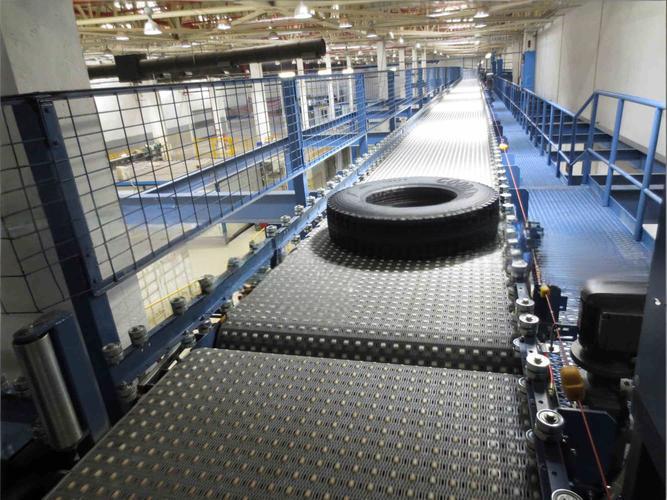
2. Line Speed and Conveyor Length Factors
Two critical factors often dictate the need for a large pitch belt: Conveyor Length and Allowable Belt Pull (ABP).
Handling High Tension: Long conveyors generate immense friction and tension at the drive shaft. Large pitch belts feature significantly thicker hinge pins. This increased pin diameter drastically increases the ABP, allowing you to run longer conveyors with a single motor, rather than breaking the line into multiple short, expensive drives.
Torque Transmission: Large pitch belts run on larger sprockets. This mechanical advantage allows for better torque transmission from the motor to the belt, ensuring smooth starts even when the line is fully loaded with heavy goods.
3. Why Large Pitch Belts Improve Stability Under Heavy Loads
Stability in heavy-duty conveying isn’t just about not tipping over; it’s about consistent tracking.
Positive Drive Engagement: The 2-inch series engages with sprockets deeply. This positive drive eliminates the risk of “belt slip” or surging, which is common when heavy loads create drag on smooth belts.
Rigidity: Large pitch belts have fewer hinge points per meter compared to smaller belts. This structural rigidity ensures the belt remains flat and true, providing a solid platform for precise filling or robotic palletizing operations downstream.

4. Cost, Durability, and Maintenance Considerations
While the upfront cost of a large pitch system might be higher than a standard belt, the Total Cost of Ownership (TCO) is often lower for heavy applications.
Extended Service Life: The “sacrificial” wear parts (the pins) are thicker and more durable. In abrasive environments (like moving construction materials), a 2-inch belt can last 2-3 times longer than a 1-inch belt.
Simplified Maintenance: Fewer modules per square meter means fewer parts to inspect. When a repair is needed, the large modules are easier for maintenance crews to grip, replace, and lock back into place with minimal downtime.
5. Conclusion: Engineer Your Line for Strength
Choosing a Large Pitch Modular Conveyor Belt is a commitment to reliability. It transforms a fragile production line into a heavy-duty powerhouse capable of meeting your throughput targets without breaking a sweat.
At Fill Package, we combine our “Smart packing” philosophy with heavy-duty engineering. Don’t risk downtime with an under-specced belt.
Need to calculate the belt pull for your heavy load? Our engineers are ready to assist you with the technical data you need.
👉 [View Technical Specs & Shop Large Pitch Modular Conveyor Belt (2-Inch Series)]
Related Blog:
What Is a Large Pitch Modular Conveyor Belt and When Should You Use It?
Large Pitch vs. Standard Pitch Modular Conveyor Belts: Which One Handles Heavy Loads Better?