

Giới thiệu
How does a bucket elevator work when the product it carries is fragile? A puffed corn snack that crumbles under impact. A whole cashew that chips when dropped. A dried blueberry whose coating cracks on contact with a hard surface. For these products, the standard answer — ‘the bucket carries it up and discharges it at the top’ — is technically correct but practically insufficient.
Specifically, the problem is not the lifting. It is the loading at the bottom and the discharge at the top — the two moments in every bucket cycle where the product experiences the highest mechanical stress. In a standard Z-type rectangular elevator bucket, both events involve impact with a flat surface. For fragile products, that impact is measurable in the quality inspection results: increased fragment rate, elevated dust, and coating damage that shows up in the finished bag.
The bowl-type elevator bucket addresses this problem at the design level, not at the speed level. Rather than slowing the elevator down to reduce impact, the arc geometry of the bowl redistributes the impact energy in a way that reduces peak stress on the product. This article explains the mechanism and its implications for food processing and packaging lines handling fragile, sensitive, or high-value products.
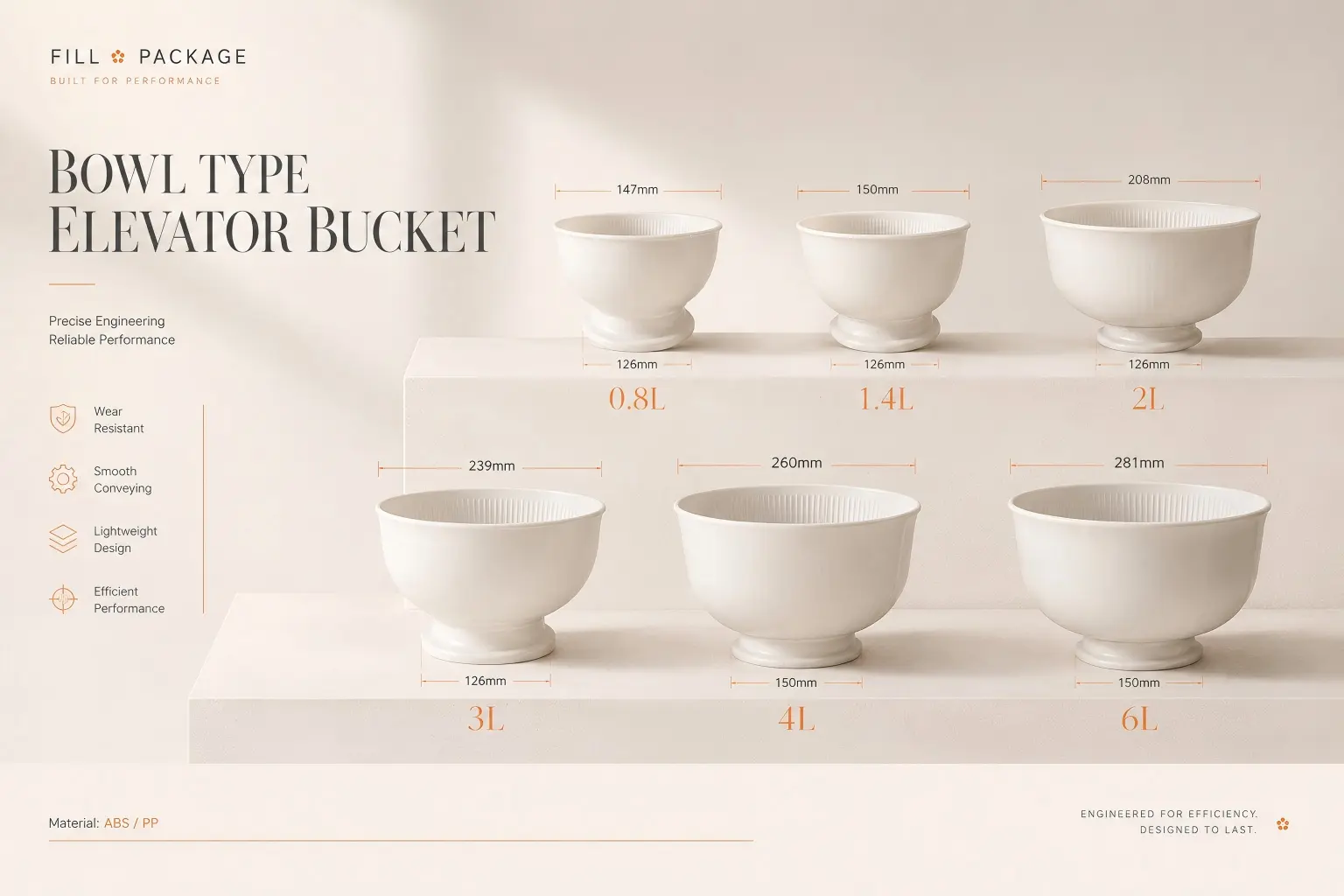
For product specifications and available sizes: Bowl-Type Elevator Buckets product page.
Section 1 — The Arc Design Principle
The Round Arc Base: Redistributing Impact Energy
To understand why the bowl-type bucket reduces product damage, it helps to compare the two impact events — loading and discharge — in a standard rectangular bucket versus a bowl-type arc bucket.
Loading at the Boot: Flat Base vs Arc Base
In a standard Z-type rectangular elevator bucket, product falling into the bucket at the boot impacts the flat base. The entire kinetic energy of the falling product is absorbed at a single contact point — the point of first contact between the product and the flat bucket base. For a dense product like a whole nut, this point-contact impact creates a peak stress that can exceed the product’s fracture threshold.
In a bowl-type arc bucket, however, the curved base redirects the impact differently. Product falling onto a curved surface does not experience a single point of contact. Instead, it contacts the curve, which deflects it sideways along the arc — distributing the kinetic energy across a larger contact area and a longer time interval. The result is a lower peak stress at any single point. In practice, this means fewer fractures, fewer chips, and less coating damage at the loading event.
Discharge at the Head: Tip-and-Drop vs Rolling Release
At the top of the elevator, the standard bucket discharges by tipping forward. Product effectively falls from the bucket lip to the discharge chute — a drop that adds another impact event, particularly if the chute surface is hard or angled steeply. For fragile products, this second impact compounds the damage initiated at the boot.
The bowl-type bucket, by contrast, creates a rolling discharge. As the bucket tips forward at the head sprocket, the curved base guides the product in a rolling motion toward the discharge opening. Rather than dropping, the product slides and rolls out of the bowl in a continuous flow. Consequently, the drop height from the bucket to the chute is reduced, and the product velocity at the moment of chute contact is lower than in a standard bucket discharge.
The combined effect: Independent measurements on comparable packaging lines show that switching from standard rectangular Z-type buckets to bowl-type arc buckets reduces visible product breakage (fragments, chips, coating damage) by 40–60% at the same elevator speed. For premium products — whole cashews, specialty coffee beans, coated confectionery — this reduction directly translates to a higher percentage of product passing visual quality inspection and reaching the consumer intact.
Section 2 — Dead Zone Elimination
The Arc Geometry Eliminates Dead Zones
Beyond impact reduction, the bowl-type arc geometry provides a second structural advantage: it eliminates the dead zones that accumulate product residue in standard rectangular buckets.
Dead zones in rectangular buckets
A standard rectangular elevator bucket has four internal corners where the base meets the side walls. In normal operation, product accumulates in these corners — particularly sticky, oily, or fine-particle products that do not discharge completely on every cycle. This accumulated product in the corners represents carry-back: material that is recirculated in the elevator rather than delivered to the discharge point.
Additionally, carry-back in the corners creates a hygiene problem on food lines. Residue in the corners is difficult to clean during washdown, particularly in a bucket that remains attached to the chain. On a food safety audit, internal bucket corner residue is a contamination risk point that auditors specifically look for.
How the arc eliminates corners
The circular cross-section of the bowl-type bucket has no internal corners. Product settles in the base of the bowl under gravity and discharges completely on every cycle because the arc provides no geometry where product can accumulate. Furthermore, the smooth arc surface is significantly easier to clean during washdown than the corner-and-flat-surface geometry of a rectangular bucket — a practical advantage on food lines that run daily cleaning cycles.
For applications where product stickiness is the primary concern, also see: Bowl-Type Elevator Buckets — second-stage lifting and buffer feeding for sticky and irregular products.
Section 3 — Industry Applications
Where Bowl-Type Elevator Buckets Are Specified in Food Processing
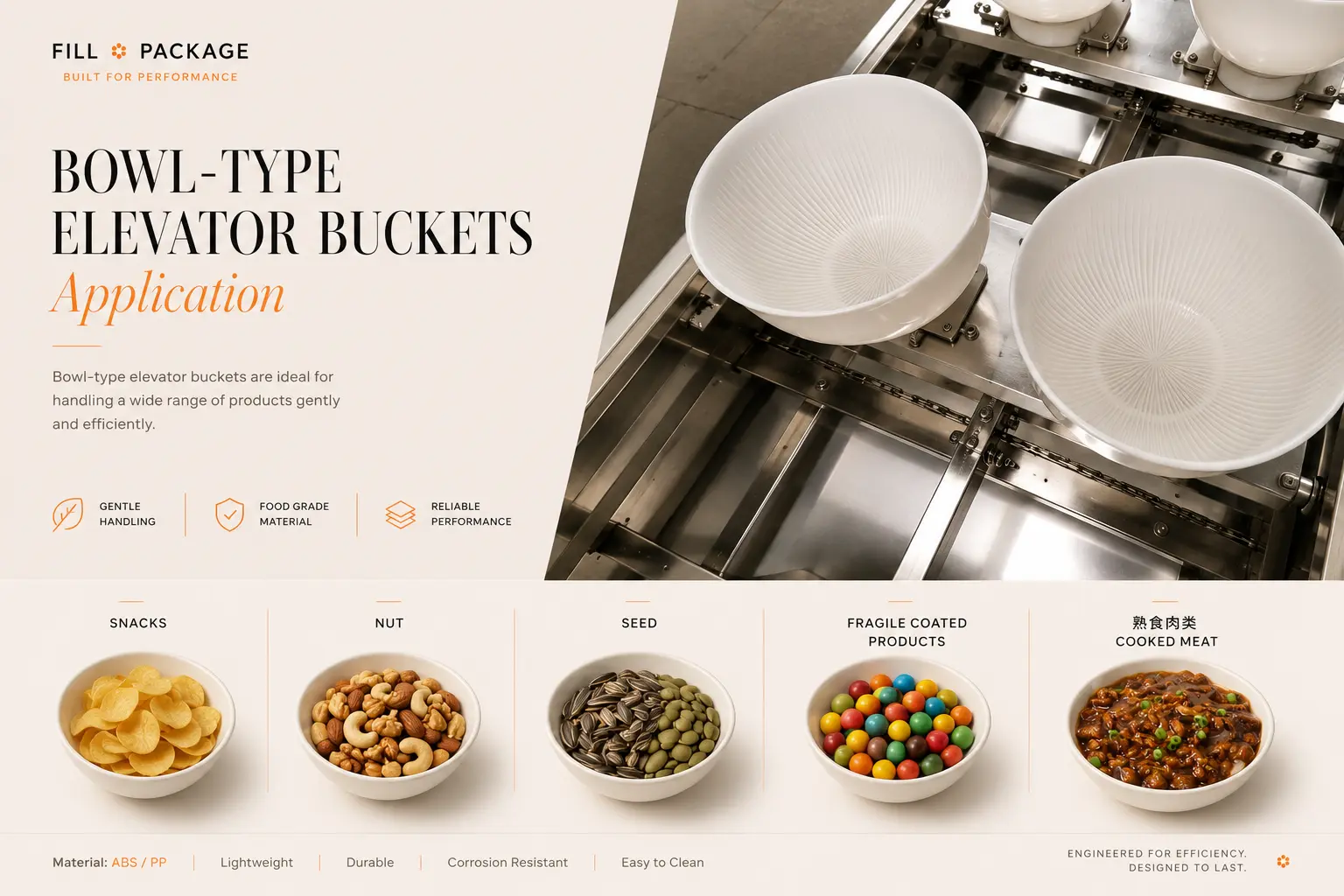
Puffed Snacks and Extruded Products
Puffed corn, rice crackers, potato crisps, and extruded snacks have a cellular structure that is inherently fragile under impact. Even modest impact energy can collapse the air cells in the structure, producing crumble and dust that fails visual inspection. As a result, bowl-type buckets are the standard specification for multihead weigher infeed elevators on puffed snack packaging lines, where they reduce dust accumulation in weigher hoppers and extend cleaning intervals.
Whole Nuts and Seeds
Whole cashews, macadamia nuts, almonds, and premium seed blends are high-value products where breakage has a direct price impact. Broken pieces sell at significantly lower prices than whole product in both retail and food service markets. Consequently, the ROI calculation for bowl-type buckets on premium nut lines is straightforward: the bucket upgrade cost is typically recovered within weeks through reduced breakage loss at current product prices.
Coffee Beans
Roasted coffee beans are brittle and generate fine dust when chipped. Beyond the quality issue, coffee dust accumulates in weigher hoppers and distribution chutes, affecting weigher accuracy and requiring more frequent cleaning. In this application, bowl-type buckets deliver two concurrent benefits: lower chip rate on the beans, and reduced dust generation that extends weigher cleaning intervals.
Fragile Coated Products
Chocolate-coated nuts, yogurt-covered raisins, candy-coated confectionery, and pharmaceutical coated tablets all share a common challenge: the coating can be damaged independently of the base product. Even if the base product survives impact intact, coating damage creates visual defects, exposes the base product to moisture and oxygen, and reduces shelf life. Bowl-type buckets, with their lower peak impact stress and rolling discharge, are accordingly specified for coated product lines where coating integrity is a quality-critical parameter.
Phần kết luận
Gentle Handling Is an Engineering Choice, Not a Speed Compromise
The conventional response to product breakage on an elevator is to slow the line down. In practice, however, slowing the elevator reduces throughput without necessarily addressing the root cause — which is peak impact stress at two specific points in the bucket cycle. The bowl-type arc bucket addresses the root cause directly, by changing the geometry of both impact events rather than reducing their frequency.
For food processing and packaging lines where product quality, value, or hygiene requirements make breakage unacceptable, the bowl-type elevator bucket is the engineering solution that protects product without sacrificing throughput.
Find the right bowl-type bucket for your product. Visit our Bowl-Type Elevator Buckets page for sizes from 0.8L to 6L, with specifications for C-type and Z-type elevator compatibility. Liên hệ đội ngũ kỹ thuật của chúng tôi
Tiếp tục đọc: Bowl-Type vs. Standard Elevator Buckets: Which Is Better for Your Sanitary Conveying Needs? →