

Giới thiệu
In a Z type bucket elevator, the sprocket is the component that converts motor rotation into chain movement. It is also the component that most maintenance programmes inspect too rarely — because unlike a chain (which can be measured for elongation) or a bucket (which shows visible cracking), sprocket wear is gradual and largely invisible from the outside of the elevator casing.
By the time a worn elevator sprocket causes a detectable problem — a skip in the chain, an irregular knock, or a sudden chain jump — the tooth profile has already deteriorated to the point where fitting a new chain on the worn sprocket will cause the new chain to fail within weeks. The cost of missing the sprocket inspection is not just the sprocket replacement. It is the chain replacement, the downtime, and the bucket damage that a chain jump can cause.
This article covers the three specific warning signs that indicate your bucket elevator sprocket is approaching end-of-service — and what the underlying mechanism is in each case, so you understand what you are looking for and why it matters.
For the complete bucket elevator sprocket specifications and replacement options: Bucket Elevator Sprockets — C2052-24Z.
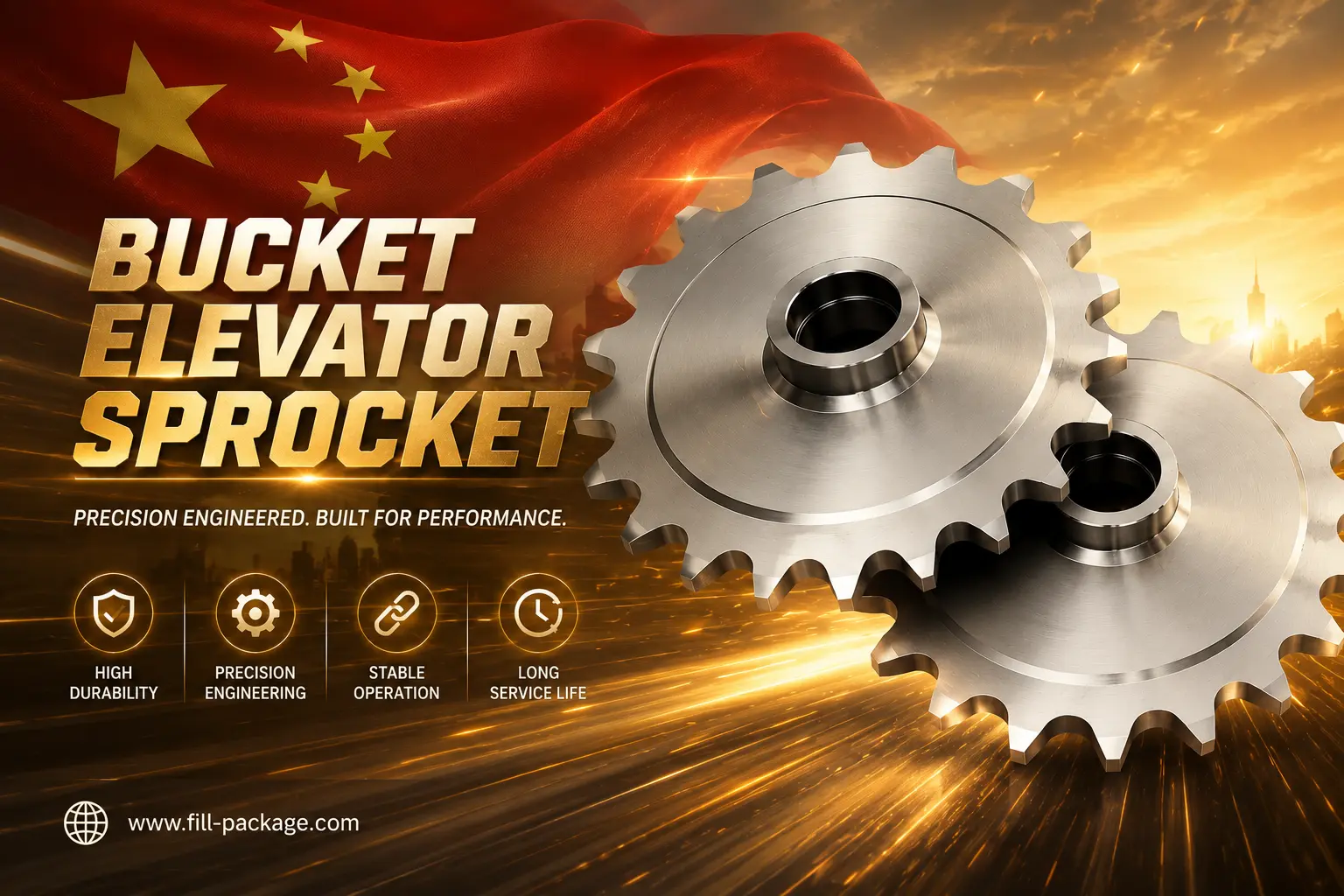
Sign 1 — Shark-Fin Tooth Wear
Sign 1: Shark-Fin Tooth Profile — The Most Critical Warning
The most important indicator of elevator sprocket wear is the tooth profile. On a new C2052-24Z sprocket, each of the 24 teeth has a symmetrical profile — the engagement side (the face that the chain roller pushes against during forward drive) and the trailing side are essentially mirror images. The roller seats cleanly in the valley between two teeth on every revolution.
As the sprocket wears, the engagement side of each tooth erodes faster than the trailing side. The reason is asymmetric loading: the chain pulls against the engagement side of the tooth on every link engagement, while the trailing side experiences much lower load. Over thousands of hours of operation, this asymmetric loading removes material from the engagement face, creating a distinctive hooked profile — the ‘shark-fin’ — where the tooth tip curves toward the chain’s direction of travel.
Why shark-fin wear causes chain jumping
A chain roller approaching a shark-fin tooth no longer settles into the tooth valley in the designed geometry. Instead, the hooked tip of the shark-fin catches the roller and redirects it upward — the roller rides over the tooth tip rather than into the valley. This is called ‘tooth climbing.’
Tooth climbing does three things simultaneously: it creates an impact load at the moment the roller snaps into the valley (or fails to), generating a shock that propagates through the chain and into the bucket mounting hardware; it changes the chain’s effective pitch at that engagement point, creating a speed variation that causes the chain to surge and slack alternately; and it accelerates wear on the chain roller, because the roller is being forced over the tooth tip rather than rolling smoothly through engagement.
The cumulative effect of tooth climbing on a Z bucket elevator is a chain that develops rapid elongation (from the impact loads), buckets that develop cracks at the mounting holes (from the surge loads), and eventually a chain jump — where the chain disengages from the sprocket entirely under load.
How to inspect for shark-fin wear
- Stop the elevator and lock out the drive — do not inspect a moving sprocket
- Access the top drive sprocket — this is typically accessible by removing a panel from the elevator head section
- Shine a torch across the tooth profile from the side — the shark-fin profile is immediately visible as a curved hook on the engagement side of each tooth when viewed in this light
- Run your finger across 3–4 consecutive tooth tips — on a worn sprocket, you will feel the hook of the shark-fin profile even before you can see it clearly
Replace when: shark-fin wear is visible on 3 or more consecutive teeth. At this point, the engagement geometry is degraded enough to cause measurable chain speed variation under load. Fit a new sprocket before fitting any new chain — a new chain on shark-fin sprockets will be damaged within 4–8 weeks of operation.
Sign 2 — Chain Climbing Under Load
Sign 2: Chain Climbing — When the Problem Becomes Visible
Chain climbing is the observable consequence of shark-fin tooth wear that has progressed beyond the point where it can be caught by a routine tooth inspection. When it occurs, the elevator chain periodically rises off the sprocket teeth under load — the rollers skip over one or more teeth rather than engaging with them — and then drops back into engagement with an impact load that is audible as a distinct knock or clunk.
How to distinguish chain climbing from other causes of elevator noise
Chain climbing produces a rhythmic knock that repeats at a specific interval — the interval corresponding to one full revolution of the sprocket. If the sprocket has 24 teeth and the chain pitch is 31.75mm, one sprocket revolution moves the chain 24 × 31.75 = 762mm. You can verify the source of a rhythmic knock by measuring the chain travel between knocks and comparing to this number.
Other common sources of elevator noise — a loose bucket, a seized carrying roller, a damaged chain link — typically do not produce a knock that repeats at the sprocket revolution interval. A loose bucket produces an irregular knock at bucket spacing intervals. A seized roller produces a continuous grinding sound. Chain climbing from sprocket wear is distinctly rhythmic at the sprocket revolution frequency.
| Sound / Symptom | Most Likely Cause | Inspection Priority |
| Rhythmic knock at sprocket revolution interval | Shark-fin sprocket wear — chain climbing | High — inspect sprocket tooth profile immediately |
| Irregular knock at bucket spacing interval | Loose bucket mounting hardware or cracked bucket | High — inspect buckets for cracked mounting holes |
| Continuous grinding or scraping sound | Seized carrying roller or worn guide rail | Medium — inspect rollers and guide rails |
| General increase in vibration level (no distinct knock) | Chain elongation — stretched past 2% nominal | Medium — measure 10-link chain length |
| Sudden chain jump or stop | Sprocket tooth failure or chain link fracture | Emergency — do not restart without full inspection |
If chain climbing is occurring: stop the elevator and inspect the sprocket tooth profile before restarting. Chain climbing under continued load rapidly worsens the tooth profile and accelerates chain elongation. Each climbing event creates an impact load that is 3–5× the normal chain tension — this is the load that fractures chain link plates and cracks bucket mounting holes.
Sign 3 — PA+GF Tooth Height Reduction
Sign 3: For PA+GF Plastic Sprockets — Tooth Height Reduction
PA+GF reinforced plastic driven sprockets wear differently from carbon steel driving sprockets. Steel sprockets develop shark-fin profiles because the asymmetric engagement loading erodes the engagement face preferentially. PA+GF plastic sprockets, because of their material properties, wear more uniformly across the tooth profile — but the tooth tips wear progressively shorter, reducing the tooth height from the nominal specification.
This difference in wear mechanism matters for inspection methodology: the shark-fin visual check that works for steel sprockets does not work for PA+GF plastic sprockets. You need to check tooth height, not tooth profile asymmetry.
Why PA+GF is used for the driven (tensioning) shaft
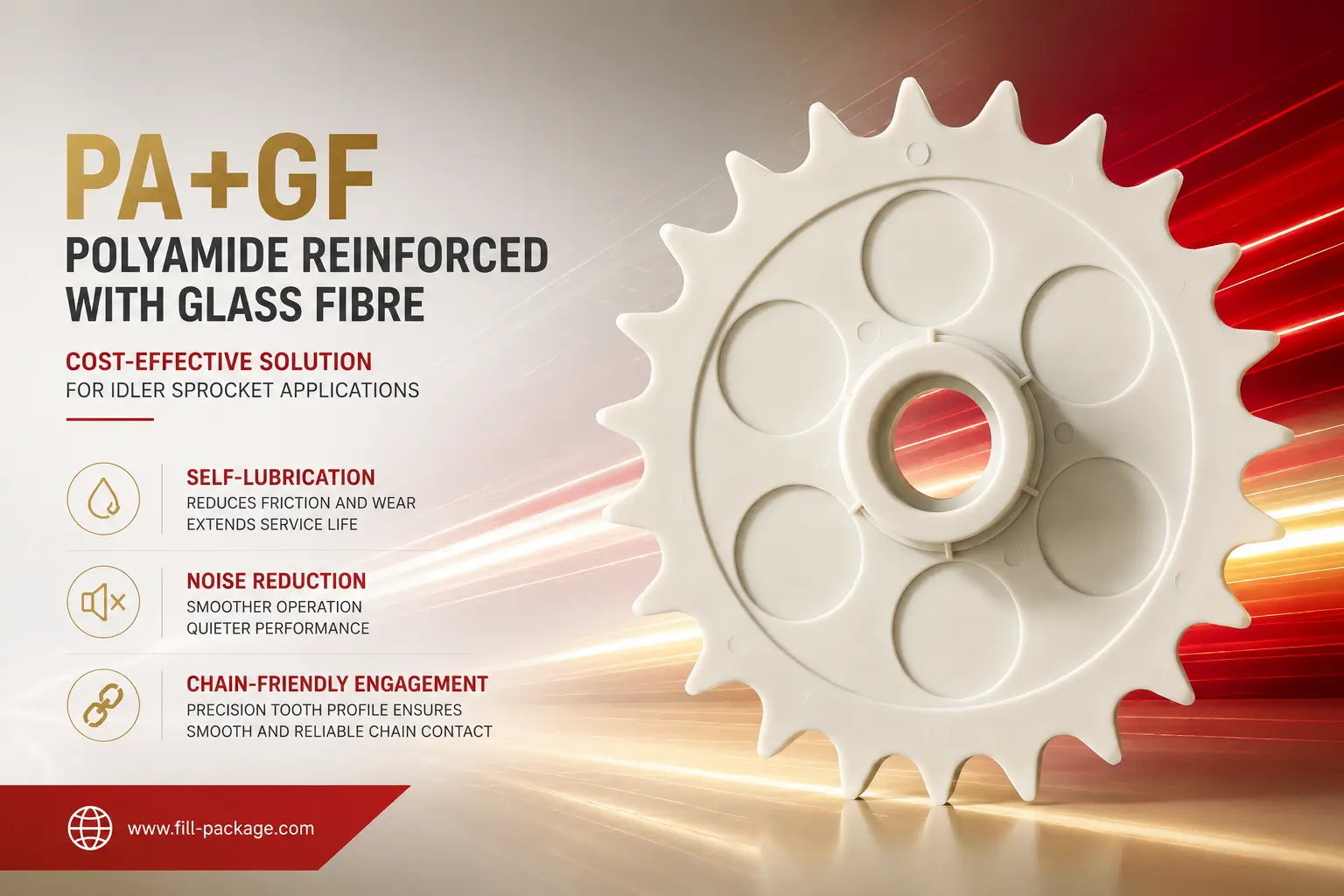
PA+GF — polyamide reinforced with glass fibre — is used for the driven (bottom tensioning) sprocket in Z type bucket elevators for three reasons that are directly relevant to why it wears the way it does:
- Self-lubrication: the PA matrix in PA+GF has inherent lubricity — the tooth surface does not require external grease, and the chain roller rolls across the tooth with lower friction than on a steel tooth. This lower friction reduces the differential wear between engagement and trailing faces, producing the more uniform wear pattern
- Noise reduction: the lower modulus of elasticity of PA+GF compared to steel means the tooth absorbs engagement shock rather than reflecting it back into the chain as an impact load. This is audible as a significantly quieter elevator — typically 8–12 dB quieter at the driven sprocket position
- Chain-friendly engagement: the PA+GF tooth’s ability to flex slightly under roller impact distributes the engagement load over a slightly larger contact area than a rigid steel tooth, reducing the peak contact stress on the chain roller bearing surface
How to inspect PA+GF sprocket tooth height
- Measure the outer diameter of the driven sprocket — use a vernier caliper across the tooth tips. Standard outer diameter for C2052-24Z PA+GF sprocket: approximately ø260.29mm
- Compare to nominal: if the measured outer diameter has reduced by more than 3mm from nominal (i.e., below approximately 257mm), the tooth height has reduced enough to affect engagement depth
- Check for visible surface cracking: PA+GF can develop surface micro-cracks in cold environments or after extended service — visible as fine white lines across the tooth face. Any cracking warrants replacement
Replacement interval: In typical food packaging Z bucket elevator applications running two shifts per day, PA+GF driven sprockets typically last 24–36 months before reaching the tooth height replacement threshold. Carbon steel driving sprockets in the same application typically last 18–30 months before shark-fin wear requires replacement. These intervals are starting points — actual service life depends heavily on chain tension, lubrication, and alignment.
Phần kết luận
The Inspection Routine That Prevents Catastrophic Failure
The three signs above — shark-fin tooth wear on steel sprockets, chain climbing under load, and tooth height reduction on PA+GF sprockets — are all detectable before they cause a line-stopping failure. The inspection itself takes 10–15 minutes on a stopped, locked-out elevator, and the frequency needed is every 3–6 months under normal operating conditions.
The asymmetry of cost is significant: a sprocket inspection at 3-month intervals costs 20 minutes of maintenance time per year. A missed inspection that allows shark-fin wear to cause chain climbing, which damages both the chain and the buckets, costs a chain replacement, a sprocket replacement, bucket replacements, and typically 4–8 hours of unplanned downtime — all at the same time, because they are all worn by the same root cause.
Inspect your sprockets and need replacements? Visit our Bucket Elevator Sprockets page for C2052-24Z specifications in galvanized carbon steel and PA+GF reinforced plastic. Drawing confirmation before every order. Contact us →
Tiếp tục đọc: PA+GF vs. Galvanized Carbon Steel: Which Sprocket Is Right for Your Driving vs. Driven Shaft? →