

Introducción
A Z type elevator bucket with the wrong mounting width cannot be fitted to the elevator chain. A bucket with the correct mounting width but the wrong hole diameter requires re-drilling before installation. A bucket ordered to the correct dimensions but without a drawing confirmation may still have an E-dimension (hole centre spacing) that does not match the chain bolt pitch — invisible until the bucket is in hand and the bolts do not align.
These are not hypothetical problems. They are the most common reasons for elevator bucket replacement orders failing to install correctly — and they are all preventable with 15 minutes of measurement before the inquiry is sent.
This guide covers the step-by-step process for measuring the five critical Z type elevator bucket dimensions, understanding the four standard mounting width options (412mm, 416mm, 418mm, 420mm), and confirming the specification with a drawing before production begins.
For context on Z type bucket selection: Blog 1: How Z-Type Elevator Buckets Revolutionize Multi-Stage Production Lines · Blog 2: Z-Type vs Industrial Buckets
Section 1 — The 5 Dimensions
The 5 Critical Z-Type Elevator Bucket Dimensions
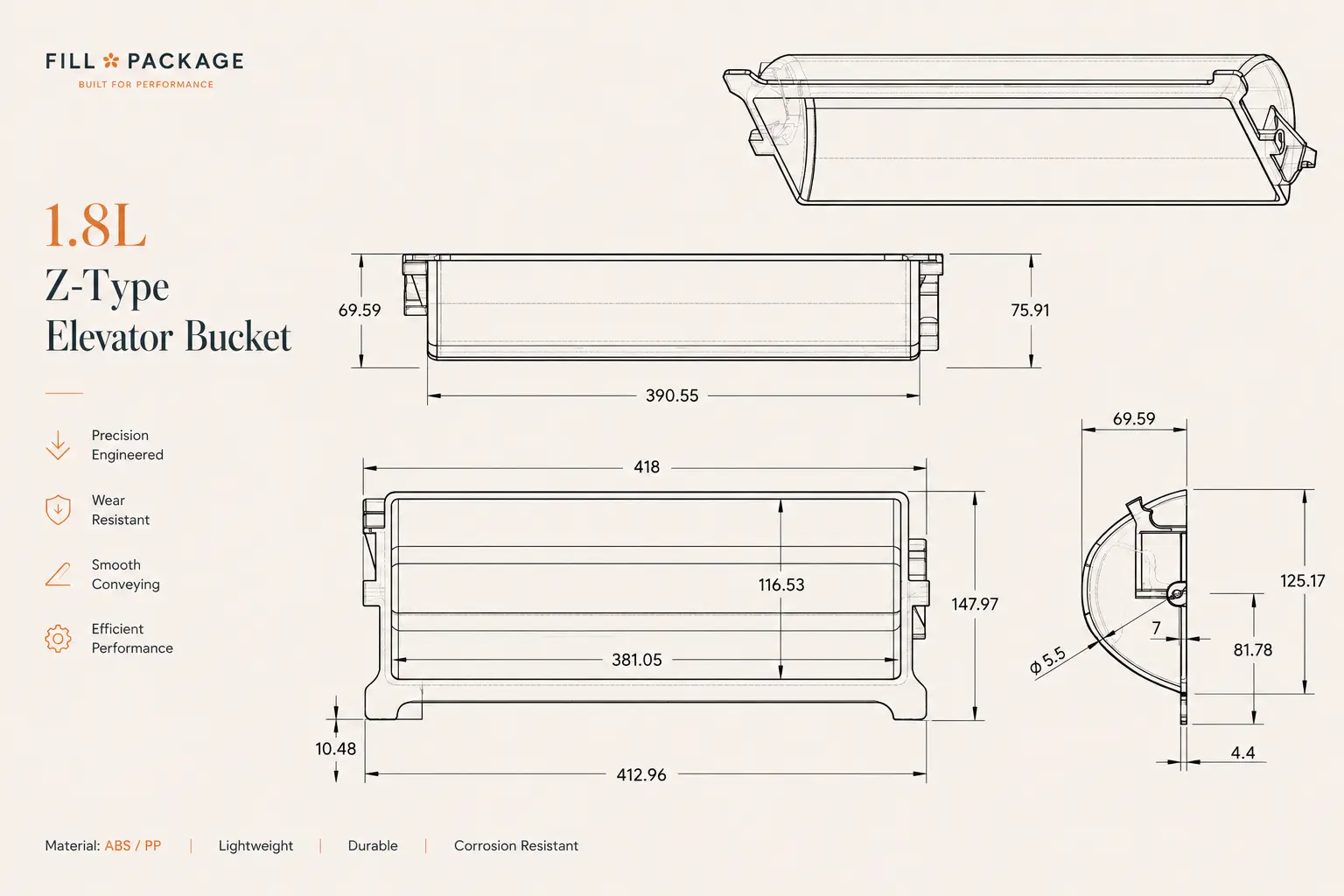
Every Z type elevator bucket is fully defined by five dimensions and two hole parameters. These seven values are the complete specification needed to confirm compatibility and place a replacement order.
| Dimension / Parameter | Lo que mide | How to Measure | Consequence of Getting It Wrong |
| A — Ancho total | Widest face of the bucket (front face) | Measure across the front of the bucket at the widest point with a vernier caliper | Bucket contacts elevator casing walls during operation — causes noise, wear, and eventual bucket failure |
| B — Profundidad de proyección | Distance from back plate to leading lip | Measure from the flat back face of the bucket to the furthest forward point of the bucket lip | Wrong discharge geometry — bucket does not fill correctly at the boot or discharge cleanly at the head |
| C — Profundidad de la cavidad interior | Usable depth of the bucket interior | Measure from the bucket lip to the lowest interior point of the base | Wrong capacity — calculated throughput does not match actual throughput |
| D — Altura de la placa posterior | Height of the flat back face (mounting face) | Measure the vertical dimension of the flat back face of the bucket | Chain clip or bolt does not engage the back plate correctly — mounting is insecure |
| E — Hole centre spacing | Centre-to-centre distance between mounting holes | Measure the distance between the centres of the two (or more) mounting holes on the back plate | CRITICAL — bolts do not align with chain attachment points. Bucket cannot be installed. |
| Hole count | Number of mounting holes | Count holes on the back plate | Wrong clip or bolt pattern — incompatible with chain attachment hardware |
| Hole diameter (mm) | Diameter of each mounting hole | Measure with a caliper — typically 7mm or 9mm for Z-type buckets | Bolts cannot be fitted through holes, or fit so loosely that mounting is insecure |
The E dimension is the most commonly missed — and the most critical: Two buckets can have identical A, B, C, and D dimensions and still be completely incompatible if their E dimensions differ. The E dimension must match the chain bolt pitch exactly. A 2mm error in E means the bolt holes do not align with the chain attachment points — the bucket physically cannot be installed. Always measure E before placing any replacement bucket order.
Section 2 — The 4 Mounting Widths
The 4 Standard Mounting Widths: 412mm, 416mm, 418mm, 420mm
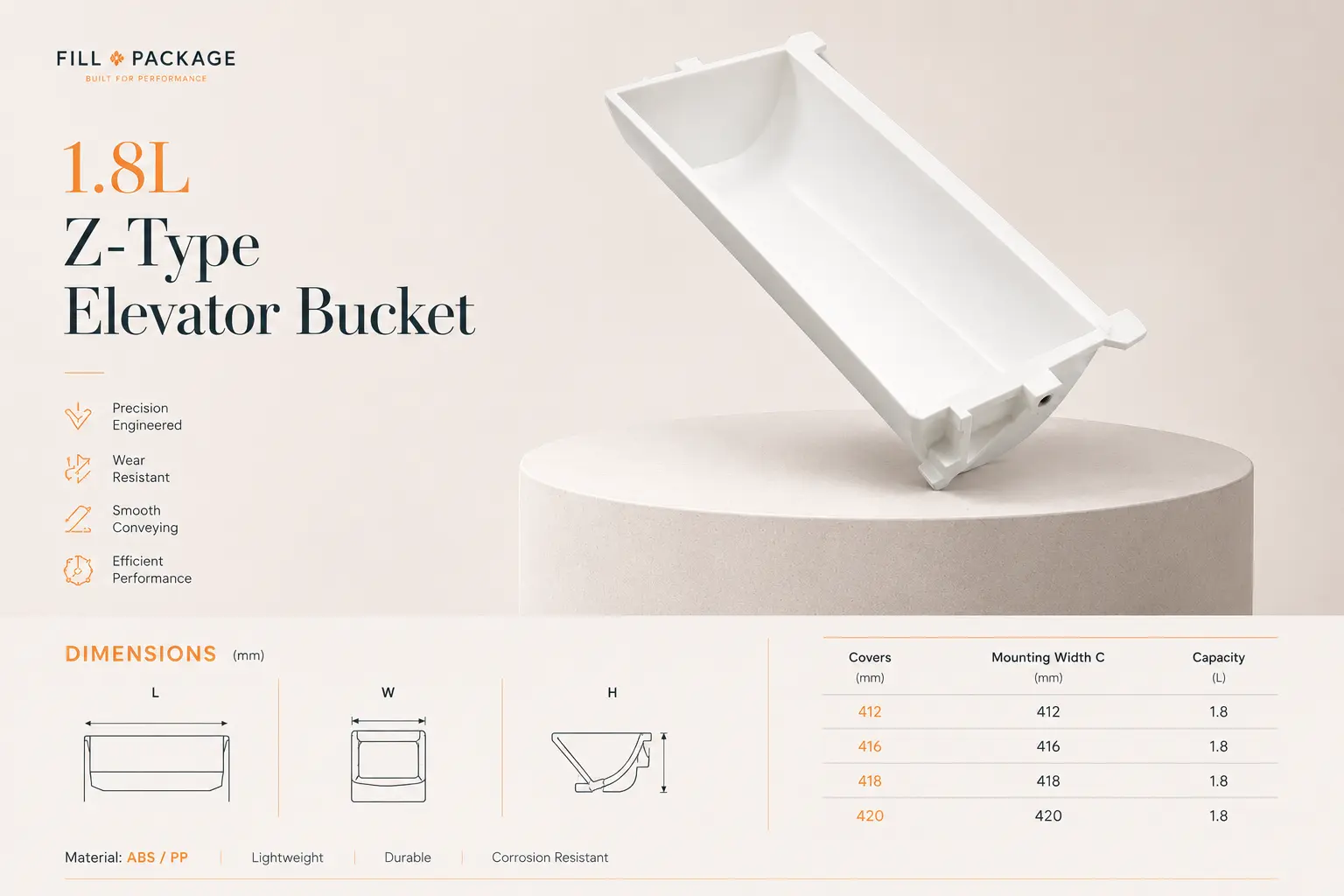
For the 1.8L Z type elevator bucket — the most commonly replaced size in food packaging line elevators — the E dimension (hole centre spacing, also called the mounting width) comes in four standard values: 412mm, 416mm, 418mm, and 420mm. These four values cover the chain pitch and bolt pattern variations used by the major Chinese Z type elevator OEM manufacturers.
Understanding which mounting width your elevator uses is the single most important specification confirmation for a 1.8L bucket replacement order. All other dimensions of the 1.8L bucket are identical or near-identical across the four mounting width variants — only E differs.
| Mounting Width (E) | Typical Elevator Brands / Configurations | How to Confirm |
| 412mm | Used on some compact Z-type elevator frames from Chinese OEMs — less common than 416mm/420mm | Measure E on existing bucket or chain bolt position |
| 416mm | One of the two most common widths — standard for many Chinese Z-type elevator manufacturers including Dahe (大禾) and similar | Measure E on existing bucket — compare to 416mm |
| 418mm | Intermediate width — used by specific elevator models where 416mm and 420mm do not fit | Measure E carefully — 418mm is easy to confuse with 416mm or 420mm without precise measurement |
| 420mm | The other most common width — standard for Kenwei (凯威) and similar manufacturers; also common on wider-frame Z-type elevators | Measure E on existing bucket — compare to 420mm |
How to measure E accurately: Use a vernier calliper — not a ruler. Place one jaw at the centre of the first hole and measure to the centre of the second hole. The centre-to-centre measurement is the E dimension. Measure twice and compare — a 2mm error (e.g., reading 418mm instead of 416mm) is within the margin that a ruler measurement can produce, but it is the difference between a bucket that fits and one that does not.
What if my E dimension does not match any of the four standard widths?
If your measured E dimension falls outside the four standard values — for example, 414mm, 417mm, or 422mm — there are two explanations: the measurement error scenario (measure again with a vernier caliper before concluding the dimension is non-standard), or the non-standard elevator scenario (a custom-built or modified elevator where the chain bolt pitch does not match any Chinese standard).
For non-standard E dimensions, we drill the mounting holes to the exact specification required. Provide the E dimension and hole diameter from your existing bucket — we confirm by drawing and produce to your specification. Custom hole drilling adds 2–3 business days to lead time, with no additional charge for orders above MOQ.
Section 3 — Triangle Edge Reinforcement
Triangle Edge Reinforcement: Why High-Speed Elevators Need It
Standard Z type elevator buckets have flat side walls. The Triangle Edge (triangular side reinforcement) is an optional structural addition — a triangular gusset moulded along the side wall and base of the bucket — that increases the bucket’s torsional rigidity and resistance to deformation under load.
Why standard buckets deform at high chain speeds
At chain speeds above approximately 35–40 cycles per minute, the inertial loads on the bucket increase significantly. The bucket is accelerating and decelerating on every cycle — particularly at the sprocket transitions where the chain changes direction. These acceleration loads create bending moments at the bucket’s side walls, and at high cycle rates, they cause the side walls of standard buckets to flex and eventually deform outward.
Deformation of the side walls does two things: it increases the bucket’s width beyond the design specification (creating clearance problems with the casing), and it changes the bucket’s volume and fill geometry (reducing consistency of discharge). On a high-speed line where weigher accuracy depends on consistent bucket volume, side-wall deformation is a direct cause of weigher performance degradation.
How Triangle Edge reinforcement prevents deformation
The triangular gusset runs from the bucket’s back plate to the base, along the side wall. The triangular profile is the most efficient structural shape for resisting bending moment — it adds approximately 40% to the bucket’s torsional rigidity with a minimal increase in material weight. The practical effect: at chain speeds above 35 cycles per minute, Triangle Edge buckets maintain their dimensional geometry over the service life of the bucket, while standard flat-wall buckets show measurable deformation within 3–6 months of operation.
| Parámetro | Standard 1.8L Bucket | 1.8L Bucket with Triangle Edge |
| Side wall structure | Flat wall — standard profile | Triangular gusset along side wall and base |
| Torsional rigidity | Línea de base | Approximately +40% vs standard |
| Recommended chain speed | Up to 35 cycles/min | Up to 50+ cycles/min |
| Side wall deformation | Visible within 3–6 months at high speed | Minimal deformation across service life |
| Impact on weigher | Inconsistent bucket volume → weigher accuracy degradation at speed | Consistent volume → weigher accuracy maintained at speed |
| Availability | Standard option | Standard option — same lead time, same price range |
Specification recommendation: If your elevator runs at 35+ cycles per minute, or if you have observed side-wall deformation on current buckets, specify Triangle Edge reinforcement on all replacement buckets. The incremental cost is minimal. The incremental service life and weigher performance benefit is significant.
Section 4 — The Drawing Confirmation Process
Step-by-Step: Confirming Your Z-Type Elevator Bucket Specification
The drawing confirmation process for Z type elevator buckets takes 24 hours from submission of dimensions to drawing approval — and it is the step that eliminates compatibility failures before they happen.
- Measure the 5 dimensions (A, B, C, D, E) from your existing bucket using a vernier caliper. Record hole count and hole diameter.
- Note any special features: smooth or dimpled surface; Triangle Edge reinforcement; multi-outlet configuration (number and position of outlets).
- Send the measurements to our technical team — by email, WhatsApp, or the inquiry form. A photo of the existing bucket with a ruler for scale is also helpful for cross-referencing.
- We produce a technical drawing showing all confirmed dimensions and the full bucket profile, and send it to you for approval within 24 hours.
- You compare the drawing to your elevator’s chain bolt pattern and casing dimensions. Approve or request corrections.
- Production begins only after drawing approval. Standard sizes: 7–10 business days. Custom dimensions: 15–25 business days.
The drawing confirmation is the document that makes Chinese replacement Z type elevator buckets reliably compatible — not luck, not assumption, but confirmed dimensions that have been agreed in writing before a single part is produced.
Conclusión
Measure Once. Confirm by Drawing. Order with Confidence.
The Z type elevator bucket replacement process is straightforward when the correct information is prepared before the inquiry. The E dimension (mounting width) is the non-negotiable measurement that determines whether a bucket fits the chain. The four standard values — 412mm, 416mm, 418mm, 420mm — cover the vast majority of Chinese Z type elevator installations. And the drawing confirmation process resolves every other dimensional question before production.
For elevators running above 35 cycles per minute, the Triangle Edge reinforcement option extends bucket service life and protects weigher accuracy at no significant additional cost. It is the specification detail that differentiates a bucket order placed with technical precision from one placed by guessing.
Ready to measure and order? Measure your 5 dimensions, note your mounting width, and send us your specification. We issue a drawing confirmation within 24 hours and produce to confirmed dimensions. Contacta a nuestro equipo técnico
View full size charts and specifications: Z-Type Elevator Buckets (1.8L, 4L, 6L, compact, multi-outlet) · Complete Bucket Elevator Parts Hub
Related Reading — Z-Type Bucket Series
Blog 1: How Z-Type Elevator Buckets Revolutionize Multi-Stage Production Lines
Blog 2: Z-Type vs. Industrial Buckets: Choosing the Right Volume and Design for Your Material
Blog 3: A Step-by-Step Guide to Ensuring 100% Fit: Measuring Pitch and Mounting Width for Z-Buckets (this article)