

Introducción
The term ‘elevator bucket’ covers a wider range of product types than most buyers realise. A Z type elevator bucket running snack food on a packaging line and a DS deep industrial elevator cup conveying grain in a feed mill are both elevator buckets — but they are engineered for fundamentally different applications, with different profiles, different discharge mechanisms, and different material specifications.
Choosing the wrong type for your application does not always cause an immediate failure, but it does cause sub-optimal performance: a Z type bucket running at the wrong chain speed for the throughput requirement, a DS bucket used where a Z type would be more appropriate, or a single-outlet bucket where a multi-outlet design would eliminate a distribution conveyor.
This article covers the selection logic across Z type elevator buckets, DS/DQ industrial elevator cups, and the multi-outlet bucket variants — with throughput analysis, material comparison, and the specific design considerations that distinguish each type.
New to Z type elevator bucket design? Read our overview first: How Z-Type Elevator Buckets Revolutionize Multi-Stage Production Lines.
Section 1 — Z-Type vs DS/DQ: Profile and Application
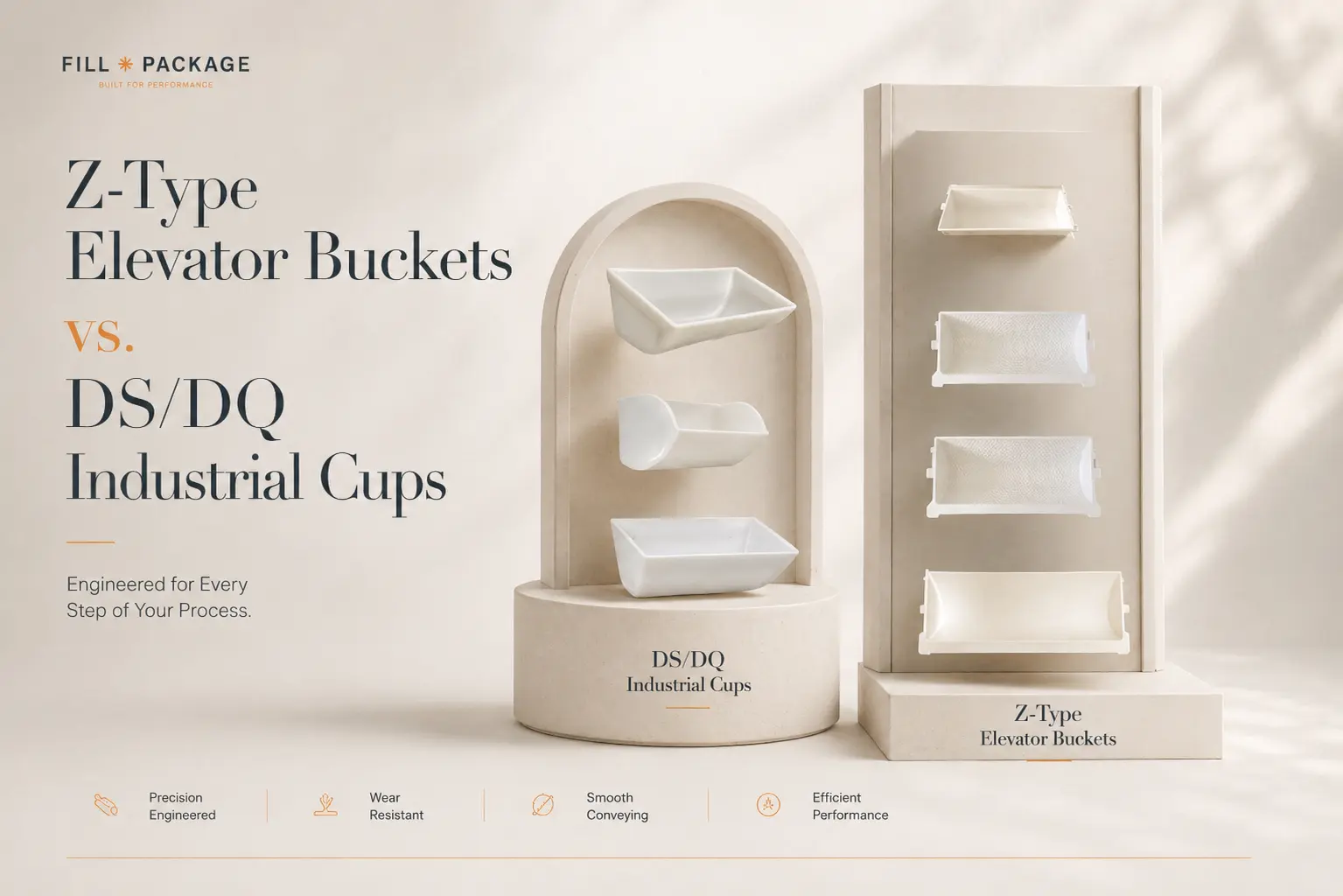
Z-Type Elevator Buckets vs. DS/DQ Industrial Cups: The Fundamental Difference
The choice between Z type elevator buckets and DS/DQ industrial elevator cups is primarily driven by the elevator inclination angle and the product characteristics — not by throughput volume, which both types can achieve across a wide range.
| Selection Factor | Z-Type Elevator Buckets | DS Deep / DQ Shallow Industrial Cups |
| Elevator path | Z-shaped — vertical + horizontal sections | Vertical or near-vertical only (DS); steeply inclined (DQ) |
| Product type | Free-flowing granules, food products, seeds, dal | Grain, chemical powders, bulk agricultural, mining |
| Discharge mechanism | Centrifugal discharge at top sprocket | DS: centrifugal (vertical); DQ: gravity-assisted (inclined) |
| Bucket profile | Rectangular with flat base | DS: deep profile (high C/B ratio); DQ: wide-shallow profile |
| Food-grade compliance | Standard — PP or ABS, FDA-compliant | HDPE standard; food-grade variants available |
| Multi-outlet option | Yes — 2.6L and 3.8L multi-outlet designs | Not standard — single discharge |
| Capacity range | 0.5L to 6L (standard range) | DS: 0.16L to 13.2L; DQ: 0.26L to 15.0L |
| Mounting width | 412 / 416 / 418 / 420mm (1.8L standard) | Per model — defined by A and E dimensions (see DS/DQ size chart) |
| Typical industry | Food packaging, multihead weigher infeed, seed processing | Grain milling, feed manufacturing, chemical processing |
Quick selection rule: If your elevator is Z-shaped, the correct bucket type is Z-type — the bucket geometry is designed for the Z path and the centrifugal discharge at the top sprocket. If your elevator is vertical or steeply inclined (not Z-shaped), DS or DQ industrial cups are the correct specification. The two types are not interchangeable on a given elevator design.
Section 2 — Capacity and Throughput Analysis
1.8L, 4L, 6L: Throughput Performance by Size
Within the Z type elevator bucket range, size selection is a throughput calculation. The target throughput in kg/hour, the product’s bulk density, and the elevator’s chain speed determine the minimum required bucket capacity.
The formula: required bucket capacity (L) = target throughput (kg/hr) ÷ bulk density (kg/L) ÷ cycles per hour. Cycles per hour = (chain speed in m/min × 60) ÷ bucket spacing in metres.
Worked example: snack food packaging line, target 300 kg/hr
Product: puffed corn snacks, bulk density 0.09 kg/L. Chain speed: 15 m/min. Bucket spacing: 250mm (0.25m).
Cycles per hour = (15 × 60) ÷ 0.25 = 3,600 cycles/hr. Required bucket capacity = 300 ÷ 0.09 ÷ 3,600 = 0.93L. Nearest standard size: 1.8L — provides 2× the minimum required capacity, giving a comfortable operating margin.
| Bucket Size | Typical Throughput Range | Bulk Density Range Where Correct | Why This Size — Not Larger or Smaller |
| 1,8L | 100–500 kg/hr | 0.05–0.5 kg/L (low to medium density) | The most versatile size. Covers the full range of food packaging line throughputs at standard chain speeds. The default specification for most Z type elevator applications. |
| 4L | 300–900 kg/hr | 0.05–0.4 kg/L (puffed, freeze-dried) | Specified when product bulk density is very low — puffed snacks, popcorn, freeze-dried products. The larger volume compensates for the very low kg/L density to achieve target throughput. |
| 6L | 600–1,500+ kg/hr | 0.3–0.8 kg/L (grain, dense food products) | High-volume applications or dense products where 4L throughput is insufficient. Available in two profiles (491mm and 521mm) to match different elevator frame widths. |
Section 3 — Multi-Outlet Bucket Design
Multi-Outlet Buckets (2.6L, 3.8L): Solving the Multi-Point Distribution Problem
The multi-outlet Z type elevator bucket is the design innovation that most effectively differentiates the Z type elevator from alternative conveying solutions. Standard elevator buckets discharge product at a single point — the discharge chute at the top of the elevator head. For a line with a single downstream weigher, this is sufficient. For a line with two or three parallel weighers or filling heads, a single-outlet elevator creates a distribution bottleneck.
The conventional solution to this problem is to add a distribution conveyor between the elevator discharge and the multiple weighers — an additional machine with its own footprint, maintenance requirement, and failure modes. The multi-outlet bucket eliminates this extra step.
How multi-outlet buckets work
A multi-outlet Z type elevator bucket has two or three discharge openings at different positions along the bucket’s width, rather than a single central opening. As the bucket tips forward at the elevator head discharge point, product exits through all outlets simultaneously, distributing to multiple downstream channels in a single bucket cycle.
| Multi-Outlet Model | Opciones de ancho | Outlet Configurations | Aplicación típica |
| 2.6L multi-outlet | 198mm, 326mm, up to 474mm | 2-outlet or 3-outlet standard; custom outlet positions available | Dual-lane weigher infeed; parallel filling head distribution on packaging lines |
| 3.8L multi-outlet | 198mm to 474mm range | 2-outlet standard; custom available | High-throughput dual-lane distribution; beverage or confectionery multi-head filling systems |
The ROI calculation for multi-outlet buckets: A distribution conveyor between an elevator discharge and two parallel weighers costs capital, floor space, and maintenance. A multi-outlet bucket upgrade costs only the price of replacement buckets. For a line that already has a Z type elevator but is adding a second parallel weigher, the multi-outlet bucket is almost always the more cost-effective solution — provided the elevator’s chain speed and bucket spacing are compatible with the required total throughput across both outlets.
Section 4 — Material Comparison
PP vs ABS vs Nylon: Which Material for Your Z-Type Elevator Bucket?
Z type elevator buckets are available in three primary materials. The correct material depends on the product being conveyed, the operating temperature, and the required service life. This is not a one-size-fits-all decision — the most cost-effective material is the one that achieves the required service life without over-engineering.
| Material | Max. Temp. | Impact Resistance | Wear Life | Mejor para | Grado alimenticio | Coste relativo |
| Food-Grade PP (Polypropylene) | 80°C | Bien | Estándar | Snacks, nuts, seeds, coffee, dal, spice, pharmaceutical granules — the default specification for food packaging lines | ✅ FDA 21 CFR / EU 10/2011 | Lowest |
| ABS (acrilonitrilo butadieno estireno) | 70°C | Excelente | 1.5× PP | Dense granules, hardware parts, products with sharp edges or high impact on the bucket at discharge — where PP chips or cracks prematurely | Industrial grade | Medio |
| Nylon PA (Polyamide) | 120°C | Very Good | 3–4× PP | High-temperature environments, abrasive products, applications where PP wears through within months under continuous operation | Food-grade variants available | Más alto |
PP vs ABS: the practical difference for food packaging lines
The choice between PP and ABS in food packaging applications is primarily about impact resistance rather than temperature. ABS has significantly better impact strength than PP — it resists chipping and cracking under the impact loads that occur when dense products (whole nuts, seeds with hard shells, or hardware parts) fall into the bucket at the elevator boot.
For lighter, lower-density food products — puffed snacks, small seeds, flour pellets — PP is the correct choice: it is food-grade, cost-effective, and has more than sufficient impact resistance for the loading conditions. For dense, hard products where PP shows premature chipping at the bucket lip within 6 months, ABS is the correct upgrade.
Surface options: smooth vs dimpled
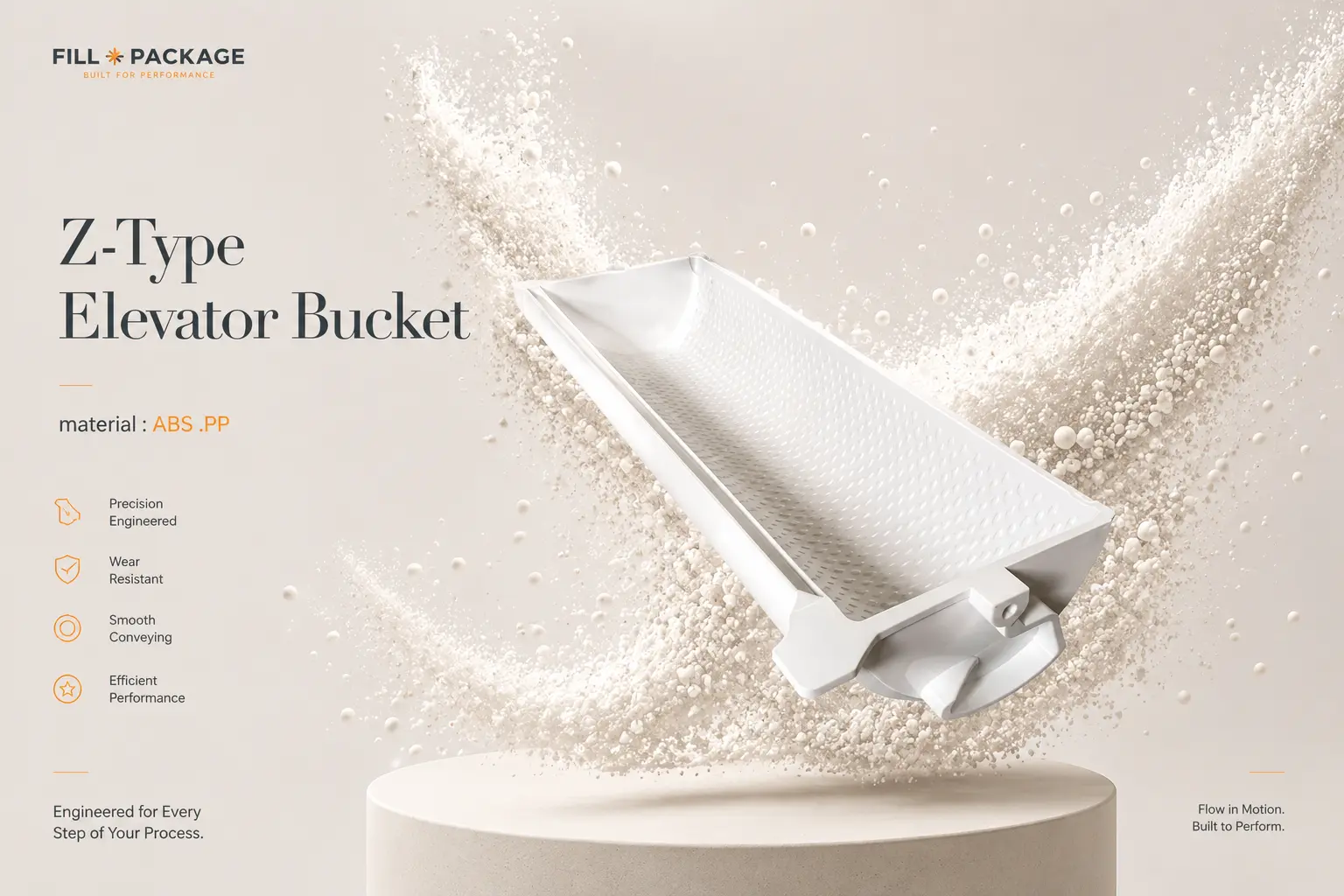
Both PP and ABS Z type elevator buckets are available in smooth surface (standard) and dimpled surface (for sticky or adhesive products). The dimpled surface increases the contact angle between the product and the bucket interior, reducing adhesion. For products with oily, sticky, or coated surfaces — glazed nuts, sugar-coated confectionery, oil-coated seeds — the dimpled surface reduces carry-back (product remaining in the bucket after discharge) from 2–5% to under 0.5%.
For detailed material specifications and size charts: Z-Type Elevator Buckets · Tazas de elevadores industriales DS & DQ
Conclusión
Match the Bucket to the Application — Not the Other Way Around
The selection logic for elevator buckets is always application-first: what is the elevator path (Z type or vertical)? What is the target throughput and product bulk density? Does the line have multiple discharge points? Does the product surface create adhesion issues? Answering these four questions determines the bucket type, size, multi-outlet requirement, and material — in that order.
For most food packaging line infeed applications, the answer is: Z type, 1.8L, single outlet, food-grade PP. For puffed snack lines needing higher volume, the answer is 4L. For multi-line distribution, 2.6L or 3.8L multi-outlet. For dense or abrasive products, ABS or Nylon. The specification exists for every application — the question is confirming which one applies to yours.
Request a bucket selection recommendation. Send us your product type, bulk density, target throughput, and elevator chain speed. We will recommend the correct bucket size, outlet configuration, and material — and provide a quotation within 24 hours. Contacta a nuestro equipo técnico
Continúa leyendo: A Step-by-Step Guide to Ensuring 100% Fit: Measuring Pitch and Mounting Width for Z-Buckets →