

Giới thiệu
Sourcing bucket elevator replacement parts from a Chinese manufacturer is a straightforward process when you have the right information prepared before the inquiry. The most common reason for delays, compatibility issues, and incorrect parts is not manufacturing quality — it is incomplete specification information in the initial inquiry.
This checklist tells you exactly what to prepare, what to ask for, and what to verify before placing any order for bucket elevator buckets, chains, sprockets, or related components. It is written for procurement managers, maintenance engineers, and plant operators who are evaluating Chinese replacement parts for the first time — or who have had compatibility problems with previous suppliers and want to understand what went wrong.
Before starting this checklist, read: The Essential Maintenance Checklist for Bucket Elevator Components (to confirm which components actually need replacement) and Original vs. Aftermarket Parts: Why Precision Measurement Is the Key to Compatibility (to understand the dimensional confirmation process).
Part 1 — What to Prepare Before Your Inquiry
Pre-Inquiry Checklist: The Information Every Supplier Needs
A complete inquiry for bucket elevator replacement parts takes 15–30 minutes to prepare correctly. This preparation time eliminates the back-and-forth that extends lead time and increases the risk of receiving incorrect parts.
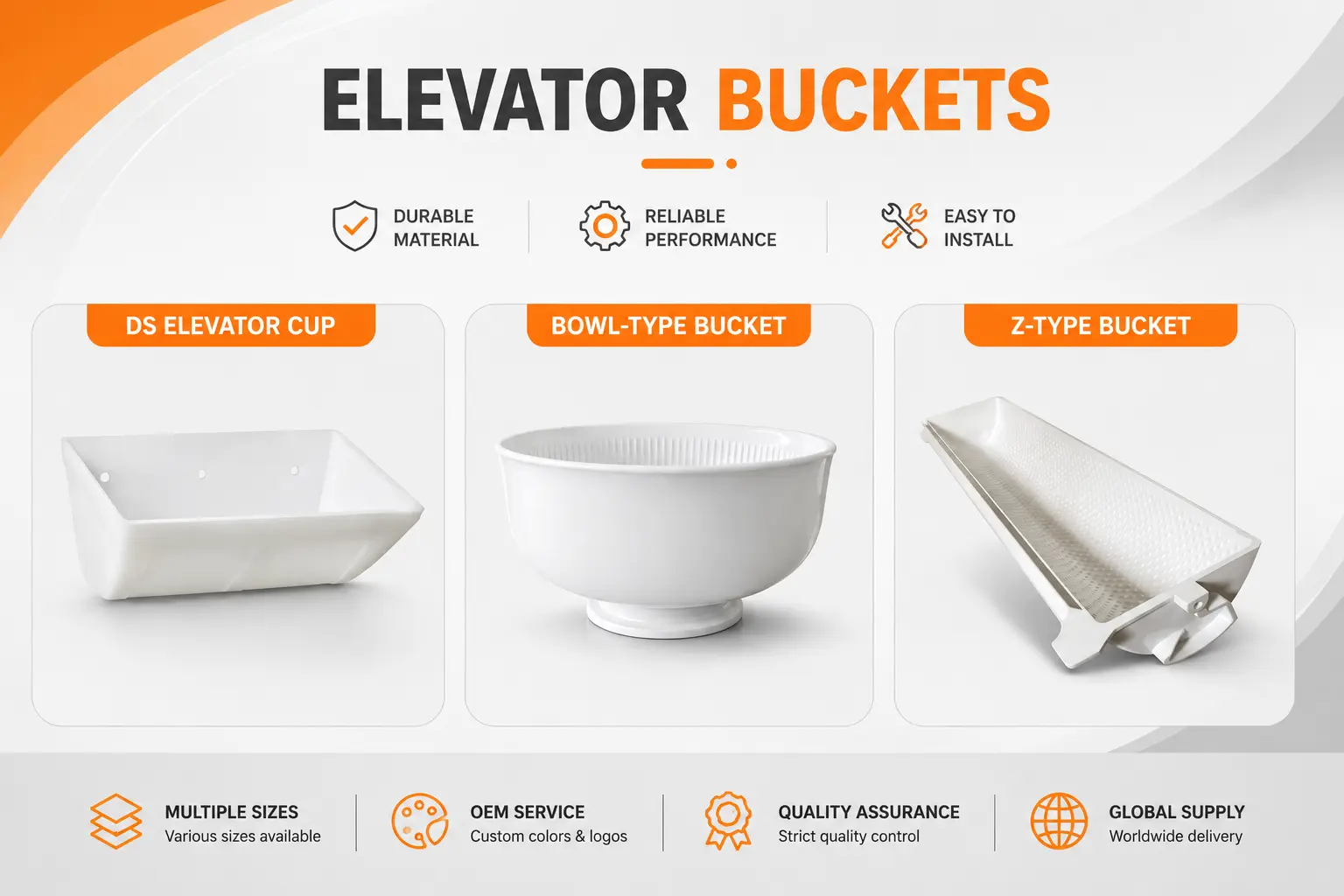
For Elevator Buckets (Z-Type, DS, DQ, or Bowl-Type)
You need the following information for every bucket inquiry:
| Item | How to Get It | Tại sao nó quan trọng |
| A — Overall bucket width (mm) | Measure existing bucket at widest point, or from elevator drawing | Determines casing clearance — wrong A = bucket contacts casing wall |
| B — Projection depth (mm) | Measure from back plate to leading lip | Determines fill geometry at the boot |
| C — Inner cavity depth (mm) | Measure inside depth of bucket | Determines bucket capacity |
| D — Back plate height (mm) | Measure the flat back face of the bucket | Must match chain clip attachment geometry |
| E — Hole centre-to-centre spacing (mm) | Measure between hole centres on the back plate | CRITICAL — must match chain bolt pitch exactly |
| Number of mounting holes | Count holes on existing bucket | 2-hole vs 3-hole vs 4-hole changes the mounting configuration entirely |
| Hole diameter (mm) | Measure hole diameter — typically 7mm or 9mm | Wrong hole diameter = bolts cannot be fitted |
| Bucket type | Z-type / DS deep / DQ shallow / Bowl-type | Different profiles for different elevator angles and products |
| Material required | PP / ABS / Nylon / PE / Stainless steel | Food grade, temperature, abrasion requirements |
| Quantity required | Total number of buckets for the elevator + spare inventory target | Affects per-unit price; MOQ considerations |
The most common inquiry mistake: Providing only the bucket width (A dimension) and assuming the supplier can determine the rest. The E dimension — hole centre spacing — is the single most critical number for bucket compatibility. Two buckets with identical A, B, C, and D dimensions but different E dimensions are completely incompatible. Always measure and include E.
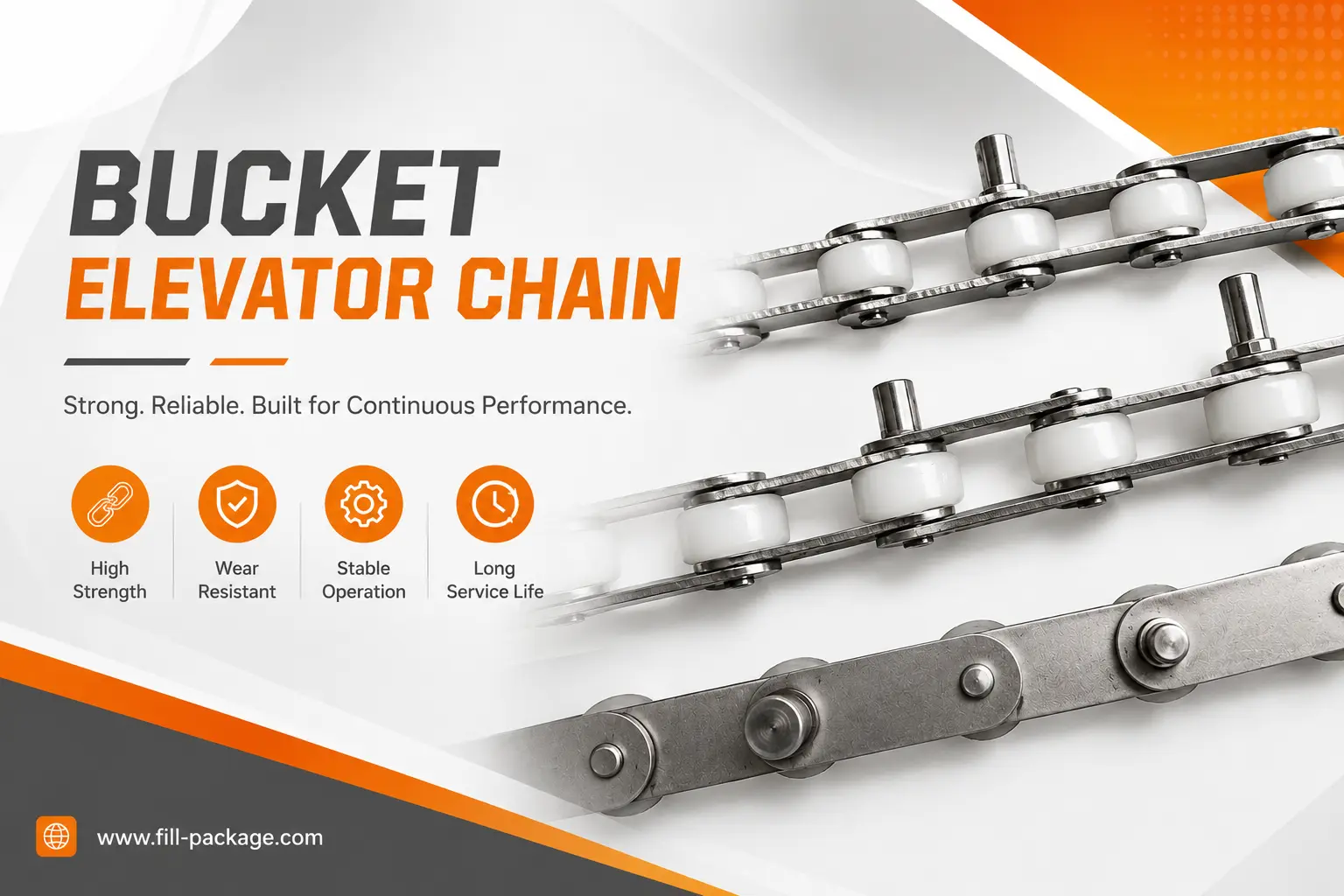
For Conveyor Roller Chain
| Item | How to Get It | Tại sao nó quan trọng |
| Chain pitch (mm) | Measure 10 links, divide by 10. Or read from elevator manual. | Determines sprocket compatibility — C2042 (25.4mm), C2052 (31.75mm), C2062 (38.1mm) |
| Roller diameter (mm) | Measure existing chain roller diameter | Must match sprocket tooth profile |
| Inner width (mm) | Measure inside width between inner link plates | Determines bucket clip width compatibility |
| Roller type | PA6 nylon (white) or stainless steel (silver) | Nylon for packaging lines; stainless for wet/heavy/cold environments |
| Chain length (metres) | Measure total chain length in the elevator, or calculate from elevator height | Determines order quantity; include 10% for tensioning and spare links |
| Attachment type | PF1 (extended pin for bucket clips) or plain chain | Bucket-carrying chain requires extended pins — plain chain cannot carry buckets |
For Bucket Elevator Sprockets
| Item | How to Get It | Tại sao nó quan trọng |
| Chain pitch (mm) | Same as chain pitch above — must match exactly | Sprocket tooth geometry is specific to chain pitch — wrong pitch = immediate tooth climbing |
| Số lượng răng | Count teeth on existing sprocket | 24-tooth is standard for Z-type elevators; confirm against your elevator |
| Shaft bore diameter (mm) | Measure shaft diameter or read from elevator drawing | Standard is ø25mm; custom bores available — must be specified before production |
| Keyway width (mm) | Measure keyway width in existing sprocket or on shaft | Standard is 8mm; must match shaft keyway exactly |
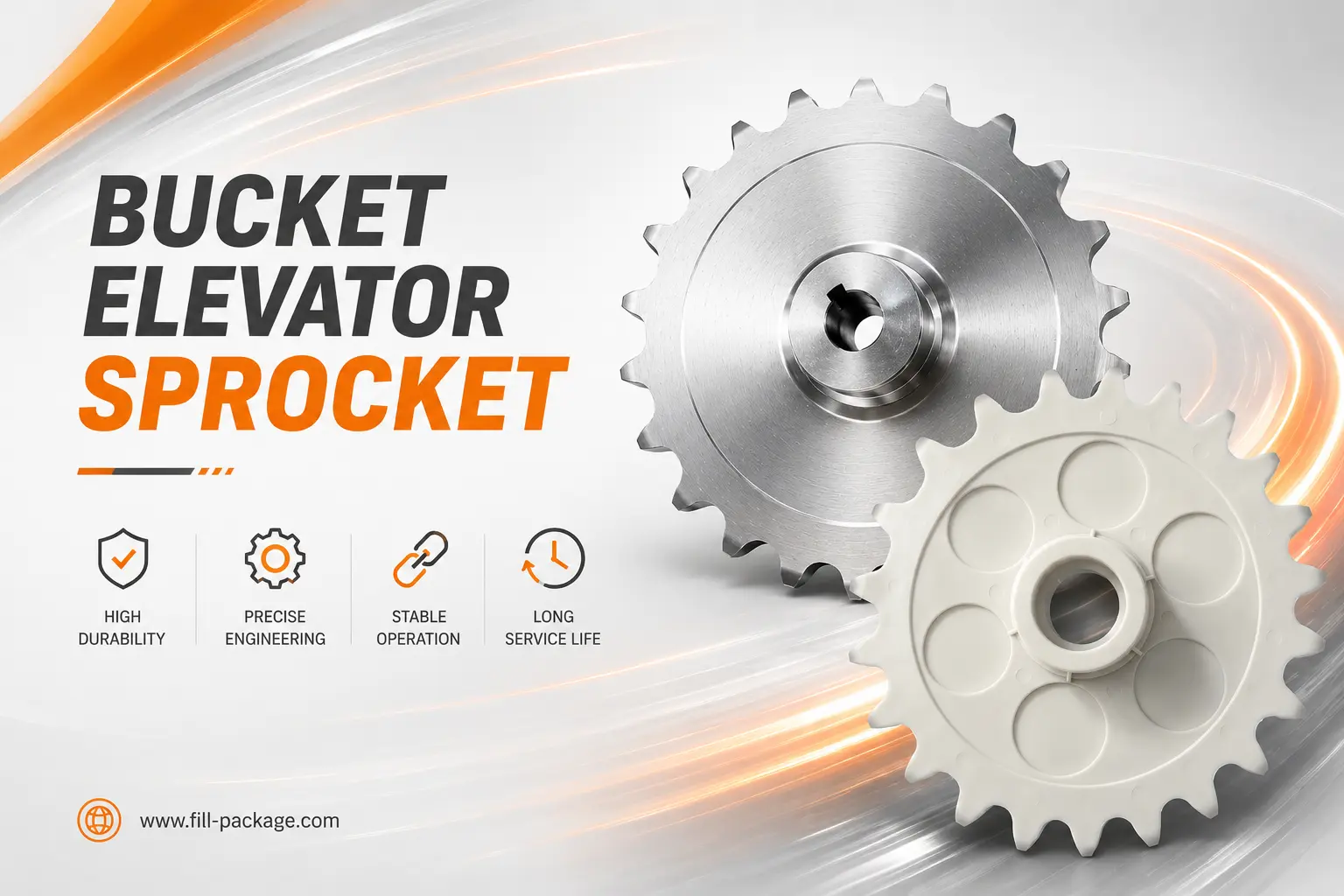
| Sprocket material | Carbon steel (driving shaft) or PA+GF plastic (driven shaft) | See Blog 1 for driving vs driven position explanation |
| Số lượng | 2 minimum per elevator (one per shaft) + spares | Sprocket wear and chain wear are linked — replace both together |
Part 2 — What to Ask the Supplier For
Supplier Verification Checklist: 6 Things to Request Before Ordering
Once you have your dimensions prepared, these are the six things to request from any Chinese bucket elevator parts supplier before placing an order. A reputable supplier will provide all six without hesitation. If any are refused or unavailable, treat that as a red flag.
1. Technical Drawing Confirmation (Before Production)
Ask the supplier to produce a technical drawing showing all confirmed dimensions — A through E for buckets, pitch and roller diameter for chain, bore and tooth count for sprockets — and send it to you for approval before production begins. This is the document that confirms the part will fit your elevator.
- What to check in the drawing: all dimensions match your measurements; tolerance specifications are shown (not just nominal dimensions); hole positions and diameters are confirmed
- Red flag: supplier wants to ship first and confirm compatibility after delivery
2. Material Certification — Virgin Resin Confirmation
For plastic buckets (PP, ABS, PE, Nylon), request a material certification confirming that virgin resin is used — not recycled material. This is the single most important quality confirmation for plastic elevator buckets.
- Why it matters: recycled PP or ABS has inconsistent molecular weight distribution, which causes micro-cracking at stress concentration points (mounting holes) within 2–3 months of operation under continuous load
- What to ask for: a material test report or supplier declaration confirming virgin-grade PP, ABS, or PA — and the material grade (food-grade vs industrial-grade if relevant for your application
3. Bucket Elevator Bucket Price Structure — MOQ and Volume Tiers
Request a clear price breakdown showing: unit price at minimum order quantity (MOQ); price at your target volume; any tooling or mould charges for non-standard sizes. This is the basis for a genuine cost comparison with OEM parts.
- Standard MOQ for most bucket elevator parts: 50–100 pieces for standard sizes (no tooling charge); 500–1,000 pieces for custom sizes (one-time mould charge)
- What to watch for: very low unit prices at unusually low MOQ often indicate standard-size parts being offered without dimension confirmation — the parts may fit, or may not
4. Sample Policy
For first-time orders of a non-standard size, or when compatibility is uncertain, ask whether the supplier will ship a sample quantity (5–10 pieces) before the full order is produced. The sample allows you to physically test fit and function in your elevator before committing to full volume.
- Note: standard size samples (e.g., 1.8L Z-type bucket in stock size) are often available from inventory for immediate dispatch. Custom sizes require production of a sample batch.
5. Lead Time Confirmation
Request confirmed lead time — not estimated lead time — for your specific part and quantity. The difference between a confirmed and an estimated lead time is significant for maintenance planning.
- Typical lead times: standard sizes in stock — 7–10 days shipping; standard sizes made-to-order — 10–15 business days production + shipping; custom sizes — 20–30 business days production + shipping
6. Shipping and Incoterms
Confirm the Incoterms for your order — particularly whether the price quoted is EXW (ex-works, you arrange shipping) or includes shipping to your port (FOB, CIF, or DDP). Bucket elevator parts are typically heavy enough that shipping cost is a material line item in the total landed cost calculation.
Part 3 — Red Flags to Avoid
5 Red Flags When Evaluating a Bucket Elevator Parts Supplier
- No drawing confirmation process: any supplier who does not offer to produce a dimensional drawing for your approval before production is asking you to trust that their standard dimensions match your elevator. This is how incompatible parts get shipped.
- Cannot provide material certification: for plastic buckets, inability to provide a virgin resin certification is a strong indicator of recycled material use. This is the most common source of premature bucket failure from Chinese suppliers.
- Very low prices at very low MOQ: pricing that appears significantly below market rate at unusually low minimum quantities often indicates standard parts being offered speculatively — without confirming that those dimensions match your elevator.
- No reference customers or verifiable track record: established bucket elevator parts suppliers have customers who can be referenced. A supplier who cannot provide any verifiable customer references for comparable part types warrants caution.
- Resistance to sample orders: if a supplier is unwilling to supply a small sample quantity for verification before full production, ask why. For a manufacturer with confidence in their parts’ compatibility, sample orders are a normal part of the sales process.
Part 4 — Special Case: Multi-Outlet Bucket Design
Do You Need a Multi-Outlet Bucket? Check This Before Ordering
Before finalising a bucket order, confirm whether your elevator uses standard single-outlet buckets or multi-outlet (multiple spout) buckets. This is a detail that is easy to overlook — and the two types are not interchangeable.
A multi-outlet bucket has two or three discharge openings rather than the standard single opening. It is used when a single elevator feeds two or more downstream weighers or filling heads. The bucket discharges product to multiple positions simultaneously at the top of the elevator, eliminating the need for a separate distribution conveyor.
- How to identify: look at the discharge end of your existing buckets. A single-outlet bucket has one opening. A multi-outlet bucket has two or three spouts or openings at different positions.
- Our multi-outlet range: 2.6L and 3.8L Z-type buckets in 2-outlet and 3-outlet configurations, widths from 198mm to 474mm.
- Confirm before ordering: multi-outlet buckets are not a standard stocked item in most cases — they require production to your specific outlet configuration. Include this requirement in your initial inquiry.
Ready to Place Your Inquiry?
Use the checklist above to prepare your dimensions before contacting us. The more complete your inquiry information, the faster we can issue a drawing confirmation and quotation.
Send us your bucket, chain, or sprocket specifications. We will issue a technical drawing confirmation within 24 hours of receiving complete dimensions — before any production begins. Liên hệ đội ngũ kỹ thuật của chúng tôi
Browse our complete product range: Bucket Elevator Parts Hub · Gàu Z-Type · Chén nâng công nghiệp DS & DQ · Bucket Elevator Sprockets · C2052 Conveyor Roller Chain
Related Reading — Complete Blog Series
Blog 1: The Essential Maintenance Checklist for Bucket Elevator Components
Blog 2: Original vs. Aftermarket Parts: Why Precision Measurement Is the Key to Compatibility
Blog 3: The Complete Checklist for Sourcing Bucket Elevator Replacement Parts from China (this article)