

Giới thiệu
When specifying elevator buckets for a food processing or packaging line, the choice between bowl-type and standard rectangular buckets is not simply a matter of preference. Rather, it is an engineering decision driven by product characteristics, hygiene requirements, and the specific role of the elevator in the production process.
Standard Z-type rectangular buckets and bowl-type arc buckets can both carry food products upward on an elevator chain. However, they do so with different force profiles, different residue accumulation characteristics, and different implications for food safety audit compliance. Understanding these differences is the basis for specifying the correct bucket type for each application.
This article compares the two bucket types across five practical criteria — product protection, hygiene, capacity range, chain compatibility, and cleaning — to help you identify which specification is correct for your line. For context on the underlying engineering of the arc design, see our earlier article:
Why Fragile Foods Require Bowl-Type Buckets: The Science of Gentle Material Handling.
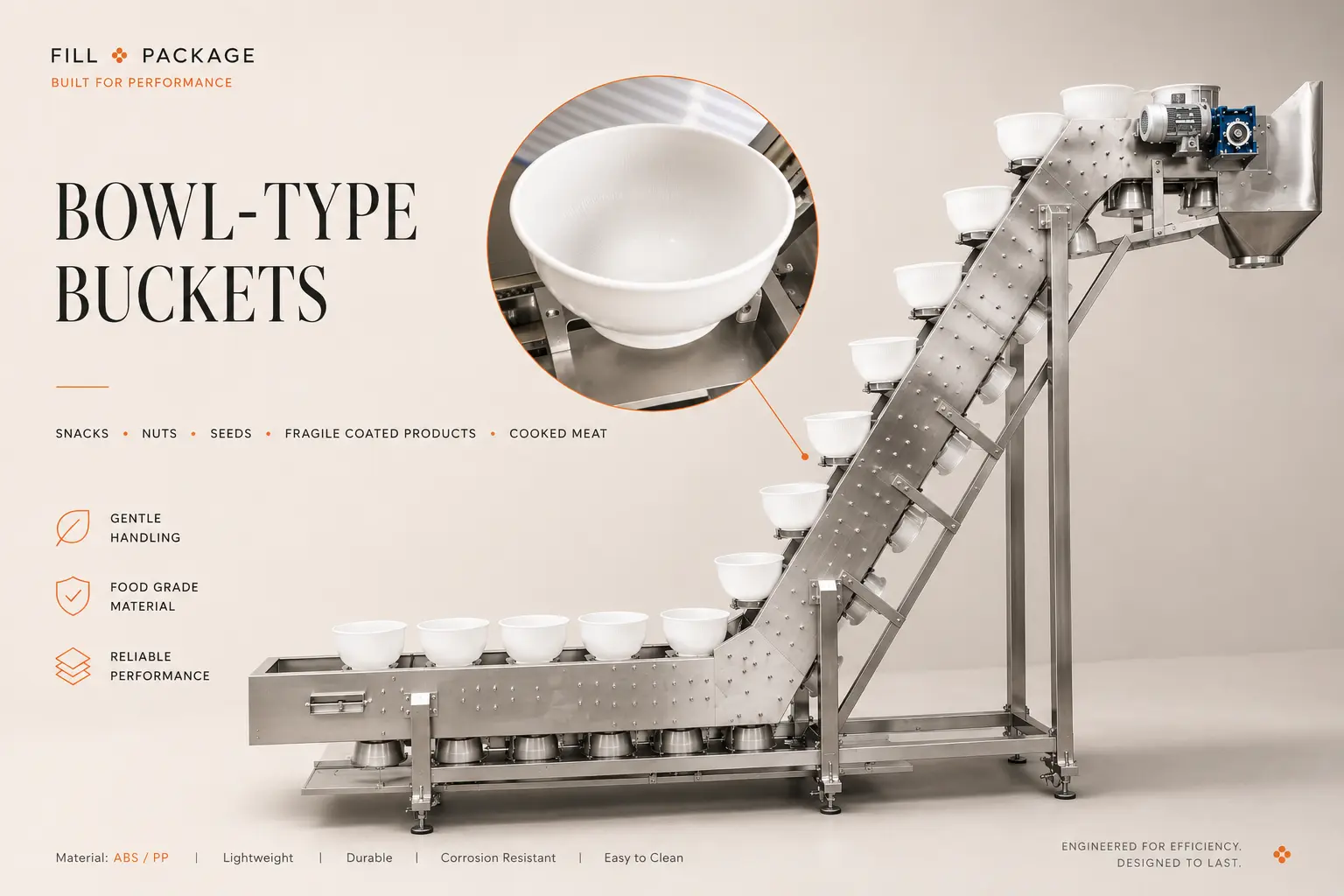
Section 1 — Five-Criteria Comparison
Bowl-Type vs. Standard Bucket: Five Practical Criteria
| Criterion | Standard Z-Type Rectangular Bucket | Bowl-Type Arc Bucket |
| Product protection | Flat base — single contact point at impact. Adequate for free-flowing granules with no breakage sensitivity. | Arc base — distributed impact, rolling discharge. Specified for fragile, coated, or high-value products. |
| Carry-back / residue | Four internal corners accumulate product. Carry-back rate 1–5% for sticky or fine products. | No internal corners. Complete discharge on every cycle. Carry-back near zero for most food products. |
| Hygiene / cleanability | Corners require focused cleaning. Internal corner residue is a food safety audit risk point. | Smooth arc interior — no corner accumulation. Significantly easier to clean. Lower audit risk. |
| Phạm vi công suất | 0.5L to 6L standard; multi-outlet designs (2.6L, 3.8L) for multi-lane distribution. | 0.8L to 6L in six standard sizes. No multi-outlet variant — single discharge point. |
| Chain compatibility | Flat back plate with two-hole mounting. Mounting widths 412/416/418/420mm (1.8L standard). | Circular mounting base (126mm or 150mm diameter). Requires C-type or modified Z-type chain attachment. |
Selection summary: Use standard rectangular Z-type buckets for free-flowing dry products (granules, seeds, coffee, dal) where breakage is not a concern and the elevator uses a standard Z-type chain. Use bowl-type buckets for fragile, coated, sticky, or irregular products, and wherever food safety audit compliance requires documented absence of product accumulation points inside conveying equipment.
Section 2 — Capacity Gradient
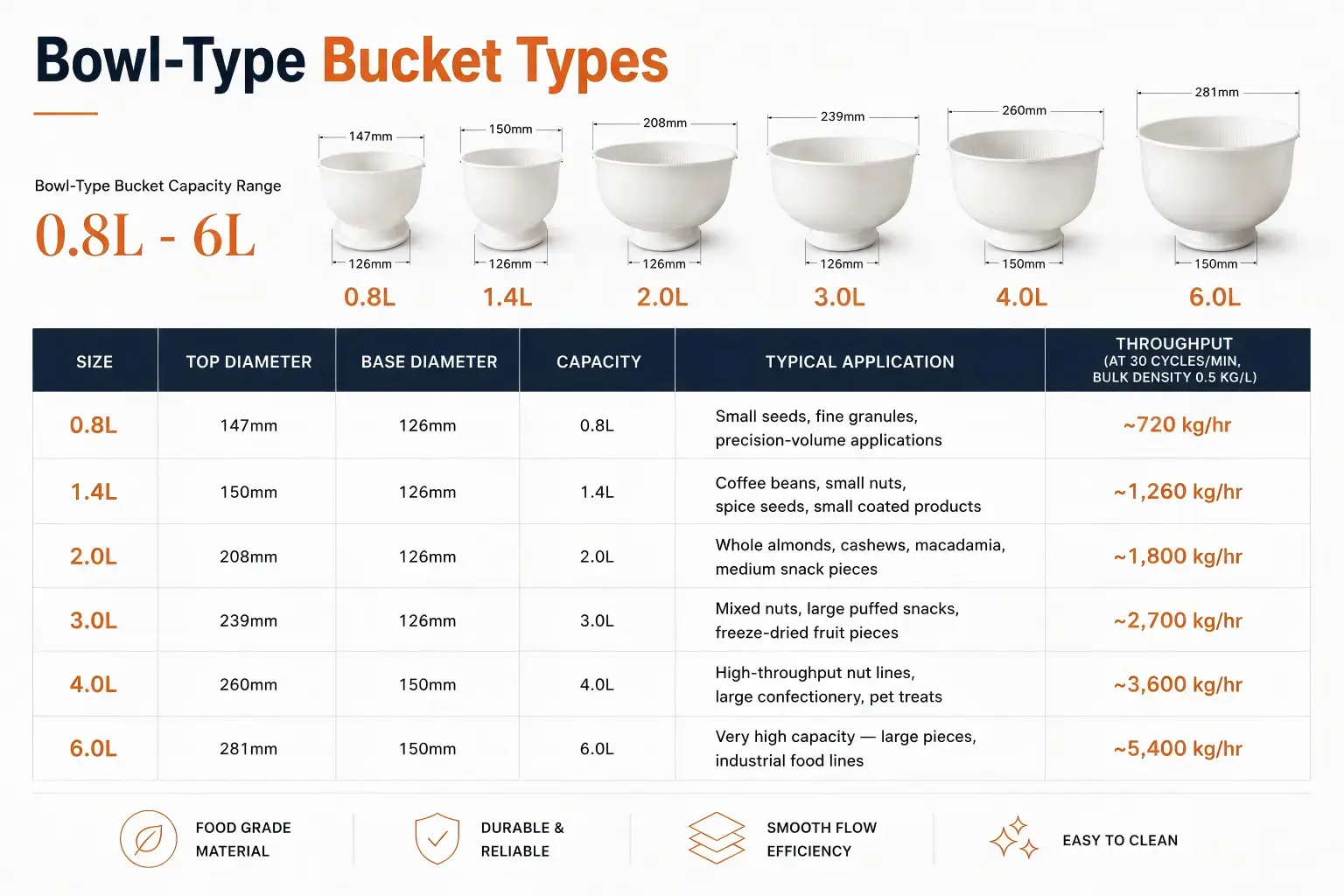
Bowl-Type Bucket Capacity Range: 0.8L to 6L
The six standard bowl-type bucket sizes cover the capacity range required for most food processing line applications. Unlike Z-type buckets, where the 1.8L size accounts for the vast majority of installations, bowl-type bucket size selection is more evenly distributed across the range — because the product type (rather than just throughput) drives the size choice.
| Size | Top Diameter | Base Diameter | Dung tích | Ứng dụng điển hình | Throughput (at 30 cycles/min, bulk density 0.5 kg/L) |
| 0.8L | 147mm | 126mm | 0.8L | Small seeds, fine granules, precision-volume applications | ~720 kg/hr |
| 1.4L | 150mm | 126mm | 1.4L | Coffee beans, small nuts, spice seeds, small coated products | ~1,260 kg/hr |
| 2.0L | 208mm | 126mm | 2.0L | Whole almonds, cashews, macadamia, medium snack pieces | ~1,800 kg/hr |
| 3.0L | 239mm | 126mm | 3.0L | Mixed nuts, large puffed snacks, freeze-dried fruit pieces | ~2,700 kg/hr |
| 4.0L | 260mm | 150mm | 4.0L | High-throughput nut lines, large confectionery, pet treats | ~3,600 kg/hr |
| 6.0L | 281mm | 150mm | 6.0L | Very high capacity — large pieces, industrial food lines | ~5,400 kg/hr |
Note: throughput calculations assume 100% fill efficiency, which is not achieved in practice. In reality, 60–80% fill efficiency is typical for most food products in bowl-type buckets. Therefore, actual throughput should be calculated at 60–80% of the theoretical maximum for accurate line planning.
Base diameter and the 126mm / 150mm split
The base diameter is a critical dimension for chain compatibility. Sizes 0.8L through 3.0L use a 126mm base diameter — allowing them to interchange on the same elevator frame without changing the chain attachment hardware. Sizes 4.0L and 6.0L use a 150mm base diameter, which requires a different chain attachment configuration.
Accordingly, if you are planning a future capacity upgrade from 2.0L to 4.0L on the same elevator, confirm with your elevator manufacturer whether the chain attachment can accommodate the 150mm base before committing to the initial elevator specification.
Section 3 — Sanitary Design Comparison
Sanitary Performance: Why Food Safety Auditors Prefer Bowl-Type Buckets
Food safety audits increasingly include inspection of conveying equipment interior surfaces for product accumulation and cleaning accessibility. Standard rectangular buckets present two specific challenges in this context.
Corner accumulation risk
The four internal corners of a rectangular bucket are accumulation points for product residue, particularly for sticky, oily, or fine-particle products. During a food safety audit, an inspector who opens an elevator casing and finds residue in bucket corners has identified a contamination risk — and a cleaning non-conformance. Depending on the audit standard (BRC, SQF, FSSC 22000), this finding may require corrective action documentation and a re-audit.
Bowl-type buckets, by contrast, have no internal corners. Their smooth arc interior produces no accumulation zones. An auditor inspecting bowl-type buckets on a well-maintained line will find clean, residue-free interiors — a straightforward compliance result.
Plasticiser-free option for direct food contact
For food applications with strict direct-contact compliance requirements — pharmaceutical, infant nutrition, organic certified — bowl-type buckets are available in a plasticiser-free food-grade PP formulation. Standard PP buckets use plasticiser additives that improve moulding performance but are not acceptable for some direct-contact certifications. The plasticiser-free variant is produced from a certified virgin PP grade that meets direct-contact requirements without plasticiser additives.
This option is produced to order. Provide your certification requirement (e.g., EU Regulation 10/2011 compliance documentation, FDA 21 CFR compliance, specific migration limits) and we will confirm the applicable material specification before production.
For detailed dimension specifications and ordering: Bowl-Type Elevator Buckets product page
Phần kết luận
The Right Bucket for the Right Application
Standard Z-type rectangular buckets and bowl-type arc buckets serve different applications. For free-flowing dry products on standard Z-type elevator chains, the rectangular bucket is the correct and most cost-effective choice. For fragile, coated, sticky, or hygiene-critical products — and wherever food safety audit compliance requires documented clean-ability — the bowl-type bucket delivers performance that the rectangular format cannot match.
Furthermore, the base diameter standardisation within the bowl-type range (126mm for 0.8L–3.0L; 150mm for 4.0L–6.0L) means that capacity upgrades within a group are straightforward without changing the chain attachment configuration.
Specify your bowl-type bucket today. Visit our Bowl-Type Elevator Buckets page hoặc liên hệ với nhóm kỹ thuật của chúng tôi for size recommendation, chain compatibility confirmation, and plasticiser-free options.
Tiếp tục đọc: Standardizing Your Bowl-Type Elevator: A Dimension Guide for Replacement Buckets →