

In the world of automated packaging, the “feeding method” of your multihead weigher often determines the efficiency limit of your entire line.
For engineers and plant managers, the focus is often on weighing accuracy. However, accuracy is a result of consistent feeding. If the machine cannot move the product reliably to the weigh buckets, accuracy is impossible.
The industry standard has long been Vibration Feeding. It is cost-effective and works perfectly for 80% of dry products. But for the remaining 20%—sticky, oily, or fresh products—vibration often becomes a source of instability.
In this engineering guide, we compare Vibration Feeding against Screw Feeding to help you decide which mechanical principle suits your product characteristics.
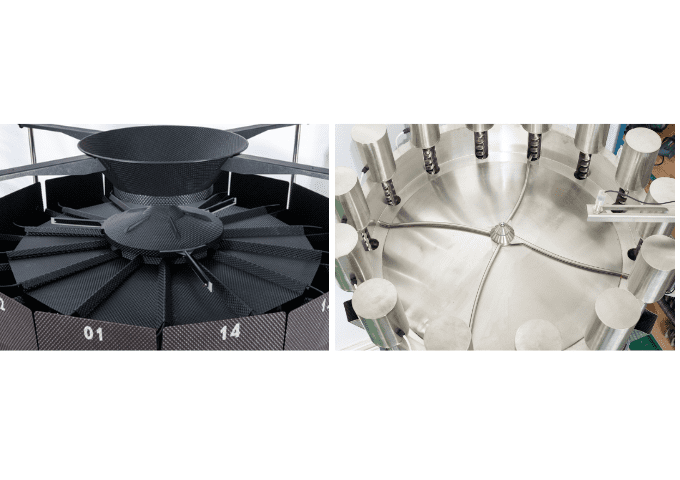
How Vibration Feeding Works
Standard multihead weighers utilize electromagnetic vibration.
- The Mechanism: A coil creates a magnetic field that pulls and releases a spring-mounted pan at high frequency.
- The Physics: This vibration overcomes the static friction between the product and the stainless steel pan. The product makes micro-jumps, moving forward in a parabolic trajectory.
- Melhor para: Free-flowing, dry granular products (e.g., nuts, candies, grains, frozen vegetables). Since these products have low surface friction, they “dance” easily across the pans.
How Screw Feeding Works
Screw feeding operates on a completely different mechanical principle: Positive Displacement.
Instead of relying on the product to “bounce,” this system uses a rotating spiral (Archimedes’ screw) inside a trough.
The Mechanism: Each feed lane is driven by an independent motor that rotates a coreless stainless steel screw.
The Physics: The rotation creates a shear force. It mechanically pushes a specific volume of material forward, regardless of the material’s viscosity or stickiness.
The Application: This is the core technology behind the alimentador de parafuso e pesador multicabeçote. It is designed specifically for materials that resist movement.
Product Types Suitable for Each Method
Choosing the right machine starts with analyzing your product’s rheology (flow properties).
| Recurso | Vibration Feeding (Standard) | Screw Feeding (Specialized) |
| Product State | Dry, Frozen, Granular | Wet, Sticky, Oily, Fresh |
| Flowability | Free-flowing | Difficult-to-flow |
| Exemplos | Nuts, Chips, Candy, Dry Pasta | Fresh Chicken, Marinated Meat, Oily Fish, Fried Rice |
| Why it works | Relies on low friction | Overcomes high friction mechanically |
Stability and Accuracy Comparison
Why do engineers recommend a screw feeding solution for difficult products over a vibration system? It comes down to control.
1. The “Damping Effect” of Vibration
When you place fresh meat or sticky marinated food on a vibration pan, the product acts as a damper. It absorbs the kinetic energy of the vibration instead of bouncing.
To make it move, operators often increase the vibration amplitude. This leads to:
Loud noise and increased wear on the machine.
Unpredictable clumps: The meat suddenly breaks free and falls in a large mass, causing overweight rejects.
2. The Linear Precision of Screw Feeding
Screw feeding offers a linear relationship between rotation and volume.
Precise Dosing: The CPU knows that X degrees of rotation equals Y grams of product.
Micro-Feeding: For the final weight adjustment, the screw can rotate just a fraction of a turn to add a single piece of meat.
Resultado: This mechanical certainty makes it a far more stable screw feeding weighing solution for high-value proteins where “giveaway” (overfilling) is expensive.
Conclusão
There is no “better” technology, only the “right” technology for your specific application.
If you are packaging peanuts, a screw feeder is unnecessary overkill. But if your production line handles fresh poultry, marinated delicacies, or sticky prepared meals, do not try to fight physics with vibration.
For these difficult applications, Screw Feeding provides the mandatory mechanical force needed to ensure consistent, automated weighing.
Still undecided?
Let the physics decide. View the specifications of our [Alimentador de parafuso e balança multicabeçote] or contact our engineering team to run a material test with your specific product.