

Conveyor Roller Chain for Z-Type Bucket Elevator Systems | C2052 Series
Corrente transportadora em aço inoxidável para elevadores de canecas
Visão geral
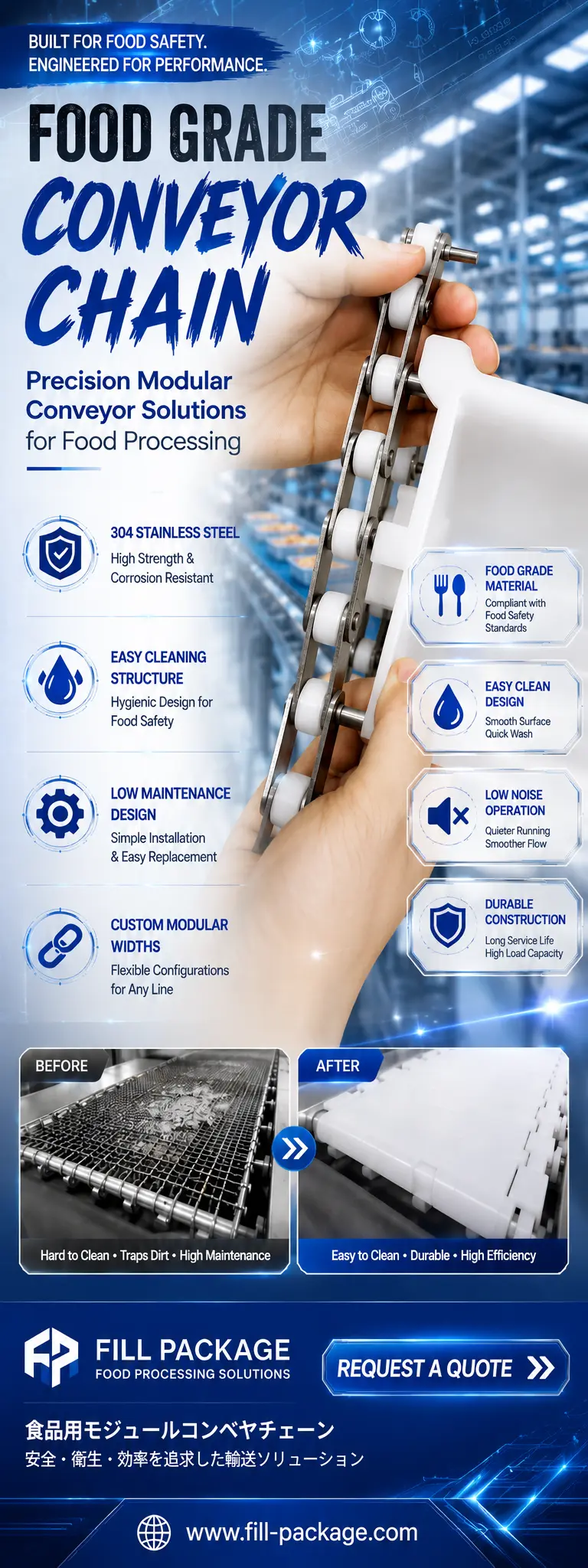
When a Z-type bucket elevator chain fails, the entire packaging or processing line stops. Chain elongation, tooth climbing, and link plate cracking are not random equipment failures — they are predictable maintenance events that happen when a chain is run past its service limit, or when the wrong specification is installed in the first place.
Our core product is the C2052-PF1-D3F30 double-pitch conveyor roller chain — the standard chain specification for Z-type bucket elevator systems used across food packaging, multihead weigher infeed, and industrial processing lines worldwide. Manufactured to ANSI B29.1 standards with your choice of PA6 nylon or 304 stainless steel rollers, it is the chain specification that most Chinese Z-type elevator OEMs build their systems around.
With 30+ years in industrial roller chain manufacturing and supplying 80% of the domestic Chinese market, we supply the chains running on most Z-type elevators currently in production — and provide the technical confirmation most OEM buyers need before placing a bulk replacement order.
Por que escolher nossa corrente transportadora de aço inoxidável?
Escolhendo o certo corrente transportadora A escolha de um fornecedor vai além da simples comparação de preços — trata-se de desempenho a longo prazo, confiabilidade e serviço. Veja por que milhares de clientes em todo o mundo confiam em nós para suas necessidades de fornecimento. correntes de rolos de aço inoxidável e corrente do elevador de canecas precisa:
- Mais de 30 anos de experiência
Estamos fabricando correntes de rolos industriais Há mais de três décadas, nosso foco é desempenho, precisão e durabilidade. - Participação de mercado do 80% na China
Somos líderes corrente do elevador de canecas Fabricante que abastece a maior parte do mercado interno e exporta para o mundo todo. - Soluções OEM e ODM disponíveis
Projetos personalizados, acessórios especiais e embalagens de marca própria — apoiamos o seu negócio em todas as etapas do processo. - Entrega rápida e suporte global
Desde projetos urgentes até implementações programadas, nossa produção flexível e logística global garantem que você receba o que precisa, quando precisa. - Compatibilidade com toda a gama de produtos
Oferecemos uma linha completa de correntes de rolos transportadoresEngrenagens, acessórios e componentes correspondentes — tudo em um só lugar. - Serviço pós-venda confiável
Nossa equipe de engenharia está disponível 24 horas por dia, 7 dias por semana, para oferecer suporte com dúvidas técnicas, orientações sobre instalação e soluções de manutenção a longo prazo.

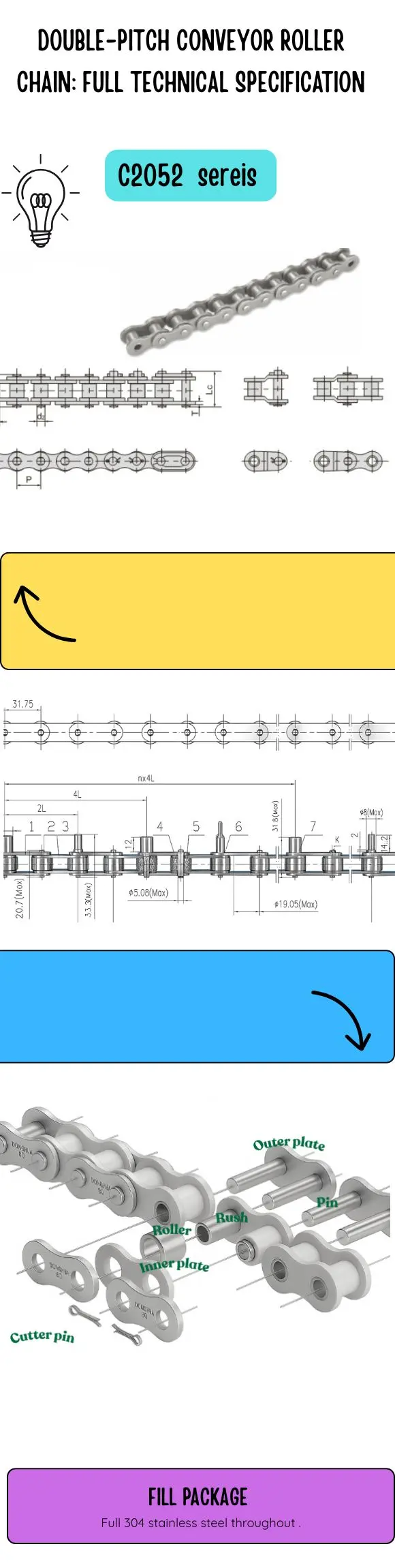
C2052 Double-Pitch Conveyor Roller Chain: Full Technical Specification
Key Dimensions & Performance Data
Model: C2052-PF1-D3F30 (鱼鳞链 / fish-scale chain) — the most commonly supplied conveyor roller chain for Z-type elevator systems.
| Parâmetro | Valor | Standard / Note |
| Chain model | C2052-PF1-D3F30 | ANSI B29.1 — double-pitch |
| Tom | 31.75mm | Double-pitch series |
| Roller diameter | ø19.05mm (Max) | PA6 nylon or 304 stainless (see roller section) |
| Pin diameter | ø5.08mm (Max) | — |
| Inner plate gap | 9.4⁺⁰·⁴ mm | — |
| Outer plate thickness | 2.03mm | — |
| Chain plate height | 13.84mm (Max) | — |
| Min. tensile strength | 21.8 kN | Per ANSI B29.1 standard |
| 21-link measured length | 666.75mm ±1mm | At 200N measuring load — factory QC standard |
| Outer plate press-fit | F_outer > 1,377 N | — |
| Inner plate press-fit | F_inner > 995 N | — |
| Max. torsion angle | 4° per metre | — |
| Pairing tolerance | ±0.05% | Chains supplied in matched pairs |
Image alt text: “C2052 double-pitch conveyor roller chain technical drawing bucket elevator Z-type”
Bill of Materials (BOM)
| Part | Componente | Material | Notas |
| Outer plate | 外链板 | 45Mn steel | High-strength manganese steel |
| Chain pin | 单排链轴 | 20CrMnMo — nickel plated | Cr-Mo alloy; nickel plating for corrosion resistance |
| Inner plate | 内链板 | 45Mn steel | — |
| Bushing / sleeve | 套筒 | 20Mn steel | — |
| Roller | 滚子 | PA6 nylon OR 304 SS | See roller selection section below |
| Extended pin A | 加长销轴A | 20CrMnMo — nickel plated | For bucket clip attachment |
| Extended pin B | 加长销轴B | 20CrMnMo — nickel plated | For bucket clip attachment |
| Connecting pin | 连接销轴 | 20CrMnMo — nickel plated | Chain joining link |
| Split pin | 开口销 | GB/T 91 — 1.6×10 | Retaining pin |
Why Nickel-Plated Pins — Not Full Stainless Steel
The nickel-plated 20CrMnMo alloy steel pin is a deliberate specification choice that balances corrosion resistance and mechanical performance:
- Higher tensile and fatigue strength than 304 stainless — 20CrMnMo alloy steel has significantly higher hardness and fatigue resistance than 304 SS at the pin diameter used in C2052 chain
- Nickel plating provides sufficient corrosion resistance for food factory environments — suitable for humid air and spray washdown conditions
- More cost-effective than full 304 stainless construction — making C2052-PF1-D3F30 the best-value specification for most food packaging Z-elevator applications
For applications requiring full 304 stainless steel throughout — including pin, bushing, and plate — we supply a full stainless variant. Contact us for specification and pricing.
Nylon Roller vs Stainless Steel Roller: Which to Specify
The C2052 conveyor roller chain is available with two roller options. The roller contacts the carrying rollers and guide rails inside the elevator casing — and the choice between nylon and stainless steel affects noise, smoothness, maintenance cost, and load capacity in ways that matter differently depending on your application.
PA6 Nylon Roller — Standard for Packaging Lines
Nylon is the default specification for the vast majority of food packaging line applications — and the reason is not cost. It is performance. Packaging lines have a fundamentally different set of priorities from industrial bulk conveying:
- Smooth, stable product movement — bags, pouches, and cartons must not bounce or shift position during transport
- Low noise — many food factories run two or three shifts, and a quiet line is an operational requirement
- No surface damage — printed packaging film and finished product must not be scratched or marked
- High-speed reliability — packaging lines run continuously at speeds where any irregularity in chain movement creates downstream problems
PA6 nylon rollers deliver on all four. The low friction coefficient produces smooth movement at high speed. Contact between the nylon roller and the nylon carrying roller is quiet — 8–12 dB lower than steel-on-steel at equivalent chain speeds. And nylon’s natural lubricity means no grease is required at the roller contact point, eliminating contamination risk on food packaging lines.
| Aplicativo | Why Nylon Roller |
| Snack packaging lines (chips, nuts, puffed food) | Smooth movement prevents bag bounce; low noise is critical |
| VFFS machine takeaway conveyor | High speed, printed film must not be scratched |
| Multihead weigher → conveyor → case packing line | Stable product positioning at all transfer points |
| Carton and plastic tray conveying | Low wear on guide rails reduces maintenance cost |
| Powder packaging (VFFS back-end) | No vibration that affects weigher fill accuracy |
| Z-type bucket elevator (light product) | Noise reduction; self-lubricating roller contact |
304 Stainless Steel Roller — For Heavy, Wet, or Cold Applications
Stainless steel rollers are specified when load, moisture, or temperature conditions exceed what nylon can reliably handle. The stainless roller has higher load capacity and is unaffected by immersion, condensation, or sub-zero temperatures that can make nylon brittle or cause premature wear.
The trade-off: stainless-on-stainless contact is louder and generates more vibration than nylon-on-nylon. For applications where load capacity and washdown resistance are the priority, this is acceptable. For packaging lines where smoothness and noise matter, it is not.
| Aplicativo | Why Stainless Steel Roller |
| Z-type bucket elevator (heavy material) | Higher load per bucket than nylon can sustain reliably |
| Fresh seafood and meat conveying | Wet + heavy product; frequent high-pressure washdown |
| Frozen product handling | Sub-zero temperatures can embrittle PA6 nylon under load |
| Raw material infeed (not finished packaging) | Load priority over noise; less concern for surface damage |
| Pharmaceutical washdown environments | Full immersion cleaning required; nylon absorbs moisture |
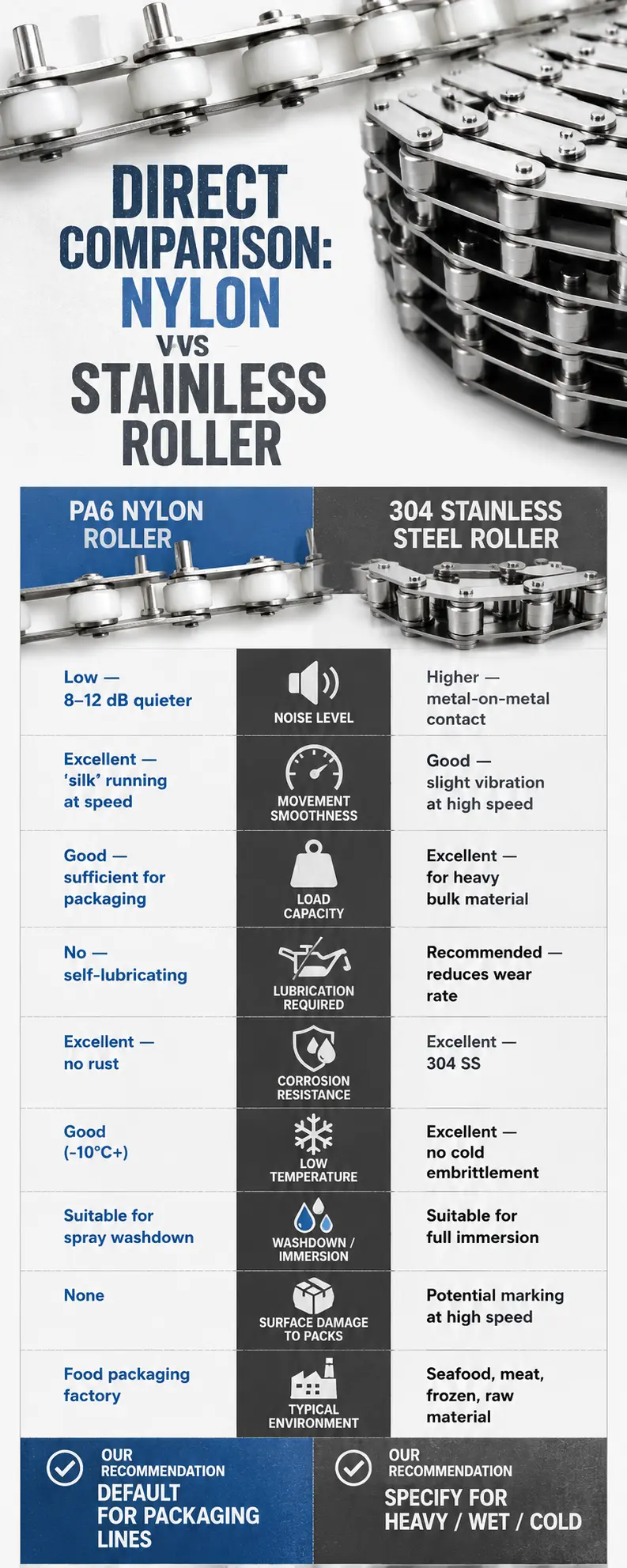
Direct Comparison: Nylon vs Stainless Roller
| PA6 Nylon Roller | 304 Stainless Steel Roller | |
| Noise level | Low — 8–12 dB quieter | Higher — metal-on-metal contact |
| Movement smoothness | Excellent — ‘silk’ running at speed | Good — slight vibration at high speed |
| Capacidade de carga | Good — sufficient for packaging | Excellent — for heavy bulk material |
| Lubrication required | No — self-lubricating | Recommended — reduces wear rate |
| Resistência à corrosão | Excellent — no rust | Excellent — 304 SS |
| Low temperature (-10°C+) | Bom | Excellent — no cold embrittlement |
| Washdown / immersion | Suitable for spray washdown | Suitable for full immersion |
| Surface damage to packs | Nenhum | Potential marking at high speed |
| Typical environment | Food packaging factory | Seafood, meat, frozen, raw material |
| Our recommendation | ✅ Default for packaging lines | ✅ Specify for heavy / wet / cold |
Quick selection guide: If your line runs bags, pouches, cartons, or any finished packaging product — specify nylon roller. If your line runs heavy bulk material, fresh or frozen meat/seafood, or requires full immersion cleaning — specify stainless steel roller. When in doubt, send us a photo of your existing chain and the operating environment description. We confirm the correct roller specification within 24 hours.
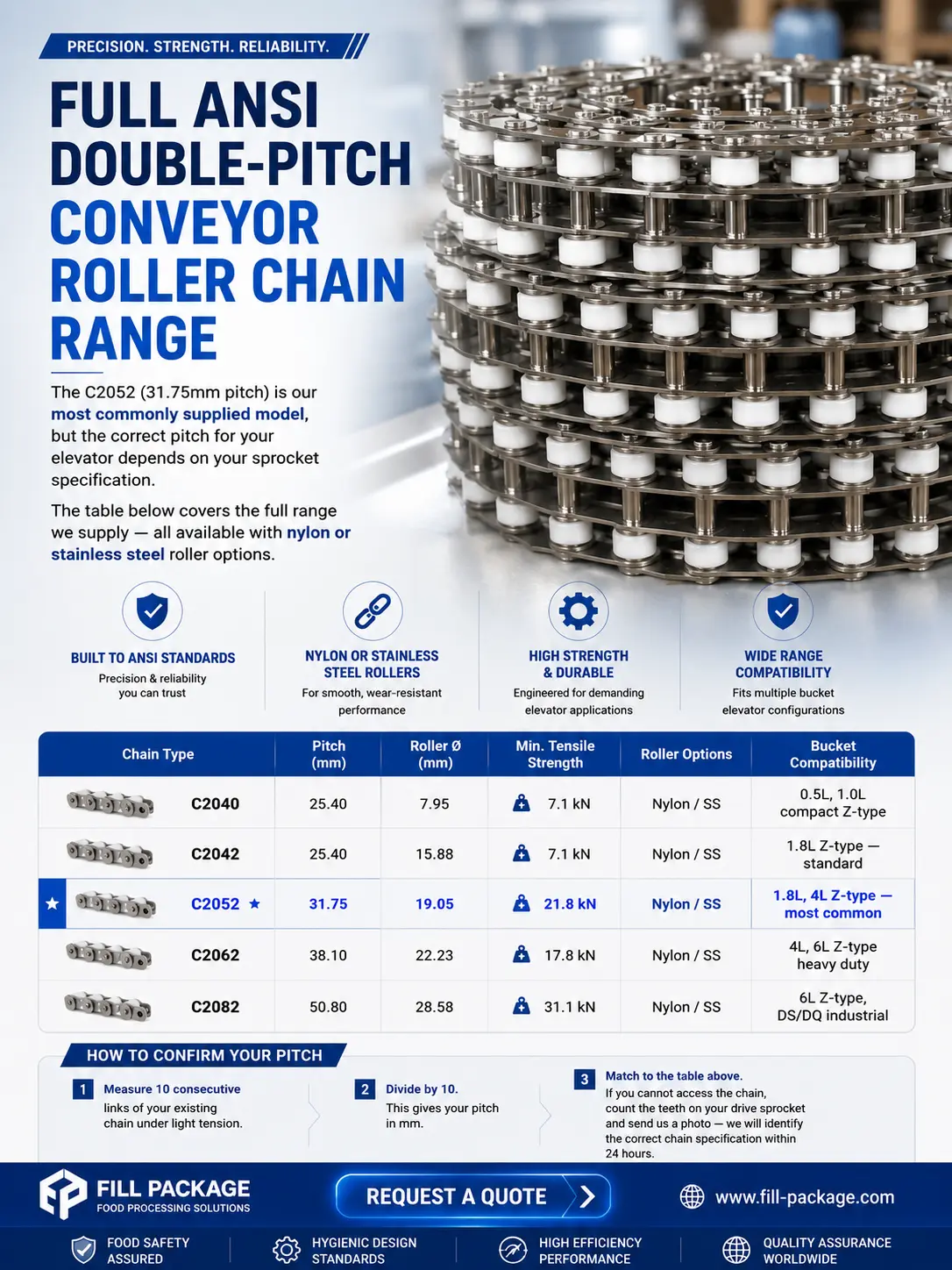
Full ANSI Double-Pitch Conveyor Roller Chain Range
The C2052 (31.75mm pitch) is our most commonly supplied model, but the correct pitch for your elevator depends on your sprocket specification. The table below covers the full range we supply — all available with nylon or stainless steel roller options.
| Tipo de corrente | Pitch (mm) | Roller Ø (mm) | Min. Tensile Strength | Roller Options | Bucket Compatibility |
| C2040 | 25.40 | 7.95 | 7.1 kN | Nylon / SS | 0.5L, 1.0L compact Z-type |
| C2042 | 25.40 | 15.88 | 7.1 kN | Nylon / SS | 1.8L Z-type — standard |
| C2052 ★ | 31.75 | 19.05 | 21.8 kN | Nylon / SS | 1.8L, 4L Z-type — most common |
| C2062 | 38.10 | 22.23 | 17.8 kN | Nylon / SS | 4L, 6L Z-type heavy duty |
| C2082 | 50.80 | 28.58 | 31.1 kN | Nylon / SS | 6L Z-type, DS/DQ industrial |
How to confirm your pitch: Measure 10 consecutive links of your existing chain under light tension. Divide by 10. This gives your pitch in mm. Match to the table above. If you cannot access the chain, count the teeth on your drive sprocket and send us a photo — we will identify the correct chain specification within 24 hours.
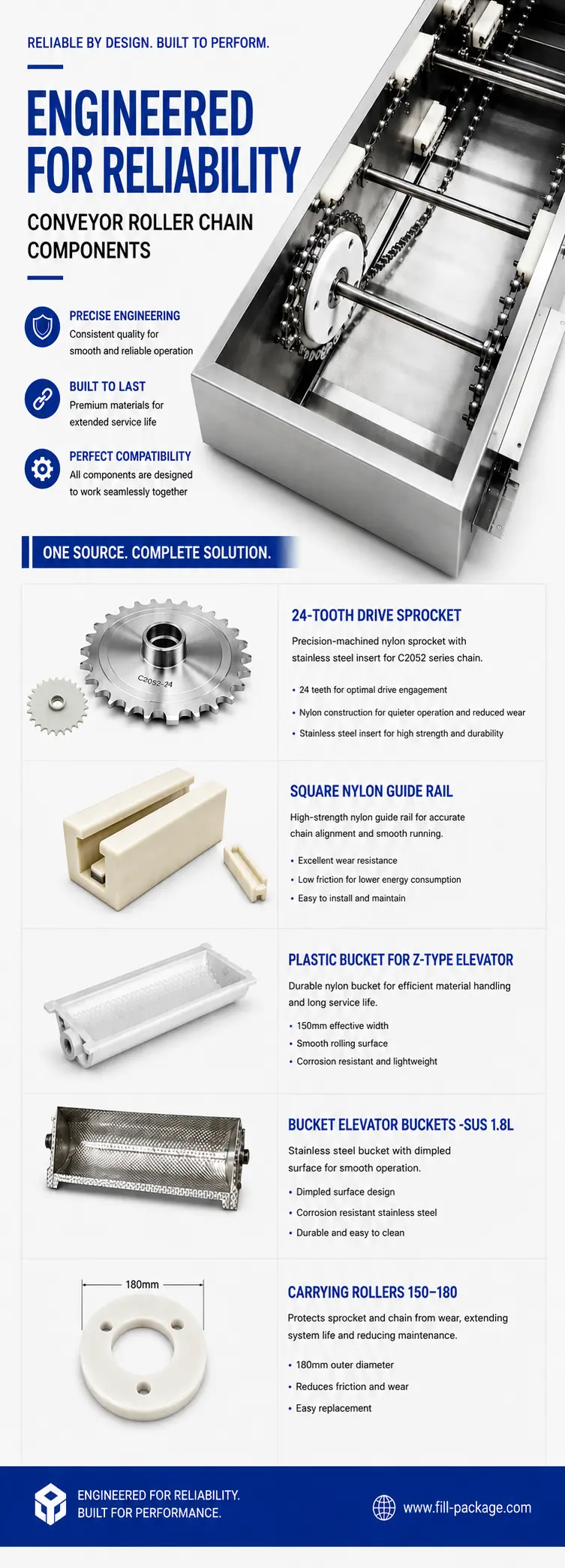
Complete Z-Type Elevator System: Matched Components
A conveyor roller chain is one part of a system. When any component wears, the others wear faster — a stretched chain accelerates sprocket tooth wear; worn sprocket teeth accelerate chain elongation. We supply the complete matched component set:
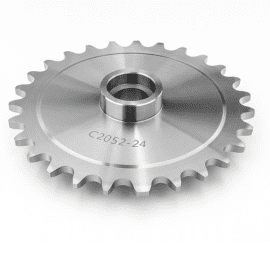
24-Tooth Nylon Drive Sprocket
- Material: food-grade nylon (PA) — quieter, self-lubricating, no corrosion
- Tooth count: 24 teeth standard — matches ANSI double-pitch chain at standard Z-elevator speed ratios
- Food grade: FDA-compliant nylon, compatible with food factory washdown environments
Full sprocket specifications: Conveyor Sprockets page
Square Nylon Guide Rail
- Material: wear-resistant nylon — low friction, self-lubricating, no corrosion
- Profile: square section, fits standard Z-type elevator casing track dimensions
- Function: maintains chain alignment on the return (non-carrying) side of the elevator loop
- Replacement indicator: visible groove deeper than 3mm; chain audibly scraping the rail
Carrying Rollers — 150mm and 180mm
| Size | Aplicativo | Replacement Indicator |
| 150mm diameter | Standard Z-type elevators — 1.8L and 4L bucket systems | Visible flat spot; roller does not spin freely by hand |
| 180mm diameter | Wide-frame Z-type elevators — 6L bucket systems, heavy-duty | Same — flat spot or seized bearing |
Replace rollers and chain together: A seized or flat-spotted carrying roller creates a localised high-friction point that the chain drags over on every cycle. If replacing the chain due to elongation, inspect all carrying rollers at the same time — replace any that do not spin freely.
Complete Rebuild Reference Table
| Componente | Qty (typical 1.8L Z-elevator) | Key Specification to Match |
| Chain C2052-PF1-D3F30 | Per elevator height in metres | Pitch 31.75mm; roller ø19.05mm; supplied in matched pairs |
| 24-tooth nylon sprocket | 2 (top drive + bottom tensioner) | Match chain pitch; bore to shaft diameter |
| Square nylon guide rail | Per elevator height — one continuous length | Match casing track width |
| Carrying roller 150mm | Height ÷ roller spacing (typically 300–400mm) | Confirm shaft bore diameter |
| 1.8L Z-type buckets | Height ÷ bucket spacing (typically 200–250mm) | Mounting width: 412 / 416 / 418 / 420mm |
Bucket specifications: Z-Type Elevator Buckets · Bowl-Type Elevator Buckets · DS & DQ Industrial Elevator Cups
How to Diagnose C2052 Chain Wear Before It Causes a Line Stop
Chain elongation is the primary failure mode for conveyor roller chains, caused by wear at the pin-bushing interface. At 2–3% elongation, the chain pitch no longer matches the sprocket tooth spacing, causing ‘tooth climbing’ that accelerates failure exponentially. Replace at 2–3% elongation — before tooth climbing begins.
Check 1 — The 21-Link Measurement (Factory Standard)
Our C2052 chain is factory-measured at 21 links with a 200N measuring load. Use the same method in the field:
| Elongation | 21-link measurement | Action Required |
| 0% — new chain | 666.75mm | — |
| 1% | 673.4mm | Note — monitor more frequently |
| 2% | 680.1mm | Plan replacement now — order chain |
| 3% — replace now | 686.8mm | Replace immediately — tooth climbing imminent |
Check 2 — Sprocket Tooth Profile (Shark-Fin Wear)
On a new sprocket, each tooth has a symmetrical profile. On a worn sprocket, the engagement side is eroded into a hooked ‘shark-fin’ shape. If shark-fin wear is visible on more than 3 consecutive teeth, replace the sprocket together with the chain. Running new chain on shark-fin sprockets causes rapid chain failure within weeks.
Check 3 — Side Plate Condition
Check side plates for lateral wear grooves (from guide rail contact) and fatigue cracks (from repeated sprocket bending). Cracking indicates misalignment or excessive tension — resolve the root cause before installing a replacement chain, or the new chain will fail in the same way.
Check 4 — Roller Rotation
With the elevator stopped, press each roller and check it spins freely. A seized roller converts rolling friction to sliding friction
— creating a wear hotspot that causes link plate failure within weeks of continued operation.
Aplicação de correntes de rolos
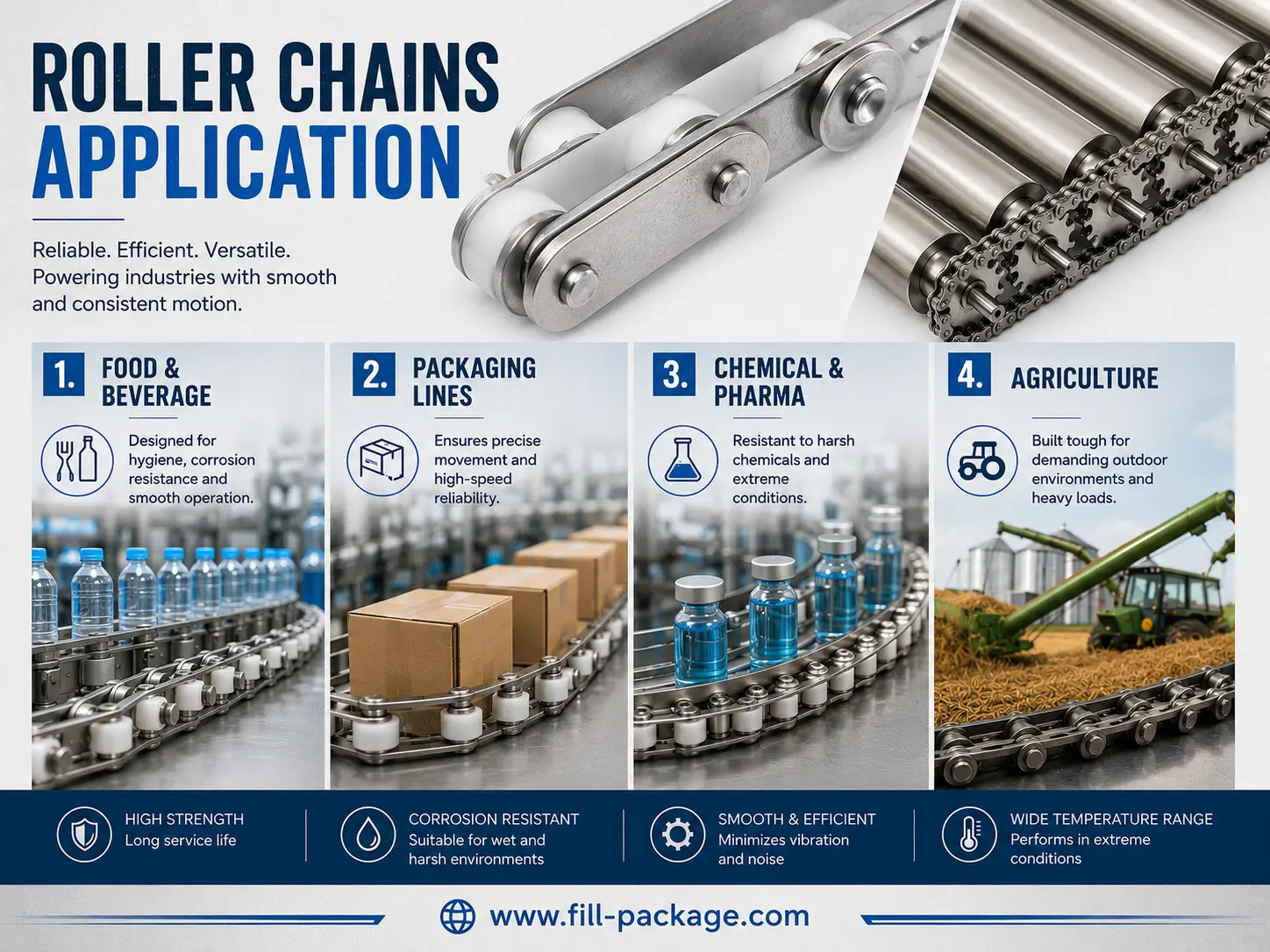
O corrente de rolos de passo duplo é uma escolha popular para sistemas de elevadores de canecas, transportadores verticais, e outros linhas de transporte industrial Onde alta carga, movimento suave e longa vida útil são essenciais. Abaixo, um guia prático sobre onde ele é usado e como mantê-lo adequadamente.
🏭 Alimentos e bebidasIdeal corrente de elevador de canecas de qualidade alimentar Para grãos, lanches, café, pós.
📦 Linhas de embalagemPara sistemas automatizados de manuseio de sacos e materiais.
⚗️ Produtos químicos e farmacêuticosTransporta com segurança pós, grânulos ou ingredientes.
🌾 AgriculturaEleva grãos, sementes ou ração animal em silos ou celeiros.
🛠 Outras aplicações de transportadores verticaisQualquer sistema que precise de um Corrente de elevador de canecas resistente à corrosão.

Manutenção Essencial – Mantenha sua Corrente Transportadora em Ótimas Condições
1. Mantenha a tensão correta da corrente
- Não muito apertadoCorrentes muito apertadas causam tensão nas rodas dentadas e nos rolamentos, levando a um desgaste mais rápido.
- Não muito folgadoCorrentes frouxas podem saltar das rodas dentadas ou descarrilar completamente — um problema comum em sistemas de transporte de alta carga.
- Dica profissionalA folga axial ideal é de 2–3% com base na distância entre os centros das rodas dentadas. Isso se aplica à maioria dos casos. correntes de rolos industriais e correntes de rolos transportadores parecido.
2. Garanta o alinhamento preciso durante a instalação.
- Mantenha as rodas dentadas alinhadas e niveladas para evitar tensão lateral.
- O desalinhamento causa desgaste lateral e deslocamento da corrente, reduzindo sua vida útil. corrente de rolos transportadora.
- Para distâncias entre centros mais curtas (<0,5 m), mantenha o desalinhamento abaixo de 1 mm; para vãos maiores, abaixo de 2 mm.
3. Monitore o desgaste e substitua de forma inteligente.
- Sempre substitua o corrente de rolos e rodas dentadas junto — Padrões de desgaste incompatíveis aceleram a degradação.
- Para correntes esticadas, remova links de número par para manter o comprimento e a integridade do arremesso.
- Usando rodas dentadas ajustáveisVire-as quando um lado se desgastar para prolongar a vida útil.
4. Lubrificação e limpeza regulares
- Lubrifique entre roletes de corrente e mangas internas para reduzir o atrito metal com metal — especialmente crucial para correntes transportadoras de aço inoxidável de alta velocidade.
- Para armazenamento a longo prazo, limpe com querosene ou diesel e, em seguida, aplique óleo ou graxa antiferrugem.
- Inspecione periodicamente o seu corrente do elevador de canecas Para poeira, detritos ou lubrificante ressecado — limpe e lubrifique novamente conforme necessário.
5. Não misture correntes novas com antigas.
- A combinação de correntes novas e antigas leva a uma distribuição desigual da carga — uma das principais causas de falhas prematuras em sistemas de corrente transportadora.
- Substitua sempre as rodas dentadas por correntes para manter o desgaste uniforme e o engate ideal.
C2052 Chain Maintenance: 5 Key Practices
- Tension — aim for 2–3% sag based on sprocket centre distance. Too tight: excessive pin-bushing wear. Too loose: chain jumps or derails under load. Check monthly and after any chain replacement.
- Sprocket alignment — misalignment causes lateral wear on chain side plates. For centre distances under 0.5m, keep misalignment under 1mm. For longer spans, under 2mm.
- Replace chain and sprockets together — new chain on worn sprockets causes rapid failure. Worn chain on new sprockets causes rapid sprocket wear. Replace both when either reaches end-of-life.
- Lubrication — apply food-grade NSF H1 lubricant between roller and bushing (not to outer roller surface). Every 500 operating hours as a starting point. Dry running is indicated by squeaking at the sprocket.
- Link removal for adjustment — remove even-numbered links to restore tension on a chain that has elongated but not yet reached 3%. Adjustable sprockets: flip when one side wears to extend service life before full replacement.
Produto relacionado
Request a Quote or Compatibility Confirmation
Know your chain model or pitch? Send us the specification (e.g., C2052, 31.75mm pitch), your roller preference (nylon or stainless), and required length in metres. We provide a quotation within 24 hours, including matched sprocket and carrying roller confirmation. Solicite um orçamento →
Need a complete matched set? Chain, sprockets, guide rail, rollers, and buckets — all confirmed compatible before shipment. Send us your elevator model or a photo of the existing chain and we specify the complete replacement set before any order is placed. Contact Our Technical Team →
Related Products & Reading
Bucket Elevator Parts Hub — complete range: Z-type buckets, DS/DQ cups, chains, sprockets, guide rails
Conveyor Sprockets — 24-Tooth Nylon Sprocket
Z-Type Elevator Buckets (1.8L, 4L, 6L)
Bowl-Type Elevator Buckets — for fragile and sticky products
DS & DQ Industrial Elevator Cups — grain and bulk material
Ultimate Guide to Bucket Elevator Components (Blog)
O C2052 apresenta rolos grandes e deve ser usado com rodas dentadas de dentes profundos Projetadas especificamente para este tipo de corrente. As engrenagens padrão não encaixam corretamente. Também oferecemos engrenagens perfeitamente compatíveis — consulte-nos para mais detalhes!
Certifique-se de que as correntes emparelhadas estejam alinhadas e tensionadas uniformemente. Recomendamos limpeza regular e aplicação de lubrificação adequada de acordo com o seu ambiente. Também podemos fornecer um serviço completo. especificação da corrente do elevador de canecas e guia de manutenção.
Sim! Além dos pacotes de corrente padrão de 3 metros, oferecemos correntes de comprimento personalizado e podemos adicionar recursos especiais, como pinos alongados ou acessórios personalizados. Entre em contato conosco com suas especificações.
Basta clicar no botão abaixo ou ligar diretamente para nossa equipe de vendas. Forneceremos um orçamento detalhado, suporte técnico e podemos enviar amostras de acordo com suas necessidades.
C2052 = ANSI double-pitch chain, 31.75mm pitch, 19.05mm roller. PF1 = extended pin attachment type for bucket mounting clips. D3F30 = attachment configuration — D3 refers to the attachment plate geometry, F30 to the extended pin length (30mm). This designation identifies the exact bucket attachment style and ensures the chain matches the bucket clip specification of your elevator.
A standard roller chain (drive chain) uses single-pitch spacing — one pitch between pin centres. A double-pitch conveyor roller chain uses twice that spacing, while keeping the same roller diameter and width. This gives lower chain speed at the same motor RPM and creates the gap between links where bucket mounting hardware attaches. For Z-type bucket elevator systems, double-pitch conveyor roller chain is always the correct specification.
No — not without changing the sprocket. C2042 (25.4mm pitch) and C2052 (31.75mm pitch) require different sprocket tooth geometry. Running C2052 chain on a C2042 sprocket, or vice versa, causes immediate tooth-climbing that will damage both chain and sprocket within minutes of operation. Always match the chain pitch to the sprocket exactly.
Yes — the chain dimensions are identical between nylon and stainless roller versions of the same model, so the chain itself is a direct dimensional replacement. However, also check the carrying rollers inside your elevator casing: if they are currently nylon and you are switching to a wet environment, they may also need to be upgraded to stainless steel. Contact us with your application details and we will confirm whether both chain and carrying rollers need to change.
In a food packaging Z-type elevator running two shifts per day with correct tension, proper lubrication, and aligned sprockets: 18–36 months before reaching the 3% elongation service limit. Key factors that shorten service life: running dry without lubrication, misaligned sprockets generating lateral plate wear, seized carrying rollers creating wear hotspots, and over-tensioning.
Technically yes, using connecting links. However, we recommend full replacement when the chain reaches 2–3% elongation. A splice of new links in a worn chain creates a pitch mismatch at the splice point — new links at nominal pitch, worn links elongated. This causes uneven sprocket engagement (chordal action) that accelerates wear on both the sprocket and the new links simultaneously. Full replacement is more cost-effective in the medium term.
Standard C2052-PF1-D3F30 (nylon or stainless roller): MOQ 5 metres for single replacement orders. OEM bulk supply: price breaks at 50m, 100m, and 500m. Private-label packaging available. Contact us for current OEM pricing
Yes. Provide your elevator height and we calculate the required chain length, adding the appropriate number of links for correct tensioning range. We supply the chain as a pre-cut continuous loop with connecting links included. For odd-link configurations, we include the necessary offset link.
Se você estiver operando em ambientes exigentes — de atmosferas corrosivas para elevadores de canecas para serviço pesado — essas etapas de manutenção podem prolongar significativamente o tempo de atividade do seu sistema e reduzir os ciclos de substituição.
💡 Deseja dicas de manutenção personalizadas para o seu corrente de rolos de passo duplo ou corrente de elevador em aço inoxidávelNossos engenheiros terão prazer em ajudar — entre em contato.