

Most exporters evaluate sachet filling machine price against purchase cost alone. The real calculation includes labour displacement, container damage, freight density, and the premium channel revenue your current machine cannot reach. Here is the complete model.
TL;DR
The true cost of running a standard sachet packing machine is not the purchase price — it is the inconsistent weights, the 3–5% container leakage rate, and the premium markets that round-corner sachet filling machines access and standard machines do not. For exporters shipping more than 5,000 sachets per day, upgrading to the BY-JLX160Z automatic Dhana Dal packing machine delivers full ROI within one to two container cycles through four compounding financial gains.
What is the real sachet packing machine price? The hidden cost calculation
When exporters search for sachet packing machine price, they are looking at the purchase invoice. But the actual cost of running a manual or standard sachet filling machine includes four categories that never appear on a supplier quote:
- Weight inconsistency: ±3–8 g per sachet
- 3–5 workers per shift minimum
- No 24/7 production capability
- 3–5% container leakage rate
- No premium channel eligibility
- High labour turnover cost
- Compliance failure risk
- Fill accuracy: ±0.5 g guaranteed
- Replaces 3–5 packers per shift
- 24/7 production capability
- 98% reduction in transport damage
- Qualifies for airline, hotel, retail
- Zero labour turnover variable
- Consistent compliance output
“We compared sachet packing machine prices from five suppliers. The BY-JLX160Z was not the cheapest. But when we calculated what our standard machine was costing us in leakage and labour, it was the lowest total cost of ownership by the third container”

BY-JLX160Z sachet filling machine: full performance specification
ROI begins with throughput. Here is what the BY-JLX160Z delivers in a standard production environment — and why these numbers change the cost model for mid-volume grain exporters:
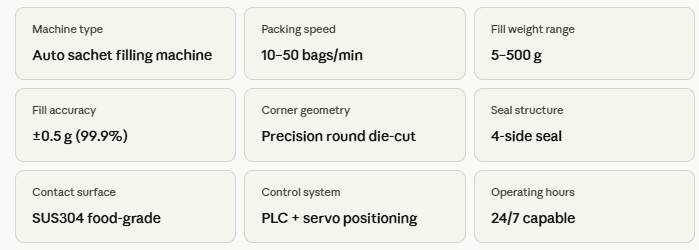
At 40 bags per minute across a single 8-hour shift, the BY-JLX160Z sachet packing machine produces 19,200 sachets — a volume that requires 4–5 manual packers at full capacity with significantly lower accuracy and a 3–5% leakage exposure on every unit produced.
Four compounding ROI factors from a round corner sachet filling machine
1. Labour displacement: the sachet packing machine price you stop paying every month
One BY-JLX160Z automatic sachet filling machine replaces 3–5 manual packers per shift. For a two-shift operation, that is up to 10 headcount reductions — a monthly labour saving that continues for the life of the machine. This is the component of sachet packing machine ROI that most buyers underestimate because they focus on purchase price rather than operating cost.
2. Container damage elimination: 3–5% of shipment value recovered per container
Standard sachet packing machines produce square-corner sachets that pierce adjacent bags under container load — the stab-point effect. At a typical $80,000 container value, 3% leakage means $2,400 in lost product per shipment, plus replacement shipping cost, plus buyer trust damage. A round-corner sachet filling machine eliminates this failure mode entirely, recovering that $2,400+ per container from the first shipment.
3. Premium channel access: 15–20% wholesale price premium
Round-corner sachet filling machines open channels — airline catering, hotel F&B supply, specialty retail — that standard sachet packing machines cannot access. Buyers in these channels pay 15–20% above commodity spot pricing for round-corner specification compliance. For a $50,000/month export volume, that premium represents $7,500–10,000 in additional monthly revenue — not from selling more, but from selling to better buyers.
4. Freight density saving: 5–8% more units per container
Round-corner pouches stack with less air gap, delivering 5–8% more sachets per carton and per container load. At scale, this freight efficiency saving compounds across every shipment without any change to product weight or film specification.
| ROI factor | Manual packing baseline | BY-JLX160Z outcome |
|---|---|---|
| Labour cost per shift | 4–5 packers | 1 operator |
| Container leakage rate | 3–5% of units | ~0% (98% reduction) |
| Cargo insurance claims | Frequent, 3–5% claims | Up to 80% reduction |
| Channel pricing | Commodity spot price | 15–20% premium |
| Freight efficiency | Baseline density | +5–8% units/container |
| Fill accuracy | ±3–8 g variance | ±0.5 g guaranteed |
| Typical payback period | 1–2 container cycles for mid-volume exporters | |
Real-world sachet packing machine ROI: two case studies
Case study 01
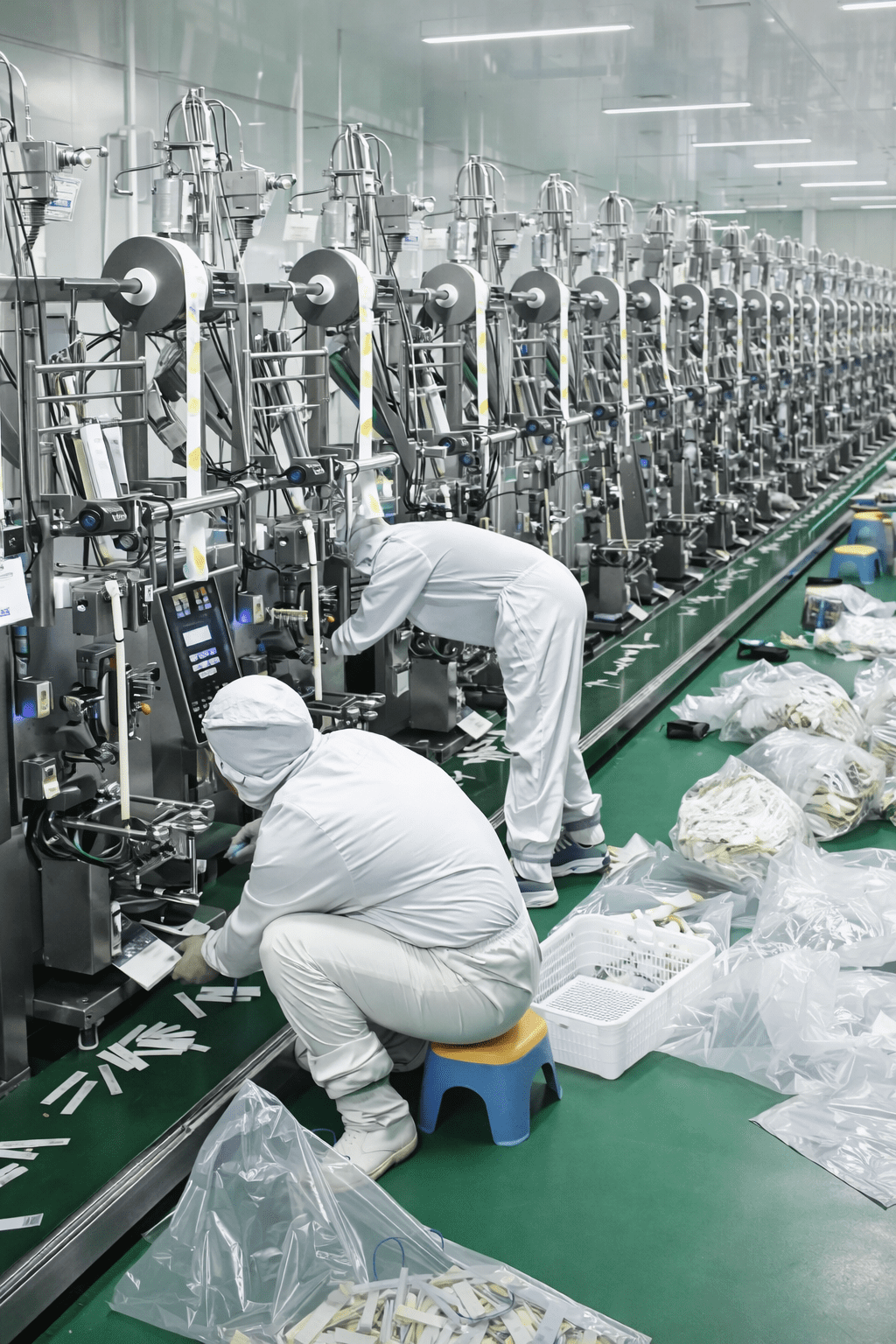
Tian Tian Le implemented automated sachet machines across their granule production line to address chronic weight inconsistency and labour turnover. Prior to automation, manual packing teams produced approximately 8,000 sachets per 10-hour shift with weight variance of ±4–6 g — creating both compliance risk and buyer trust issues in export markets.
Post-implementation, the same line produces over 20,000 sachets per 8-hour shift at ±0.5 g accuracy. Labour headcount on the packing floor reduced from 6 to 1 operator per line.
Case study 02
Guo He Tang required medical-grade sealing consistency for probiotic granule sachets destined for regulated export markets. Manual production created unacceptable dosage variance and seal integrity failure rates that triggered buyer audits and import holds.
Transitioning to the BY-JLX160Z PLC-controlled system achieved 99.9% dosage consistency and eliminated seal failures entirely. The round-corner output also resolved a recurring customs packaging standard non-compliance issue in their primary European export market.
Should you upgrade your sachet packing machine now? A decision checklist
Ready to calculate your actual sachet packing machine ROI?
Request a custom ROI calculation from a reliable sachet packing machine manufacturer — based on your granule type, daily volume, and target export market. Or explore the BY-JLX160Z product page directly.
FAQ
- What is the real sachet packing machine price when you include operating costs?The purchase invoice is only part of the cost. A standard sachet packing machine also costs you: 4–5 packers per shift in labour, 3–5% of container value in leakage losses, cargo insurance premiums, and the revenue difference between commodity pricing and premium channel pricing. For mid-volume exporters, these hidden costs typically exceed the machine purchase price within six months.
- How fast does the BY-JLX160Z sachet filling machine pay for itself?For exporters shipping more than 5,000 sachets per day, the combination of labour displacement, damage elimination, freight density savings, and premium channel pricing typically delivers full ROI within one to two container cycles — before accounting for ongoing monthly labour savings.
- Can one automatic sachet filling machine pack both Dhana Dal and coffee granules?Yes. The BY-JLX160Z quick-changeover design and broad fill range (5–500 g) support Dhana Dal, coffee granules, probiotic powder, nuts, spice blends, and vitamin granules on the same production line — eliminating the need for dedicated sachet packing machines per product.
- What makes the BY-JLX160Z a reliable sachet packing machine manufacturer choice?SUS304 food-grade contact surfaces as standard, precision die-cut round corner tooling (not manual cutting), PLC servo positioning with optical registration, documented ±0.5 g fill accuracy test reports, and proven production case studies in food and pharmaceutical export applications.
- How does a round corner sachet filling machine increase wholesale pricing?Round-corner sachet format qualifies products for airline, hotel, and specialty retail buyer programmes that specify packaging format as a supplier requirement. These channels pay 15–20% above commodity spot pricing — a structural revenue premium tied to the sachet packing machine’s output geometry, not the product formulation.
- What daily volume justifies upgrading my sachet packing machine?5,000 sachets per day is the practical threshold. Below this, manual packing may remain cost-competitive on total cost. Above this threshold, the four compounding ROI factors — labour, damage, freight, and premium channel pricing — generate positive return within two container cycles for most grain export operations.
- Does the BY-JLX160Z automatic sachet filling machine support 24/7 production?Yes. The BY-JLX160Z is built for continuous operation, unlike manual sachet packing operations which are limited to staff working hours. 24/7 production capability is the enabler of the volume threshold where the machine’s ROI compounds most rapidly.
Related reading