

Why the gap between your spiral freezer discharge and the portioning station is costing you more than you think — and how a small-footprint screw feeder multihead weigher closes it permanently.
The Bottleneck Nobody Measures
In a frozen meat or poultry processing facility, the spiral freezer is one of the largest capital investments on the floor — and, in many plants, also the point at which the production line stalls. Product exits the spiral tower frozen, consistent, and moving at the freezer’s discharge rate. What happens in the next ten metres determines whether that throughput is maintained or squandered.
In facilities without integrated portioning automation, the answer is usually: a manual breakdown station, three to five operators in 4°C conditions, breaking apart frozen-stuck pieces by hand and loading them onto a scale one portion at a time. The spiral freezer runs at its rated speed. The manual portioning station runs at human speed. The mismatch between the two creates the backlog that defines the line’s real throughput — not the freezer spec sheet.
This article covers the engineering of the gap between spiral freezing and automatic weighing: why frozen poultry and marinated meat products behave differently at the portioning stage, what the condensation adhesion problem actually is and how it causes traditional automation to fail, and how a small-footprint alimentador de parafuso e pesador multicabeçote closes the gap without requiring a floor-plan redesign.
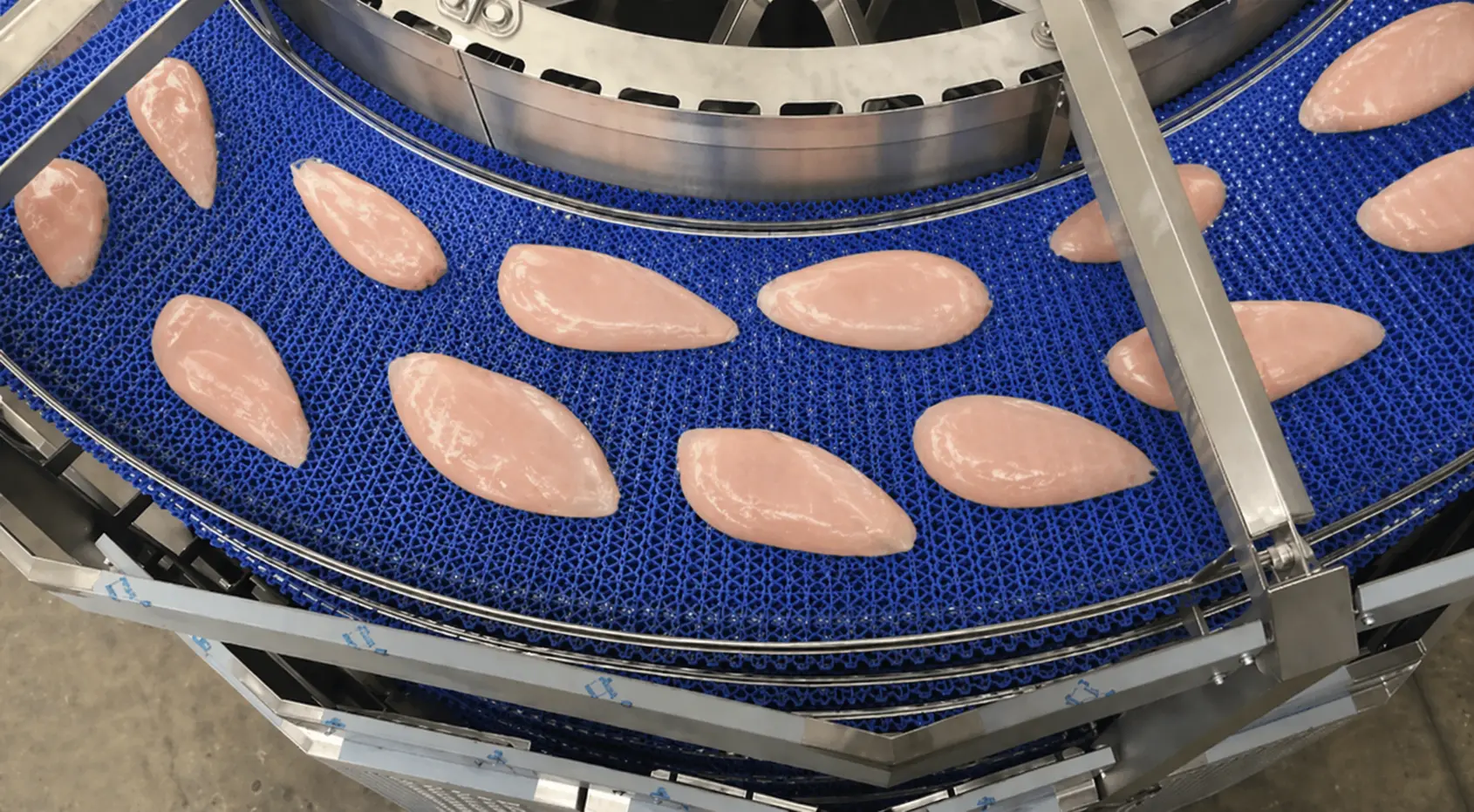
The Spiral Freezer Bottleneck: Why Portioning Is the Weak Link
What Happens at the Spiral Discharge Point
A spiral flat top chain freezer discharges product continuously at the chain’s linear speed — typically 5 to 25 metres per minute. For frozen chicken wings, a medium-capacity spiral freezer might discharge 800 to 1,200 kg per hour in a continuous stream.
The product at discharge is surface-frozen: the exterior of each piece is hard, the core may still be partially soft, and — critically — adjacent pieces on the chain are in contact with each other during the freezing process. The result is a product stream that is partially agglomerated: pieces lightly bonded by ice bridges at their contact points.
This is the first reason manual portioning stations are slow: operators must break the agglomerated product apart before it can be weighed. The breakage force required varies unpredictably piece-to-piece, and the work is ergonomically demanding in sub-10°C conditions.
The Condensation Adhesion Problem
When frozen product exits the spiral freezer at -18°C to -25°C and enters a 4°C processing room, its surface is significantly colder than the ambient air. Moisture condenses almost immediately — and on a frozen food surface, it freezes within seconds, creating a thin ice film on every piece.
Why This Breaks Vibratory Automation
Standard vibratory multihead weighers rely on vibration to move product across stainless steel chutes from infeed to weighing hoppers. In a cold-chain environment with condensation-iced product surfaces, vibration does not reliably move product — the ice film creates a friction coefficient that resists the vibratory force. Product stalls on the chutes, accumulates, and eventually bridges — requiring manual intervention that reintroduces exactly the labour cost the automation was supposed to eliminate. Increasing vibration amplitude does not solve this and damages fragile frozen product.
Screw Feeder Technology: Forced Displacement in Cold-Chain Conditions
The screw feeder multihead weigher replaces vibratory motion with positive, forced displacement: a rotating screw moves product from the hopper to the weighing hoppers by physically pushing it, regardless of the friction characteristics of the product surface. Ice-glazed chicken wings, frozen-bonded marinated meat pieces, and cold-sticky poultry parts all move reliably because the screw does not rely on gravity or vibration — it overcomes adhesion mechanically.
How the Screw Handles Spiral-Discharged Frozen Product
In an integrated layout, the discharge from the flat top chain feeds directly into the screw feeder hopper. The screw’s rotating action does two things simultaneously:
- It breaks the light ice bridges between adjacent pieces — the agglomeration that forms on the spiral chain — through the mechanical action of screw rotation, without the impact forces that damage frozen product surfaces
- It moves product positively into the weighing hoppers at a controlled, consistent rate — independent of product temperature, surface ice coating, or piece-to-piece friction variation
Poultry Parts Automatic Weighing: The Combination Algorithm
Once product is in the weighing hoppers, the multihead weigher’s combination algorithm selects the combination of hoppers whose combined weight is closest to the target portion weight. For a 500g frozen chicken wing portion, the system evaluates thousands of combinations per second across 10 or 14 weighing heads, achieving ±0.5% accuracy consistently.
Accuracy that manual portioning cannot match in cold conditions
Operators working in 4°C environments with cold product suffer from reduced manual dexterity and visual estimation accuracy over the course of a shift. The weigher’s accuracy is consistent from the first portion of the shift to the last — a difference that compounds into significant giveaway reduction over a full production week.
Frozen Chicken Wings in a 4°C Portioning Room: Full Line Flow
| Estágio | Equipamento | Cold-Chain Consideration |
|---|---|---|
| 1. Spiral discharge | Flat top chain conveyor exit | Product exits at -20°C; condensation begins immediately on surface |
| 2. Transfer conveyor | Stainless steel modular belt, sloped | Belt material selected for ice-release properties; slope angle prevents product accumulation |
| 3. Screw feeder infeed | Hopper with rotating screw | Screw breaks agglomerated pieces; anti-condensation heating on all electronics |
| 4. Weighing heads | 10–14 head screw feeder multihead weigher | IP67 sealed construction; heated internal enclosures prevent moisture ingress |
| 5. Portion discharge | Timed discharge chute to bagger | Portion drops directly into VFFS or premade pouch bagger below |
| 6. Sealing | VFFS or tray sealer | Jaw temperature adjusted for cold-temperature film sealing |
| 7. Date coding & metal detection | Inline on exit conveyor | Standard integration; no cold-chain modification required |
Marinated Meat: Same Logic, Different Surface Challenge
For marinated products — BBQ chicken chunks, teriyaki beef strips, Korean-style marinated pork — the adhesion mechanism is different but the solution is the same. Marinade viscosity increases at 4°C, making the product surface more adhesive than at room temperature. At sub-zero, the marinade partially freezes, creating a surface that is sticky, icy, and highly resistant to vibratory movement.
We cover the specific challenges of marinated meat packaging in detail in our guide to mastering wet and marinated food packaging (#12) — including how the scraper hopper design prevents marinade build-up inside the feeder system.
Ready-to-Eat Meal Assembly: Food Service Automation at the Portioning Stage
For food service automation applications — contract catering, airline catering, ready-to-eat meal assembly lines — the portioning stage is the highest-labour point in the production process. The screw feeder multihead weigher in this context is typically integrated with a multi-lane discharge that portions directly into multiple tray lanes simultaneously, maintaining the throughput required by a high-speed meal assembly line.
For an application-specific case study of this integration in a ready-meal and kimchi production environment, see our kimchi and ready-meal packaging automation guide (#43).
IP67 Screw Feeder Multihead Weigher: Cold-Chain Configuration
Not all screw feeder multihead weighers are built for cold-chain production environments. The standard industrial specification that works in an ambient snack packaging facility will fail within weeks in a 4°C meat processing room — because the electrical and electronic components are not designed for the condensation, humidity, and thermal cycling of a cold-chain environment.
Anti-Condensation System (防结露设计)
Internal resistance heaters maintain the temperature inside all electrical enclosures above the dew point of the room air, preventing condensation from forming on circuit boards, sensors, and load cell connectors. Without this system, condensation accumulates and causes intermittent electrical faults — the kind that disappear when the enclosure warms up during troubleshooting, making them extremely difficult to diagnose.
IP67 Waterproof Construction
All enclosures are sealed to IP67 — complete dust exclusion and protection against temporary immersion. This is the minimum for a machine that will be hosed down with high-pressure water and food-grade sanitiser at the end of every shift. IP65 (water jet resistance only) is insufficient for meat processing environments where puddles form during washdown.
Screw-Driven Forced Feeding
Forced displacement by screw rotation is the engineering principle that makes cold-chain portioning automation viable. The screw geometry — pitch, diameter, and rotational speed — is configured for the specific product: finer pitch for smaller pieces (chicken wings), coarser pitch for larger pieces (chicken breast fillets, diced beef).
5-Minute Tool-Free Disassembly
The screw, hopper, and all product-contact components are removable without tools for daily deep cleaning. In a meat processing environment with 2026 food safety audit standards, a cleaning procedure that requires a maintenance technician or more than 10 minutes is a procedure that gets shortened under production pressure — creating the hygiene risk that auditors look for. Tool-free quick-release clamps make compliant cleaning the path of least resistance.
Cold-Resistant Lubrication
Standard food-grade lubricants become viscous at 4°C and can freeze at sub-zero temperatures. Cold-chain-specified lubricants maintain consistent viscosity from -20°C to +40°C, covering the full operating range from frozen storage environments to washdown with hot water.
| Especificação | Standard Ambient Weigher | IP67 Cold-Chain Screw Feeder Weigher |
|---|---|---|
| Classificação de proteção | IP54–IP65 | IP67 minimum |
| Anti-condensation | Not included | Internal heating on all enclosures |
| Feeding mechanism | Vibratório | Screw forced displacement |
| Cold-chain lubrication | Standard food-grade | Cold-rated, -20°C to +40°C |
| Disassembly for cleaning | Tool-required, 20–40 min | Tool-free, <5 min |
| Operating temp range | 10°C – 40°C | -10°C – 40°C |
| Suitable for frozen products | ❌ Condensation ice causes stalling | ✅ Designed for this condition |
| Suitable for marinated meat | ❌ Chute adhesion | ✅ Screw clears adhesive product reliably |
Small Footprint Integration: Designing Around a Spiral Freezer
Spiral freezers are large. The floor area around and below the spiral tower is typically limited — and in a retrofit scenario, that limited floor area is exactly where the portioning and weighing system needs to fit.
The space-saving design principle is vertical stacking: the screw feeder weigher is positioned directly below the spiral discharge, with the VFFS bagger or tray loader positioned below the weigher’s discharge chute. The product moves downward through the system by gravity, with no horizontal conveyor runs between stages.
- The spiral discharge conveyor feeds directly into the weigher hopper from above — no intermediate floor-level conveyor between the freezer exit and the infeed
- The VFFS machine or tray sealer sits on the floor directly below the weigher — the portion drops through the discharge chute by gravity
- Total floor footprint of the weigher + bagger combination is typically 1.5m × 2.0m — fitting within the space of the manual portioning table it replaces
- Space-saving cooling conveyors between the spiral exit and the weigher infeed can be configured as a compact S-curve or right-angle transfer to match the specific spiral tower discharge geometry
Free Layout Drawing Service
Send us your facility floor plan — including the spiral freezer position, discharge height, and available footprint — and our engineering team will produce a layout drawing showing the weigher, conveyor, and bagger positions. This is provided before any purchase commitment, and it resolves the most common objection to automating the portioning stage: “I don’t have the space.”
The Gap That Is Costing You Every Shift
The gap between a spiral freezer and a manual portioning station is the most consistently underperforming section of a frozen meat or poultry packaging line. It is where the freezer’s capacity is capped by human throughput, where giveaway is highest because manual weight estimation is least accurate in cold conditions, and where labour cost is highest because the work is ergonomically demanding.
The integration of a space-saving cooling conveyor with a cold-chain-rated screw feeder multihead weigher closes this gap — mechanically, reliably, and in a footprint that fits within the spatial constraints of most existing spiral freezer installations. The IP67 anti-condensation construction, screw-driven forced feeding, and tool-free cleaning design address the specific failure modes that cause conventional weighing automation to underperform in cold-chain environments.
Don’t Let Your Spiral Freezer Become Your Production Bottleneck
Send us your facility floor plan and current portioning line configuration. Our engineers will design a cold-chain-integrated automatic meat weighing and bagging system layout — including conveyor routing, weigher position, and bagger integration — tailored to your available space.
Explore Our Meat & Poultry Packaging Equipment
Screw feeder weigher specifications, IP67 cold-chain configuration details, and integration options for spiral freezer discharge lines.