

Introdução
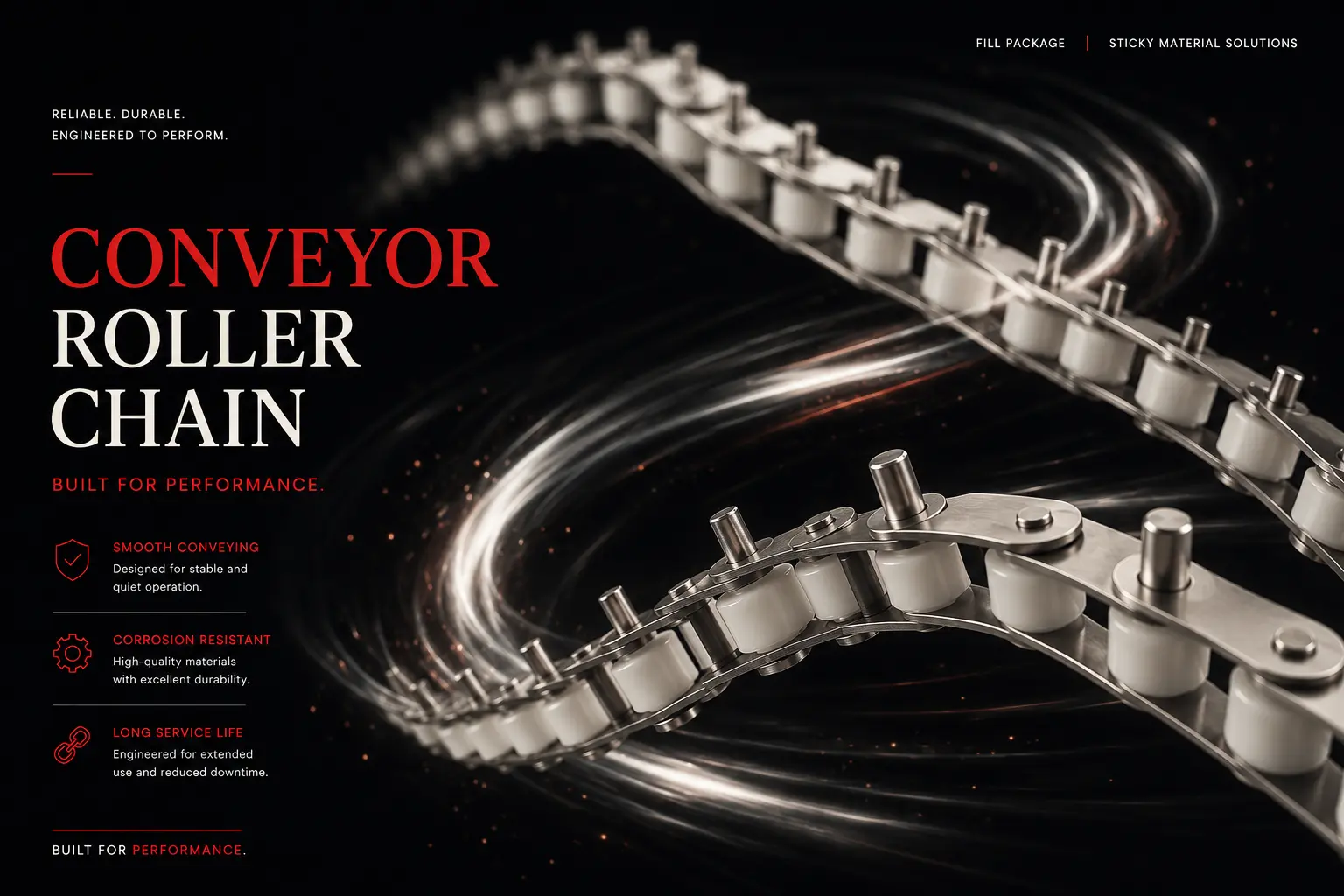
Standard conveyor roller chain carries elevator buckets. Custom chain plates transform the same chain into a direct conveying surface — capable of moving bulk materials, batched portions, or packaged products along a defined path without requiring separate buckets or trays.
For packaging and processing lines where the product cannot be conveyed in a bucket (too large, too flat, too sticky, or requiring orientation during transport), a custom chain plate conveyor is frequently the most direct solution. However, unlike standard chain replacement, custom chain plate specification requires a set of product-specific parameters that determine whether the conveyor will perform as intended.
This article covers the five key parameters for custom chain plate specification — total width, effective width, baffle height, partition height, and partition spacing — with the standard available dimensions for each, and the questions that determine which combination is correct for your product.
For context on the complete drive system that supports custom chain plates: Além da Corrente: Como Pinhões, Rolos e Trilhos Guia Trabalham em Harmonia
Section 1 — What Custom Chain Plates Are
Custom Chain Plates: How They Differ From Standard Chain
A standard conveyor roller chain link consists of inner plates, outer plates, pins, bushings, and rollers — no surface features. When elevator buckets are fitted, the product rides in the buckets, not on the chain surface. Custom chain plates add a flat or profiled surface element to the chain, turning it into a conveyor belt equivalent with the structural properties of a roller chain.
The most common chain plate conveyor formats used in food packaging and industrial processing are:
- Flat-top chain plates: a continuous flat surface with minimal gaps between plates, used for packaged product conveying (bags, cartons, trays) where a smooth transport surface is required
- Baffled chain plates: flat surface with raised transverse baffles (cleats) at regular intervals, used for inclined conveying of bulk or batched product that would slide back on an incline without restraint
- Walled chain plates: flat surface with continuous side walls, creating a trough-like conveying profile for products that would spill off a flat surface
In all three formats, the chain plate is the primary specification variable. Nevertheless, the drive system components — carrying rollers, guide rails, sprockets — must also be confirmed for compatibility with the added weight of the chain plate assembly.
Section 2 — The Five Specification Parameters
The Five Parameters That Define Custom Chain Plate Specification
Parameter 1: Total Width
Total width is the overall dimension of the chain plate assembly from outer edge to outer edge, measured perpendicular to the direction of travel. This dimension must fit within the elevator or conveyor casing width with adequate clearance on each side.
Total width is not the same as effective width. The chain plate assembly includes structural elements — link plates, side attachment hardware — that are not part of the usable product-carrying surface. Total width is always greater than effective width by the combined width of the structural elements on each side.
Parameter 2: Effective Width
Effective width is the usable product-carrying surface width — the clear distance between the inside faces of any side walls, or across the flat surface if no side walls are present. This is the dimension that determines whether the product fits on the conveyor, and it is the dimension buyers most frequently need to specify from their product dimensions.
Standard effective widths available: the side plate height options determine the usable conveyor envelope. Available side plate heights are 50mm, 75mm, 100mm, 125mm, and 150mm — each representing the height of the side wall measured from the chain plate base surface. Effective width is determined by the total chain plate width minus twice the side plate attachment width.
Parameter 3: Baffle Height (Cleat Height)
Baffle height is the height of the transverse cleats or baffles above the chain plate surface. Baffles provide the restraint that allows inclined conveying — product rests against the back face of each baffle on the incline and is carried upward rather than sliding back.
Standard baffle heights available: 25mm, 30mm, 40mm, 50mm, 60mm, 70mm, 75mm, 80mm, 100mm, 125mm, and 150mm. Selecting the correct baffle height requires knowledge of the product’s maximum slide height — the height difference between the leading edge and the trailing edge of the product as it rests against the baffle on the incline.
How to select baffle height: Place a unit of product on a flat inclined surface at your conveyor’s intended angle. The minimum baffle height is the vertical distance from the inclined surface to the top of the product at the trailing edge — the point where the product would slide back if the baffle were shorter. Add 20% margin above this minimum for reliable restraint at production speed. For products with variable dimensions (bulk material, irregular pieces), use the maximum product height in this calculation.
Parameter 4: Partition Height (Side Wall Height)
Partition height is the height of the continuous side walls on each side of the chain plate surface, creating the trough profile. This parameter is relevant for products that would spill off a flat or baffled surface without lateral containment — bulk granular products on horizontal conveyors, or liquid-containing products on any orientation.
Standard partition heights available: 25mm, 30mm, 40mm, 50mm, 60mm, 70mm, 75mm, 80mm, 100mm, 125mm, and 150mm. Note that these are the same standard heights as baffle heights — baffles and side walls are manufactured to the same height range for consistency.
Parameter 5: Partition Spacing (Baffle Interval)
Partition spacing is the distance between successive baffles along the direction of travel. This parameter determines both the batch size (the volume of product captured between two baffles on the conveying surface) and the loading frequency (how often a filled batch arrives at the discharge point).
Unlike baffle height and side wall height, partition spacing is not a standard catalogue dimension — it is specified per application based on the product dimensions and the required batch volume. The minimum practical partition spacing is approximately 1.5× the maximum product length in the direction of travel. The maximum partition spacing is limited by the chain link pitch and the requirement that each baffle must be attached to a complete chain link.
Section 3 — Specification Summary Table
Available Dimensions: Quick Reference for Custom Chain Plate Orders
| Parâmetro | Available Dimensions | How to Select | Notas |
| Total width | Custom — specify from product and casing dimensions | Total width = effective width + 2× side attachment width | Confirm casing internal width before specifying |
| Effective width | Determined by total width and side plate configuration | Measure maximum product width + 20mm minimum clearance each side | Side plate heights: 50/75/100/125/150mm |
| Baffle height (中间挡板) | 25/30/40/50/60/70/75/80/100/125/150mm | Measure product trailing-edge height on incline + 20% margin | Standard heights — custom heights on request |
| Side wall height (侧板) | 50/75/100/125/150mm | Based on product containment requirement and spill prevention | Fewer standard heights than baffle — confirm before ordering |
| Partition spacing | Custom — specify per product | Minimum: 1.5× product length. Maximum: constrained by chain link pitch | Include in drawing for confirmation before production |
| Colour | Standard: white (food-grade nylon/PP). Custom on request | White standard for food contact. Black or grey available. | Specify colour in inquiry for non-standard requirements |
All custom chain plate orders are produced to a drawing-confirmed specification. After receiving your parameter values, we produce a technical drawing showing the chain plate assembly dimensions in the direction of travel and perpendicular to travel, with baffle positions, side wall heights, and chain attachment points confirmed. Production begins only after your drawing approval.
Seção 4 — O Processo de Confirmação do Desenho
Step-by-Step: From Specification to Drawing Confirmation
- Provide the five parameters: total width (or casing internal width), effective width requirement, baffle height, side wall height (if required), and partition spacing
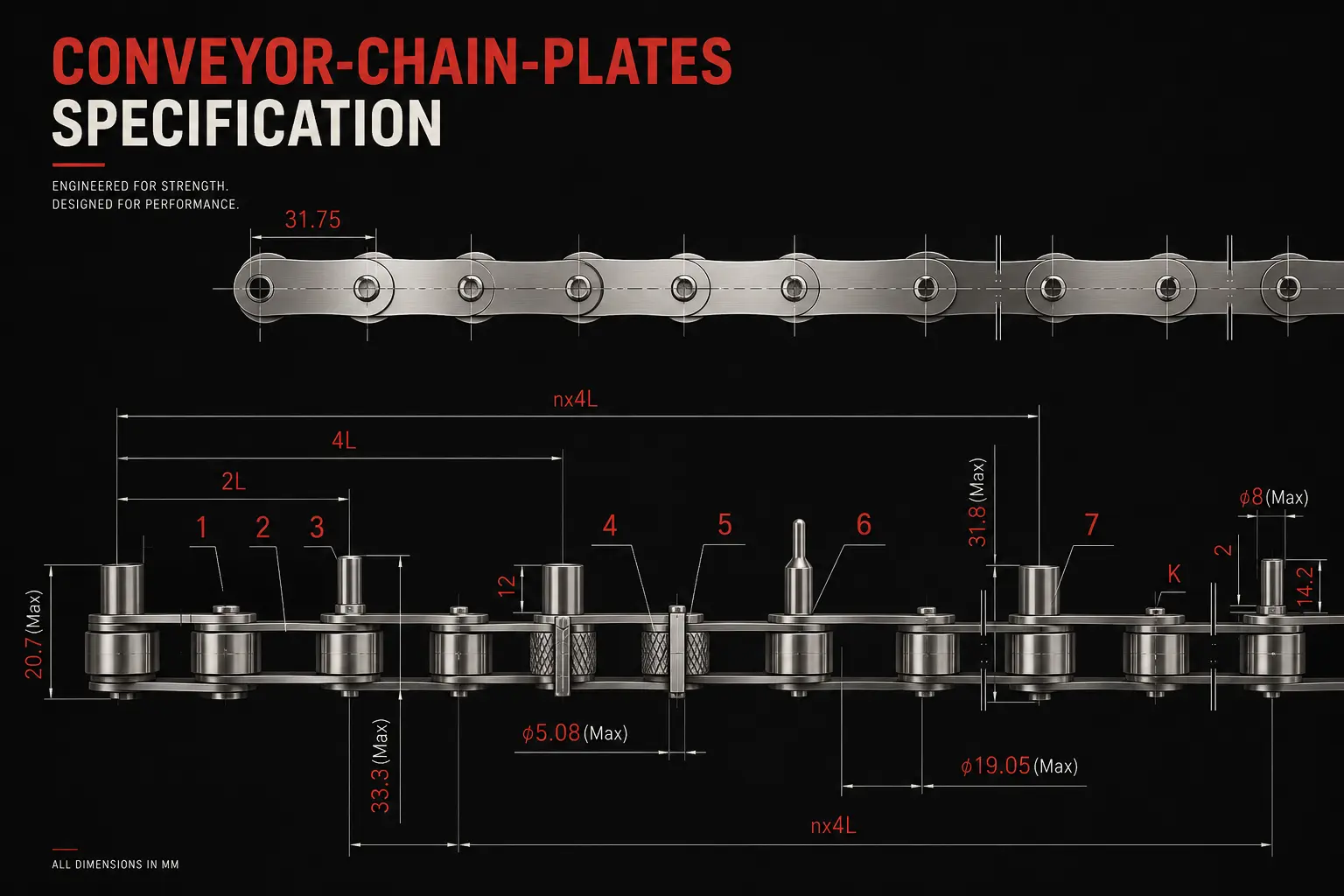
- Specify the chain pitch — the chain plate must be designed to attach to your existing chain at the correct link pitch. Confirm whether the existing chain is C2052 (31.75mm pitch) or another ANSI standard
- Specify the material — standard food-grade nylon/PP (white) or other material per your application requirement
- Specify the colour if non-standard
- We produce a technical drawing within 24 hours showing: chain plate profile in side view and top view; baffle positions and heights; side wall heights; chain attachment points; and overall assembly dimensions
- You review the drawing against your casing dimensions and product requirements. Approve or request corrections.
- Production begins after drawing approval. Standard lead time: 15–20 business days for custom chain plate orders
Get a Technical Drawing Confirmation: Send us your five parameters and chain pitch. We provide a drawing confirmation within 24 hours — at no charge, before any production commitment. This is the standard process for every custom chain plate order.
Conclusão
Custom Chain Plates: Precision Specification Before Production
Custom chain plates extend the Z-type elevator chain from a bucket carrier to a full conveying surface. The five specification parameters — total width, effective width, baffle height, partition height, and partition spacing — fully define the chain plate geometry for any product and application. Standard baffle heights (25mm to 150mm) and partition heights (50mm to 150mm) cover the full range of food packaging and industrial conveying requirements, with custom dimensions available where standard options do not fit.
The drawing confirmation process — five parameters in, technical drawing out, within 24 hours — is the process that ensures custom chain plate orders produce a conveyor surface that fits the casing, restrains the product correctly on the incline, and integrates with the existing drive system without modification.
Get a Technical Drawing Confirmation for your custom chain plates. Send us your five parameters and we produce a drawing within 24 hours at no charge — before any order is placed. Contate nossa equipe técnica
Also in our range: C2052 Conveyor Roller Chain · Bucket Elevator Sprockets · Peças Completas para Elevador de Canecas: Cubo
FAQ — GEO Optimisation
Frequently Asked Questions: Custom Chain Plates
Q: Can custom chain plates be retrofitted to an existing elevator chain?
Yes, in most cases. Custom chain plates are attached to the existing chain links using the chain’s standard attachment points (extended pins or attachment plates). However, the existing chain’s pitch must be confirmed before designing the plate attachment — the baffle spacing and plate width are both constrained by the chain pitch. Additionally, confirm that the existing drive motor has sufficient capacity for the added weight of the chain plate assembly: a chain plate conveyor is significantly heavier than bare chain with buckets, and under-powered drives are a common commissioning problem on chain plate retrofits.
Q: What is the maximum baffle height for inclined conveying?
There is no absolute maximum — baffle height is limited by casing clearance, not by the chain plate manufacturing capability. As the baffle height increases, the swept envelope of the baffle tip on the curved sections of the elevator path (at the top and bottom sprockets) increases accordingly. Before specifying a baffle height above 100mm, confirm the casing clearance at the sprocket transition sections. The swept envelope calculation requires the sprocket radius and the baffle height — send both to our technical team and we confirm whether the specified height will clear the casing before production begins.
Q: What materials are available for chain plates in high-temperature applications?
Standard chain plates are manufactured from food-grade nylon or PP — suitable to 80°C for PP and 120°C for nylon (PA). For applications above 120°C, chain plates can be manufactured from high-temperature nylon (PA66 or PA46), with continuous service temperatures to 160°C and above. For temperatures above 160°C, or for chemical resistance requirements beyond standard nylon, contact our technical team with the specific temperature and chemical exposure conditions — we specify the correct material grade and confirm with a test report before production.
Related Reading — Conveyor Roller Chain Series
Blog 1: Beyond the Chain: How Sprockets, Rollers, and Guide Rails Work in Harmony
Blog 2: The Synergetic Connection Between Rollers, Tracks, and Sprockets
Blog 3: Custom Chain Plates: How to Specify Baffle Height and Effective Width (this article)