

Jelly is one of the most commercially interesting products in the sachet category. It is shelf-stable and visually appealing. Children love it. Adult consumers are increasingly drawn to it in the form of functional gels and nutritional jellies. Additionally, it commands a strong retail price premium in shaped pouch formats that rectangular competitors simply cannot match.
However, jelly sachet packaging also presents specific technical challenges. You need to understand these challenges before you invest in a jelly packaging machine. This guide covers everything a manufacturer needs to know. It explains how to choose the right shape, which seal format works best, what realistic production speeds look like, and how to evaluate a machine before you commit.
Whether you are setting up a new jelly sachet line, expanding from rectangular to shaped pouches, or troubleshooting an existing line, this guide gives you the technical and commercial context to make good decisions.
Understanding jelly as a packaging material
Before discussing shapes and machines, it is important to be precise about what jelly actually is from a packaging engineering perspective. “Jelly” covers a wide range of product characteristics. These differences have significant implications for your filling equipment and seal performance choices.
Firm-set jelly
At one end of the spectrum is a firm, set jelly. Its gel structure is strong enough to hold its shape after filling. Think of a traditional fruit jelly cube that a consumer squeezes from the pouch as a recognisable piece. This product fills well because it does not flow after filling. It also exerts minimal pressure against the seal during the sealing process. As a result, the primary challenge is getting it cleanly into the pouch without breaking the gel structure.
Pour-able jelly
In the middle of the spectrum is a soft-set or pour-able jelly. It is semi-solid at room temperature but fluid when squeezed. This is the most common retail jelly sachet format. It fills by volumetric pump ou piston filler. It flows into the pouch shape and then sets or stabilises as it cools. The key challenge here is temperature management. Many pour-able jellies are filled warm — when they are more fluid — and set as they cool inside the sealed pouch.
Gel-consistency jelly
At the other end of the spectrum is a jelly gel. This type is common in functional nutrition and sports applications. It has a smooth, gel-like consistency similar to a sports nutrition gel or a probiotic gel sachet. Therefore, it behaves more like a paste than a traditional jelly. It requires careful nozzle specification and anti-drip management — similar to honey or thick sauce in a standard liquid sachet machine.
Knowing where your product sits on this spectrum is the first step in selecting the right jelly packaging machine configuration. The filling mechanism, nozzle specification, and temperature management requirements all differ across these three product types. → View the BY-JLS180G Jelly Packaging Machine
Choosing the right shape: the three-factor framework
Shape selection involves three considerations you need to balance: brand strategy, consumer usability, and production feasibility. All three matter equally. Optimising one at the expense of the others creates problems after launch — when they are expensive to fix.
Factor 1: Brand strategy — what does the shape communicate?
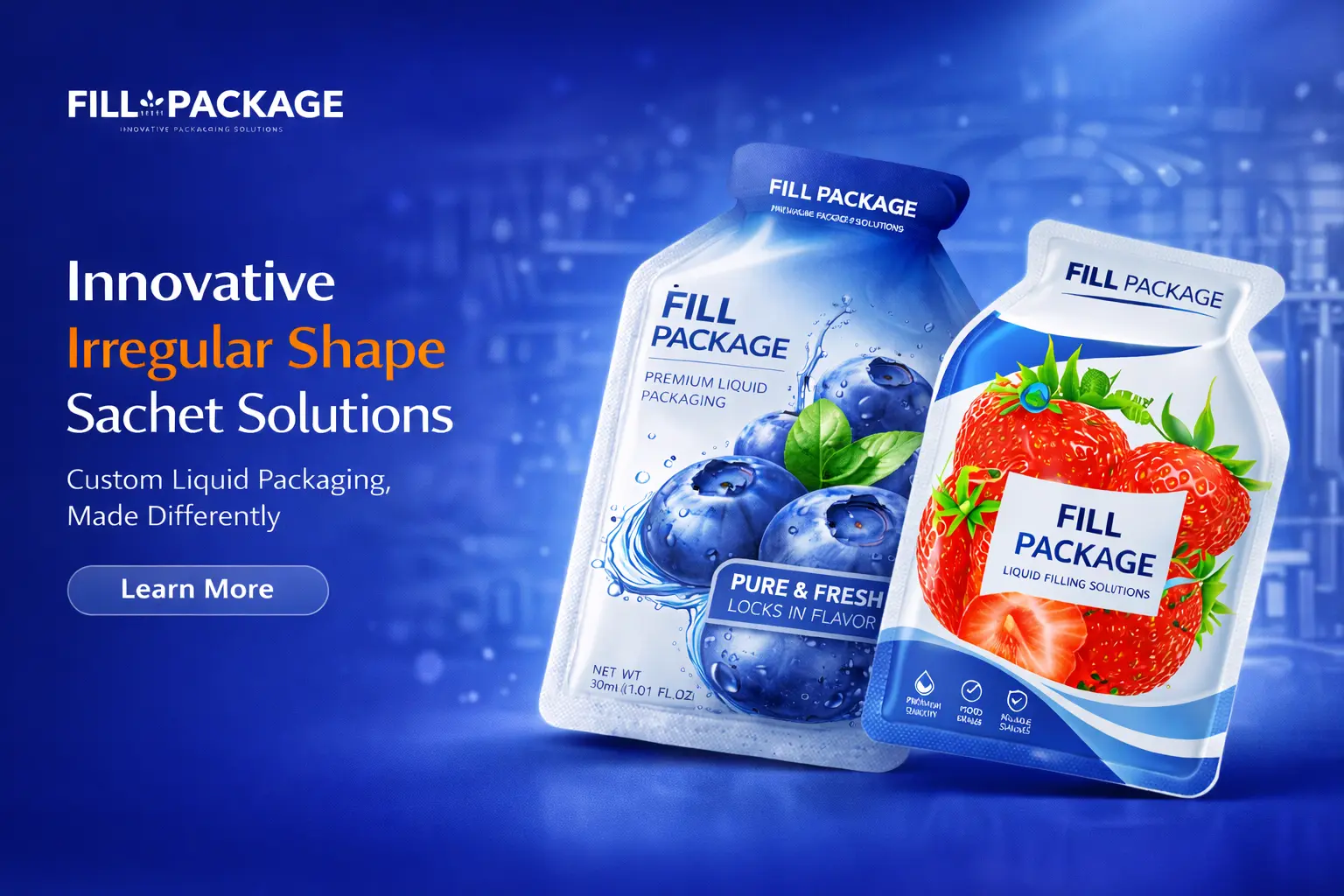
For children’s jelly products, shape communicates flavour and fun at the moment of first visual contact. A strawberry-shaped sachet tells the consumer it is strawberry-flavoured before they read the label. In a category where a child makes the purchase decision, this pre-verbal communication is extremely powerful. The same principle applies to mango shapes, grape shapes, and animal or character shapes for licensed products.
For adult health and functional gel products, shape communicates premium quality and intentional design. A rounded, organically curved pouch signals that the brand has invested in its presentation. This, in turn, signals confidence in the product inside. For example, a probiotic gel or a sports nutrition sachet in a shaped pouch commands a higher retail price than the same product in a generic rectangle.
For cosmetic gel samples — face masks, serum concentrates, hair treatments — shape extends the brand’s visual identity. A cosmetic brand with a signature curved bottle can mirror that design language in its sachet samples. As a result, the consumer experiences a consistent brand at every touchpoint.
Factor 2: Consumer usability — how will the sachet be opened?
The opening mechanism is the most critical usability factor in jelly sachet design. However, it is frequently neglected until consumer complaints arrive after launch.
A shaped jelly pouch that the target consumer cannot reliably open fails at its most basic function — regardless of how beautiful the shape is. For children’s products, the easy-tear notch must sit where small hands naturally grip the pouch. It should be sized for small fingers and angled so that tearing is intuitive without adult help.
For adult consumers eating on the go, the tear notch should sit at the top of the pouch. It should allow the contents to be squeezed out in one controlled motion without spillage. For cosmetic gel sachets, the notch should be sized for careful, drip-free opening over a small area.
All of these requirements can be designed into the die tooling at the specification stage. They cannot be added after tooling is manufactured. Therefore, usability must be part of the initial shape design brief — not an afterthought.
Factor 3: Production feasibility — what shapes work in practice?
Not every shape that looks great in a design file is equally feasible in production. Three technical constraints define the practical shape space for jelly sachet packaging.
Seal geometry at corners and curves. Very sharp corners or very tight curves — with a radius smaller than approximately 3–5 mm — create stress concentration points in the seal. Liquid jelly exerts pressure against the pouch walls. That pressure finds weak seal points first. Shapes with smoother curves and rounded corners seal more reliably through the supply chain. Sharp decorative details, therefore, should sit away from the primary seal lines wherever possible.
Fill volume to pouch volume ratio. A complex shape with many indentations has a lower usable internal volume per unit of film area than a simpler shape. For jelly, consumers expect the pouch to look visually full when they open it. A very complex shape may therefore require more film and more product per sachet than simpler alternatives. This affects both production economics and consumer experience.
Film behaviour around the shape perimeter. Some film laminates do not behave consistently around tight curves. The film can gather or wrinkle at curve points if the servo-driven film tension system does not compensate correctly. This is an engineering challenge for the machine and tooling supplier — not a fundamental shape limitation. However, it means that complex shapes require close collaboration between the designer, the tooling manufacturer, and the machine supplier during the trial phase.
Seal format comparison: which is right for your jelly product?
The seal format determines the shape possibilities, the structural integrity of the pouch under liquid pressure, and the visual character of the finished sachet. Here is a direct comparison of the three options.
| Seal Format | Machine Model | Melhor para | Fill Weight | Visual Character |
|---|---|---|---|---|
| 3-side seal | BY-JLS180G | Classic jelly snacks, fruit shapes, stand-up gel pouches | 5–50 g | Stand-up, full-body shaped profile |
| 4-side seal | BY-JLS160Y | Cosmetic samples, flat sauce portions, lay-flat gel | 1–50 g | Flat, wide-format, maximum rigidity |
| Side seal | BY-JLC160Y | Tall jelly tubes, upright drink concentrates, narrow gel | 1–40 g | Tall, narrow, upright silhouette |
Why three-side seal is the standard for jelly
O BY-JLS180G uses a three-side seal format. The machine seals the bottom and both sides. The top of the pouch forms during the bag-making process. This is the classic jelly sachet configuration and the most widely used format for retail jelly products globally.
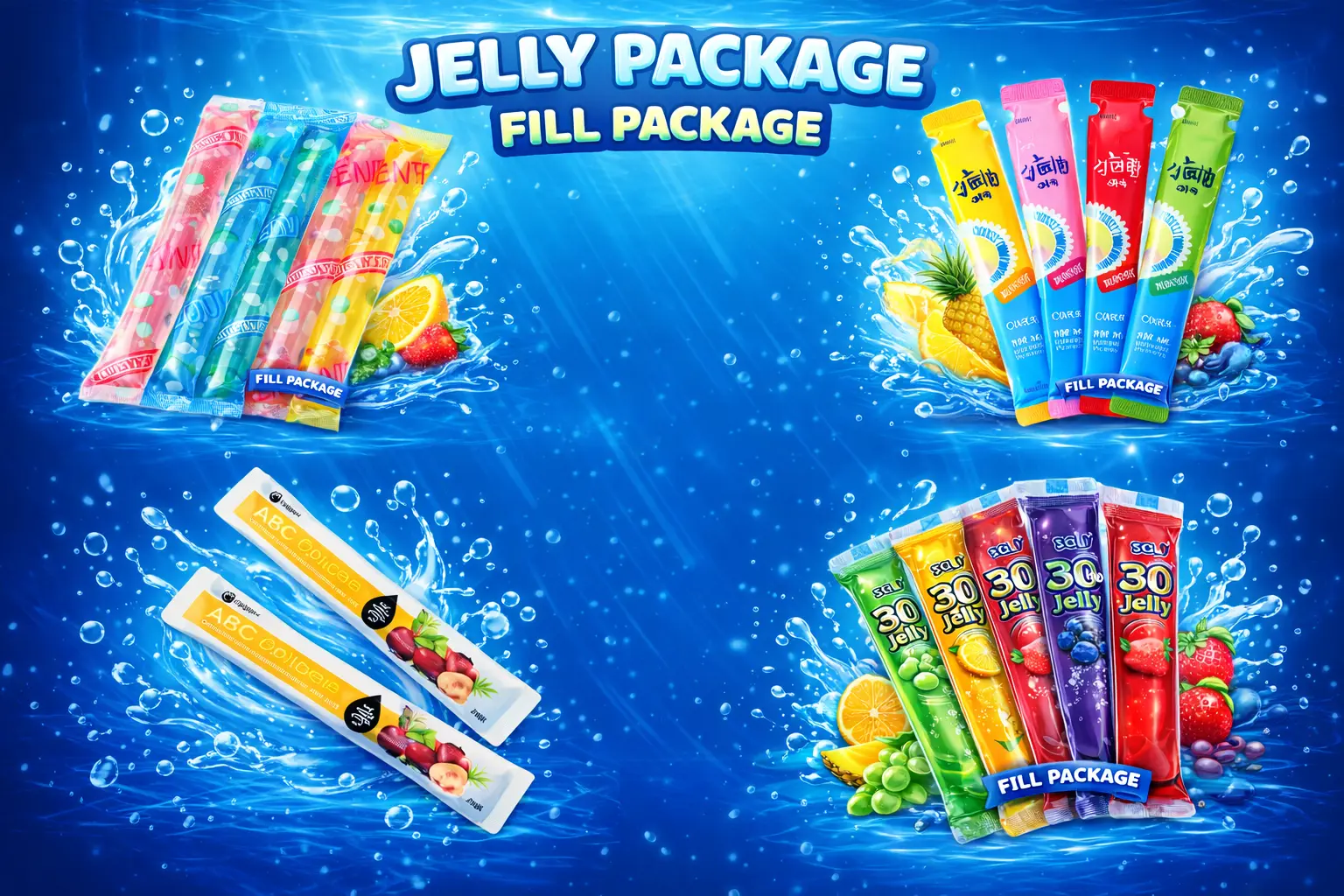
The three-side seal creates a stand-up pouch that presents well on shelf. It is stable when filled and sealed. It provides a natural top-tear opening that consumers find intuitive. The body of the pouch — between the two side seals — is where the shaped profile appears. This is the part the consumer sees and handles. This is where the die-cut shape creates visual differentiation.
When to consider alternative seal formats
For manufacturers who want a different seal format for gel products, two alternatives are available. The four-side seal — used on the BY-JLS160Y — produces a flat, pillow-format pouch that lies completely flat on a surface. This suits gel products designed to be opened and applied rather than squeezed and consumed.
In contrast, the side-seal format — used on the BY-JLC160Y — produces a tall, narrow upright pouch. This suits gel drink concentrates or elongated jelly tube formats.
However, for the classic jelly snack application — fruit shapes, animal shapes, premium rounded forms for adult health products — the three-side seal BY-JLS180G is the right machine.
Production speeds: what is realistic for your jelly product?
The rated speed of the BY-JLS180G is 10–50 bag/min. However, the realistic speed for your specific product depends on four factors. Understanding each one helps you plan production capacity accurately.
Speed factor 1: Product viscosity at fill temperature
Jelly filled warm fills faster than jelly filled near-set. Most commercial operations fill at a temperature that balances speed — favoured by higher temperature and lower viscosity — against setting behaviour in the pouch — favoured by lower temperature and faster set. The right fill temperature for your product is determined through a filling trial, not from a datasheet.
Speed factor 2: Fill weight per sachet
Smaller fill weights allow faster cycling. A 10 g jelly sachet fills faster than a 30 g one. There is less product to deliver, and the smaller volume enters the pouch more quickly. At the upper end of the fill weight range — approaching 50 g — production speeds at the lower end of the range (10–20 bag/min) are more realistic for most jelly viscosities.
Speed factor 3: Shape complexity
A complex shape requires the die mechanism to move through a more complex path than a simple rounded rectangle. Very complex shapes may therefore limit maximum production speed. This ensures clean die-cut quality at every sachet. Simple shapes run at the upper end of the speed range.
Speed factor 4: Product stabilisation time
Pour-able jellies fill warm and set by cooling. The filled sachet needs time to stabilise before it can tolerate handling without distortion. This stabilisation time affects effective throughput. It is a product-specific parameter that only a filling trial can determine accurately.
Realistic speed benchmarks by product type
| Tipo de produto | Fill Weight | Realistic Speed | Sachets per 8-hr Shift |
|---|---|---|---|
| Simple fruit-shape jelly, pour-able | 10–15 g | 25–35 bag/min | 12,000–16,800 |
| Nutritional gel, medium viscosity | 20–30 g | 18–25 bag/min | 8,640–12,000 |
| Thick paste or firm-set jelly | 30–50 g | 10–18 bag/min | 4,800–8,640 |
| Cosmetic gel sample, 4-side seal | 5–15 g | 20–30 bag/min | 9,600–14,400 |
These are planning benchmarks — not guaranteed outputs. Your actual throughput depends on your specific product and configuration. A filling trial with your actual product gives you the accurate figure before you commit to a production capacity plan.
Quality control: the three checks every jelly sachet line needs
Jelly sachet quality control has three specific requirements. These differ from standard liquid sachet QA. The combination of shaped pouch geometry and gel-consistency product creates unique challenges that straight-seal machines do not face.
QC Check 1: Seal integrity at shape curve points
The seal at the curves and corners of a shaped pouch is under more complex stress than a straight seal line. Therefore, quality control sampling must include testing at the curve and corner points — not just the straight sections.
The test is simple. Grip the seal at a curve point and pull sharply perpendicular to the seal line. The film should tear before the seal parts. If the seal parts cleanly at a curve point, adjust your seal dwell time e seal temperature specifically for that geometry.
QC Check 2: Fill weight consistency through the shift
Jelly viscosity changes with product temperature. Product temperature in the hopper changes through the shift. As a result, fill weight can drift if you do not monitor it actively. Weigh five consecutive sachets every 30 minutes and compare against your target. If fill weight drifts consistently in one direction as time passes, a temperature-controlled product pathway is the correct engineering response.
QC Check 3: Shape definition quality
A shaped jelly pouch that is under-filled loses its shape definition. The pouch profile collapses instead of maintaining the designed silhouette. An over-filled pouch, in contrast, risks seal stress and leakage. The target fill weight should produce a pouch that looks visually full and holds the shape profile clearly — without over-stressing the seals. Calibrate this during the initial production trial and verify it at the start of each production run.
How to evaluate a jelly packaging machine: five questions that matter
Before you commit to any jelly packaging machine purchase, get clear and specific answers to these five questions.
Question 1: Can the machine handle your product’s specific viscosity?
Ask specifically about the filling mechanism for your product type — fluid jelly, gel-consistency nutritional jelly, or firm-set jelly. The filling approach differs for each. A supplier who gives the same answer for all three product types has not engineered specifically for jelly.
Question 2: Can you run a shape trial with your actual product?
Request a trial with your specific shape concept and your actual product. → Request a free jelly sachet trial here. The trial should produce shaped sample pouches. It should also provide fill weight data and seal integrity assessment across the shape perimeter — including at curve and corner points. Do not accept a trial on a generic product or a different shape.
Question 3: How does the machine maintain fill weight consistency through a full shift?
Ask specifically about temperature management in the product pathway. For pour-able jellies filled warm, this is a critical production stability requirement — not an optional feature. A supplier who does not have a clear answer has not built the machine specifically for jelly production.
Question 4: Where is the easy-tear notch, and can you adjust its position?
For children’s products, the notch position is a usability requirement — not an aesthetic preference. Confirm that the notch can be positioned where your target consumer’s hands naturally grip the pouch. Additionally, confirm the notch geometry suits your consumer’s ability to open it without assistance.
Question 5: What is the realistic throughput for your product and fill weight?
Ask for throughput data from a trial with a comparable product and fill weight. Nameplate speed and real-world speed differ significantly for jelly products, depending on consistency and shape complexity. A supplier who only quotes nameplate speed without discussing your specific product is not giving you the information you need to plan production capacity.
Conclusão
Jelly sachet packaging is a commercially compelling category. It offers high visual appeal, strong retail demand, and meaningful price premiums for shaped formats. It also translates well across children’s snacks, adult health gels, and cosmetic applications.
However, getting it right requires clarity on three things before you invest. First, understand what your jelly’s viscosity characteristics mean for machine configuration. Second, identify which seal format and shape geometry deliver the right combination of aesthetics, usability, and production reliability. Third, know what realistic throughput looks like for your specific product — not a generic datasheet figure.
The right starting point for any jelly sachet packaging investment is a production trial with your actual product in your target shape. A properly conducted trial answers every important question — fill accuracy, seal quality at the shape curves, throughput rate, and consumer ease of opening — in a way that no specification sheet can match.
Request a Jelly Sachet Shape Trial →
View BY-JLS180G Jelly Packaging Machine Specifications →