

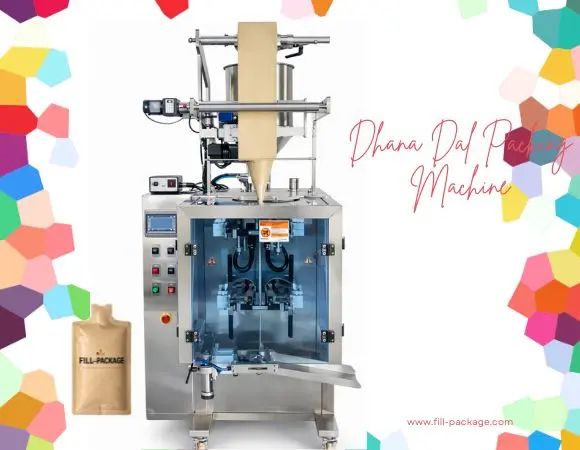
The Dhana Dal packing machine is not just about lentils. It represents the gold standard for any high-precision sachet filling machine handling granular food products — and the entry point into premium export markets most small exporters are missing.
TL;DR
While the Dhana Dal packing machine is highly sought after for specific lentils, it represents the gold standard for any high-precision sachet filling machine handling granular food products. If you are looking for the best sachet packing machine for premium grains, the technology used in automatic Dal packing machines offers the precise dosing and round corner aesthetics your brand needs to enter airline, hotel, and specialty retail channels
Why is your sachet filling machine causing leakage? The stab point problem
It is one of the most common questions grain exporters search for online: “Why is my sachet filling machine causing leakages during shipping?” ou “How do I fix pouch breakage in grain transit?”
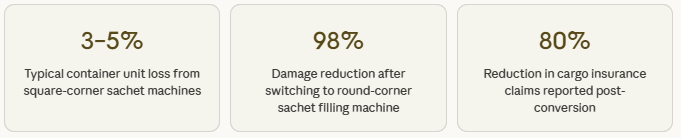
The answer is almost never the film quality or the seal strength. It is the corner geometry of the sachet itself. Standard square-corner sachet packing machines produce sharp corners that concentrate every gram of compressive shipping load at four needle-like points — piercing adjacent bags, contaminating product, and triggering buyer returns you never see coming.
“We were running a standard sachet packing machine at 30 bags per minute and losing 4% of every container to corner-pierce damage. The machine looked fine. The problem was the shape it was making.”
The hidden costs most exporters never measure
Standard sachet packing machine
- Square corners = 4 pressure points
- 3–5% container leakage rate
- Cargo insurance claims frequent
- Blocked from premium channels
- Weight variance ±3–8 g/sachet
- No airline / hotel eligibility
- Round corner = distributed force
- 98% reduction in transport damage
- Claims reduced up to 80%
- Airline, hotel, retail qualified
- Fill accuracy ±0.5 g guaranteed
- 15–20% wholesale price premium
Technical specs of a high-speed sachet filling and sealing machine
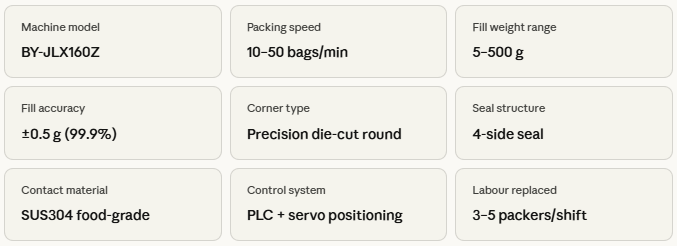
Understanding what separates a professional Dhana Dal packing machine from a generic sachet packing machine starts with the engineering. The BY-JLX160Z is purpose-built for small granule export applications — here is what that means technically:
Why your sachet packing machine needs round corner technology
Round corner technology is not a cosmetic upgrade to a standard sachet filling machine — it is a structural certification. In premium export markets from Dubai to London and Tokyo, packaging specifications from airline caterers, hotel chains, and specialty retailers explicitly require round-corner sachet formats. A standard square-corner sachet packing machine does not qualify — regardless of fill accuracy or seal strength.
The BY-JLX160Z achieves round corners through a precision die-cut mold, not a manual or guillotine cut. The arc radius is fixed and cannot drift mid-run, ensuring every sachet produced meets the same geometric specification at bag 1 and bag 100,000.
Standard sachet machine vs. professional Dhana Dal sachet filling machine: full comparison
| Especificações | Standard sachet packing machine | BY-JLX160Z (Dal sachet filling machine) |
|---|---|---|
| Corner geometry | Square — 4 pressure points | Round die-cut — force distributed |
| Fill accuracy | ±3–8 g (manual) | ±0.5 g (PLC servo) |
| Seal structure | 2-side or 3-side | 4-side seal — max burst resistance |
| Film tension control | Manual / drift-prone | Clamping system — zero slippage |
| Contact surface | Varies | SUS304 food-grade standard |
| Transport damage rate | 3–5% per container | ~0% after conversion |
| Premium channel eligibility | No | Airline, hotel, specialty retail |
| Wholesale price premium | Commodity spot | +15–20% in ME & EU markets |
Applications: beyond lentils
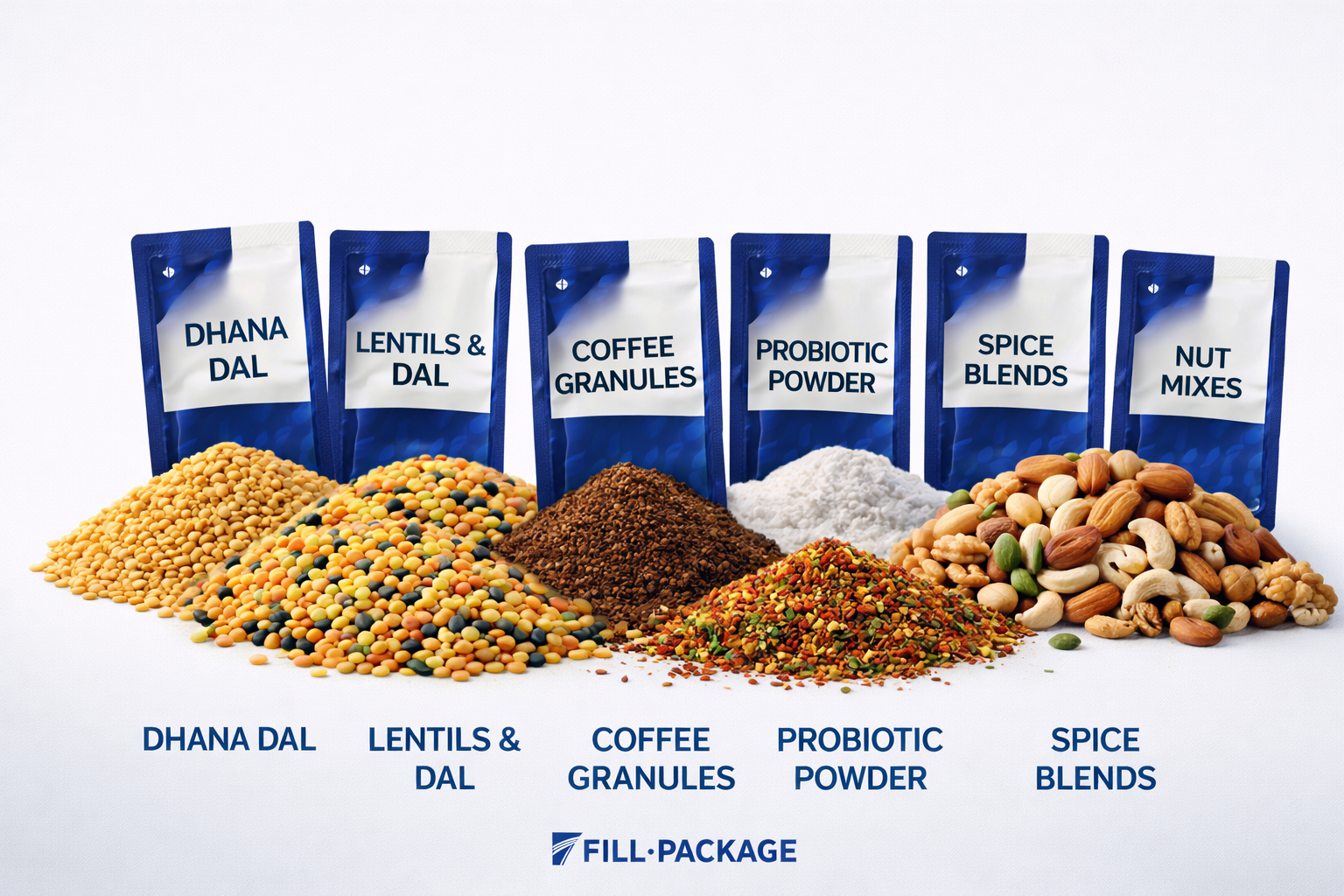
As a professional sachet filling machine, the BY-JLX160Z is optimized for Dhana Dal packing — but it represents the best automatic Dal packing solution for any free-flowing granule product destined for global markets:
ROI preview: how fast does a sachet packing machine pay for itself?
Here is a simplified calculation for an exporter packaging 5,000 sachets per day with the BY-JLX160Z versus a manual packing operation. This is a preview — see our full ROI analysis article for the complete model.
| Labour cost saved (4 packers → 1 operator) | +$2,400/mo |
| Container damage eliminated (3% × $80k shipment) | +$2,400/container |
| Freight density saving (5–8% more units/container) | +$1,200/container |
| Premium channel price uplift (15–20% on eligible orders) | +$3,000–6,000/mo |
| Typical full ROI payback period | 1–2 container cycles |
For a deeper breakdown including your specific material cost, daily volume, and target market premium, read our full BY-JLX160Z ROI Analysis →
Proven in production: case study endorsements
Choosing a reliable sachet packing machine manufacturer
When evaluating suppliers, a reliable sachet packing machine manufacturer should be able to confirm: SUS304 food-grade contact surfaces as standard, precision die-cut round corner tooling (not manual or guillotine), PLC servo positioning with optical registration, and documented fill accuracy test reports at your specific granule density. These are not premium features — they are baseline specifications for export-grade automatic Dal packing production.
Ready to upgrade your sachet filling machine?
Explore the BY-JLX160Z product page, request a custom ROI calculation, or contact us to match your granule type and daily volume with the right automatic Dal packing configuration.
FAQ
- Why is my sachet filling machine causing leakage during shipping?The most common cause is square-corner sachet geometry. Standard sachet packing machines produce sharp corners that concentrate compressive shipping load at four points, piercing adjacent bags. Switching to a round-corner sachet filling machine like the BY-JLX160Z eliminates this failure mode entirely.
- How do I fix pouch breakage in grain transit?The structural fix is round-corner sachet production combined with a 4-side seal structure. No film upgrade or seal strength adjustment resolves the stab-point problem — only changing the corner geometry of the sachet packing machine output does.
- What is a Dhana Dal packing machine and why does it matter for other grains?The Dhana Dal packing machine sets the precision standard for any sachet filling machine handling small granular food products. Its technology — ±0.5 g fill accuracy, round corner die-cut, 4-side seal — applies equally to coffee granules, probiotic powder, spice blends, and all dal/lentil varieties.
- How many sachets per day do I need to justify upgrading my sachet packing machine?5,000 sachets per day is the practical threshold. Above this, the combination of labour displacement, damage elimination, and premium channel access generates positive ROI within one to two container cycles for most export operations.
- What makes a reliable sachet packing machine manufacturer?SUS304 food-grade contact surfaces, precision die-cut round corner tooling, PLC servo positioning with optical registration, and documented fill accuracy reports at your specific granule density. These are baseline export-grade specifications, not premium options.
- Can one sachet filling machine handle both Dhana Dal and coffee granules?Yes. The BY-JLX160Z’s quick-changeover design and broad fill range (5–500 g) support switching between Dhana Dal, coffee granules, probiotics, nuts, and spice blends on the same production line.
- What wholesale price premium does round-corner sachet packaging command?In Middle East and European markets, round-corner sachet products typically command 15–20% above standard square-corner commodity pricing — a structural pricing advantage tied entirely to packaging format eligibility in premium channels.
Related reading
Pingback: vidalista 100 mg
Pingback: cenforce 200 mg reviews
Pingback: semaglutide california reddit
Pingback: ozempic costco tijuana
Pingback: doxycycline monohydrate 100mg and alcohol
Pingback: metronidazole face cream and alcohol
Pingback: vardenafil starting dose
Pingback: duration of vardenafil effects
Pingback: secure online health purchases
Pingback: Sildenafil vs Cialis Duration Analysis
Pingback: Brand vs Generic PK Variability