

In industrial packaging, choosing a conveyor belt based solely on price is a common trap. For an engineer or production manager, the real cost isn’t just the purchase price—it’s the total cost of ownership, including downtime, product loss, and maintenance.
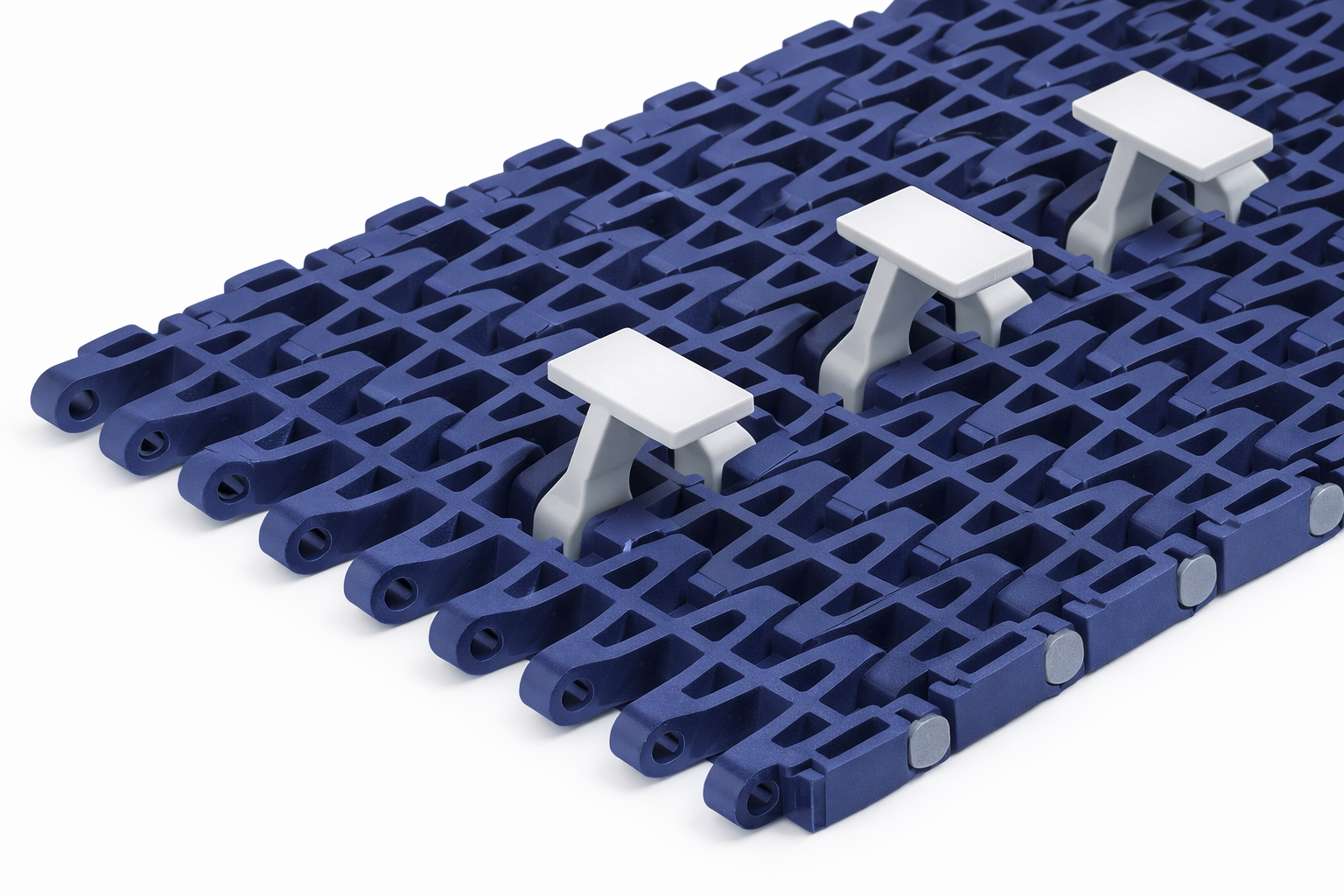
UM standard pitch modular belt (typically the 1-inch series) is often the most reliable choice, but how do you ensure it fits your specific packaging environment? This guide breaks down the engineering criteria you need to consider.
1. Product Size and Weight Considerations
The first rule of belt selection: The belt must support the product’s footprint.
Support Surface: While standard 1-inch pitch belts are robust, you must choose between a Topo plano (solid surface for stability) or a Grade nivelada (open surface for airflow or drainage).
Weight Distribution: Standard pitch belts are engineered for medium to heavy-duty loads. If you are conveying secondary packaging (like cardboard cases or bundled bottles), the 1-inch series provides the necessary tensile strength to prevent belt stretching under load.
Engineering Tip: For items smaller than $50$ mm, check the “collapse” risk at transfer points. If the product is too small, you may need a small-pitch alternative. For everything else, the standard 1-inch is your most cost-effective workhorse.
2. Line Speed and Conveying Stability
In high-speed packaging lines, stability is everything. When evaluating how to choose a standard pitch modular belt, consider these two factors:
Sprocket Engagement: Standard pitch belts utilize larger sprockets, which provide more teeth engagement. This ensures positive drive and prevents “belt slip,” which is critical for synchronized packaging machinery (like fill-and-seal lines).
Vibration Control: Although larger than fine-pitch belts, a well-engineered 1-inch belt minimizes “chordal action” (the pulsing effect) enough to keep cases and large containers stable even at speeds of $40$–$60$ meters per minute.
3. Why Standard Pitch Works for General Conveying
Why is the 1-inch pitch considered the “Goldilocks” of the industry?
Versatilidade: It is compatible with a massive range of accessories, including cleats (for inclines), side guards (to prevent spills), and friction tops.
Integridade Estrutural: The hinge design of a standard belt is thick enough to resist impact from falling products, making it far more durable than thinner, specialized belts in rugged packaging environments.
4. Cost and Maintenance Advantages
From a procurement and maintenance perspective, the standard pitch series is hard to beat:
Simplified Inventory: Since 1-inch belts are the industry standard, replacement modules and pins are readily available. You don’t need to wait weeks for custom-engineered parts.
Easy Washdown: The hinge architecture of standard belts is typically designed for easy cleaning, reducing the risk of bacterial buildup in food-grade packaging lines.
Investimento inicial reduzido: Compared to specialized high-precision belts, the standard series offers the highest performance-per-dollar ratio for $90\%$ of general conveying tasks.
5. Conclusion: Choosing the Right Partner
Selecionar o certo standard pitch modular belt is about balancing technical specs with long-term reliability. At Fill Package ,we don’t just sell belts; we provide the engineering data to ensure your packaging line runs at peak OEE (Overall Equipment Effectiveness).
Ready to specify the belt for your next project? Our 1-Inch Series is available in Acetal, Polypropylene, and Polyethylene to match your temperature and chemical requirements.
👉 [Download Technical Specifications & Shop the 1-Inch Series]
Related Blog :Standard Pitch vs. Small Pitch Modular Belt: Which One Do You Really Need?