

Introduction: The Forgotten Corner with “Veto Power”
In highly automated packaging workshops, business owners and engineers focus their eyes on the stars: high-speed Flow Wrappers, precise VFFS baggers, and flexible Robotic Palletizers.
Yet, right next to these expensive main lines lies a corner that is often forgotten—the End of the Packaging Line.
A universally ignored truth is that, very often, the limit to your overall capacity is not the speed of the packaging machine itself, but the chaotic, slow “Last Mile” at the discharge point. Today, we analyze this critical efficiency bottleneck and introduce a simple yet crucial solution: the Mesa de embalagem rotativa.
1. Why is the “Last Mile” Always Ignored?
When planning and optimizing production lines, our thinking pattern is usually linear: Feeding → Weighing → Packaging → Sealing → Output.
When line speed doesn’t meet expectations, the first reaction is usually to upgrade the front-end packaging machine. This is like the “Wooden Bucket Theory”: we keep adding height to the longest plank (machine speed) while ignoring the shortest plank—Discharge, Organization, and Batching—which actually determines the bucket’s capacity.
The “Last Mile” is ignored for three reasons:
Cognitive Bias: “Output equals Completion.” Subconsciously, we think that once the product leaves the machine, the task is done.
The “Low-Tech” Label: Unlike standardized packaging machines, the post-discharge sorting, boxing, and labeling are often manual and seen as “low-tech” processes not worth investing in.
Hidden Costs: The efficiency loss here is invisible. It shows up as product backlog, exhausted staff, and occasional machine micro-stops, rather than direct cost figures on a spreadsheet.
2. The Real Bottleneck: Not Machine Speed, But Lack of Buffering
Imagine a scenario: A high-speed Flow Wrapper is stably outputting 120 bags per minute.
However, the downstream scene is chaotic:
A worker guards the discharge chute, frantically grabbing products to put into a box.
When a box is full, they need to turn around, seal it, move it, and grab an empty box. This process might take 15-30 seconds.
During this time, the packaging machine must either slow down, or the products pile up on the narrow chute, falling over or getting damaged.
The Root Cause: UM “Rigid Connection” with no buffer. There is no smooth “flow regulator” between the high-speed, continuous machine and the low-speed, intermittent human operation. This leads to three major evils:
Wasted Efficiency: Expensive machines are forced to stop and start, with actual utilization dropping below 70%.
Quality Risk: Piling and collision lead to broken packaging and deformed products.
Labor Intensity: Workers are “pinned” to the discharge port, performing high-intensity, repetitive grabbing, leading to fatigue and errors.
3. The Solution: Building a Critical Buffer Zone
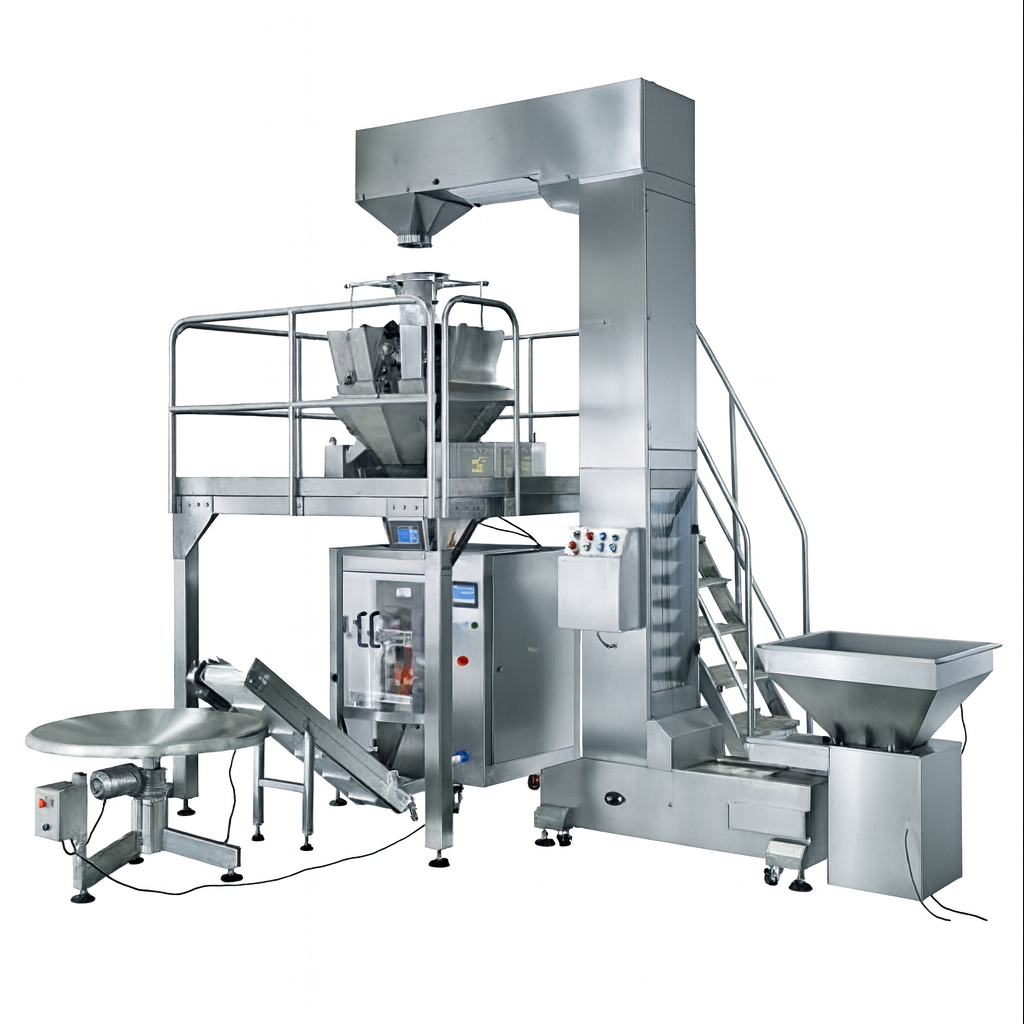
The core value of the Mesa de embalagem rotativa is breaking this “Rigid Connection.” It acts as a mechanical, low-cost Smart Buffer that seamlessly connects automated packaging with manual downstream processes.
How does it become the “Efficiency Savior”?
A. Creating Physical Buffer Space
The table typically offers a large surface area. Products coming out of the packaging machine are evenly distributed across the table. When a worker is busy moving a full box, the table continues to receive products on other sections. The packaging machine can run at full speed without interruption.
B. Decoupling Human and Machine Rhythms
Workers no longer need to “chase” the machine.
The table rotates slowly, bringing full sections to the operator and returning empty space to the inlet.
Human rhythm and machine rhythm are decoupled. Humans work at a stable, ergonomic pace, while machines work at maximum continuous speed.
C. Improving Quality and Flexibility
The table provides a spacious, organized surface. This allows workers to inspect products more carefully and stack them neatly, significantly reducing missing or wrong items. It naturally acts as a “batching station,” perfect for flexible production modes with multiple varieties and small batches.
Conclusion: Rethink Your Line Design
The goal of investing in an automated line is not just to make the “machine run fast,” but to make the “whole line flow smoothly.” True efficiency is determined by the weakest link.
Before you consider upgrading your high-speed packaging machine again, take a moment to observe the end of your line:
Is the product flowing smoothly and in an organized way?
Is your expensive machine “waiting” for humans?
Are your workers in a state of tension and chaos?
If the answer is yes, then investing in a Mesa de embalagem rotativa will yield returns far beyond your expectations. It unlocks the true potential of your packaging machine and is the key to improving overall OEE.
Optimize the end, and you unleash the power of the whole line. Start by valuing that ignored “Last Mile.”
Ready to eliminate the bottleneck? Don’t let the last meter determine your factory’s speed.