

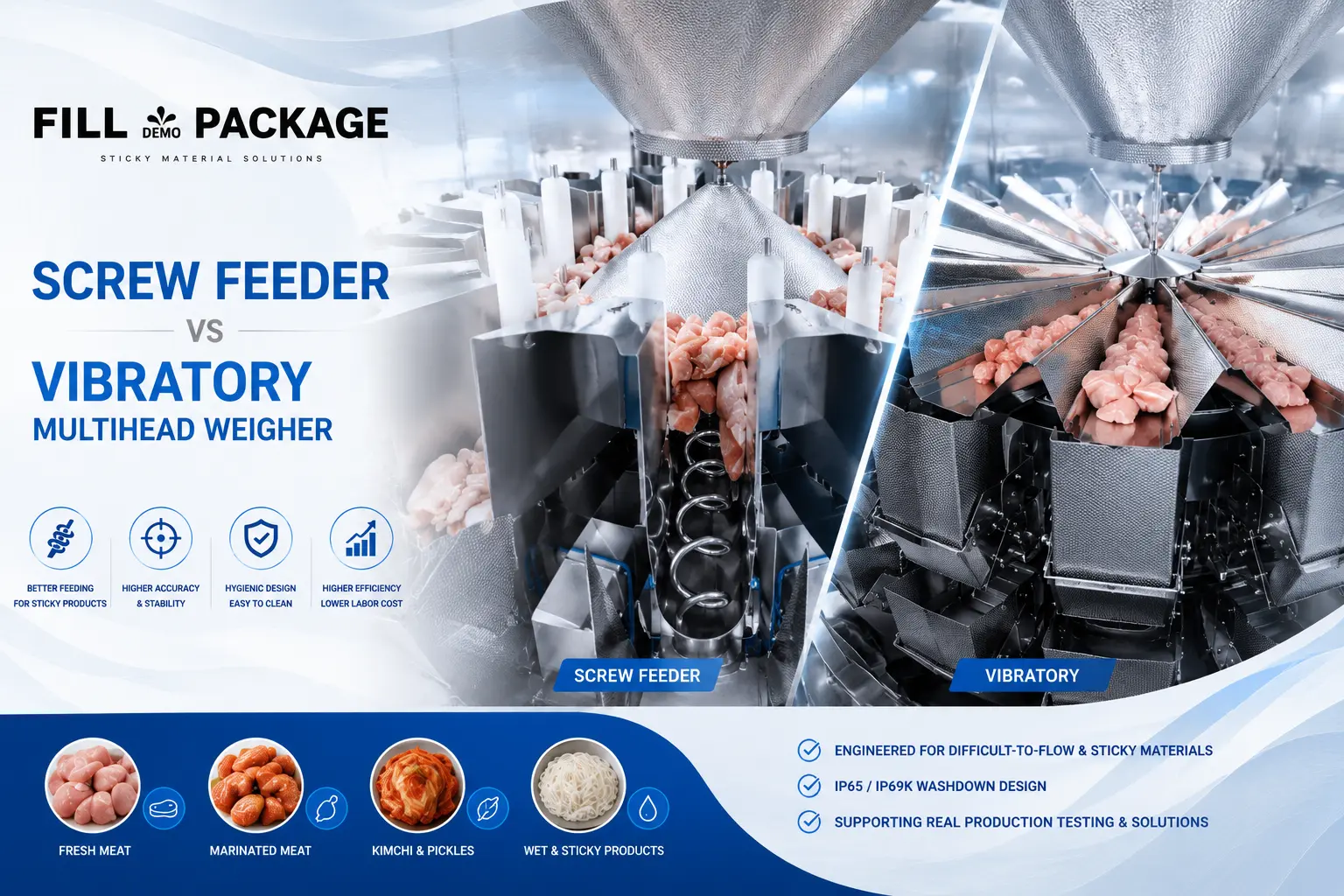
If you are searching for a pesadora con alimentador de tornillo for chicken breast, fresh meat, or kimchi packaging, you have probably already encountered one specific problem: the vibratory weigher either runs empty — or does not run at all.
This article does not tell you that one machine is always better. It explains the actual physics behind the failure, the real trade-offs between both technologies, and a practical framework for deciding which one fits your product — based on years of field experience with sticky material packaging lines.
The Real Problem: Why Vibratory Weighers Fail with Sticky Products
Vibratory multihead weigher: A combination weigher that uses electromagnetic vibration to move product from the central dispersion cone through radial feeder pans and linear feeder pans into individual weigh hoppers.
The failure mode most people expect is inaccuracy. The failure mode that actually shuts down a production line is more fundamental: the product does not move.
Fresh chicken pieces — with individual lengths of 7 to 13 cm — make direct contact with stainless steel across a large surface area. Stainless steel and moist protein have a natural affinity for each other. Without an active mechanical force pushing product forward, vibration alone cannot overcome that adhesion. The product stalls on the feeder pan.
For kimchi and marinated products, juice and oil compound the problem. Once sauce accumulates on the radial feeder pan, the surface becomes a trap. This typically produces two specific failure patterns:
- Empty bags: Product sits on the feeder pan and never reaches the weigh hoppers. The machine cycles through weighing combinations with insufficient material and produces underweight or empty packages.
- Batch dump: After accumulating enough vibration cycles, product suddenly releases all at once — causing a single overweight dump and disrupting the entire weighing sequence.
These are not calibration problems. You cannot tune a vibratory weigher to handle this. It is a physics problem.
How a Screw Feeder Weigher Solves the Flow Problem
Screw feeder multihead weigher: A combination weigher where the central dispersion table and linear feeder pans are driven by rotating screw conveyors (augers), which actively push product forward through mechanical contact rather than relying on vibration.
The screw does not wait for the product to slide. It pushes. Regardless of how sticky the marinade is, how heavy the chicken piece is, or how much brine kimchi has released, the screw physically moves product toward the weigh hoppers at a controlled, consistent rate.
Products that run reliably on a screw feeder weigher include:
- Fresh chicken breast and chicken pieces for poultry packaging
- Bone-in cuts for chicken packaging trays
- Marinated and seasoned meat — packaging of meat and poultry products
- Kimchi and pickled vegetables with brine (kimchi packaging pouch and jar formats)
- Fresh meat packages — pork, beef, lamb
- Coated or oily food products
The machine configuration — screw pitch, screw diameter, number of screws, hopper design, and optional Teflon surface treatment — is determined by the specific material. There is no universal screw feeder specification. Every machine is built around your product’s actual behavior.
Screw Feeder vs Vibratory Multihead Weigher — Direct Comparison
| Factor | Vibratory Weigher | Pesadora de alimentador de tornillo |
|---|---|---|
| Suitable products | Dry, free-flowing (nuts, snacks, grains, frozen IQF) | Sticky, wet, oily, large-piece (fresh meat, kimchi, marinated protein) |
| Flow mechanism | Electromagnetic vibration | Rotating screw conveyors — active mechanical push |
| Velocidad | 60–120+ bags/min for dry goods | ~40–45 bags/min for fresh meat applications |
| Weighing accuracy | ±1–2g for dry goods | ±5g+ depending on product and piece size |
| Limpieza | Simpler — blower clean sufficient for dry products | Waterproof + built-in wash mode; honestly: screws add minor extra corners vs open pan |
| Precio | Más bajo | Higher — additional screws, motors, drive components, possible Teflon treatment |
| Recommended bag weight (meat) | Not recommended for fresh meat | 2–5 kg most common; up to 7 kg possible |
| Corrosion resistance (kimchi) | Standard grade | Must specify food-grade anti-corrosion stainless + sealed hoppers |
One important note on speed: the weigher’s output rate is not the same as your line’s output. The downstream VFFS packaging machine — seal jaw cycle time, film speed, and bag format — typically determines actual bags-per-minute. Do not select a weigher based on speed figures alone.
What to Check Before You Choose
The decision process is straightforward, but it cannot be skipped.
Step 1 — Send a product photo or physical sample. The first question we ask any customer is: can you show us the product? A photo immediately reveals piece size, surface condition, and approximate moisture content. A physical sample tells us what a spec sheet never will.
Step 2 — Define your output requirement. What is your target bags per minute? What is your bag weight range? These two numbers narrow the machine configuration significantly.
Step 3 — Run a material test before committing. No matter how much experience we have with similar products, the conclusion is a hypothesis until tested. We configure a trial and test your actual material. The test result determines the final machine specification — not the initial recommendation.
For kimchi and brine-heavy products specifically: Confirm that the machine includes corrosion-resistant stainless steel on all contact surfaces and proper hopper sealing to prevent brine from reaching internal components. Kimchi brine is acidic. A standard-spec machine will show corrosion over time.
When a vibratory weigher is still worth considering: Not every slightly sticky product needs a screw feeder weigher. For borderline materials, we first attempt modifications to a standard vibratory unit: surface texturing on feeder pans, Teflon coating, raised pan angle, adjusted vibration frequency. These modifications cost significantly less than a full screw feeder configuration. We only recommend stepping up to screw feeding when testing shows the vibratory cannot maintain consistent flow. The right machine is the one that fits your product — not the most expensive option.
Cleaning and Maintenance — What Nobody Tells You
A common concern before purchasing a screw feeder weigher is: “Isn’t it hard to clean?” The assumption is that a more complex machine is proportionally harder to maintain. The reality is more nuanced.
All Fill Package screw feeder weighers are fully waterproof and designed for direct hose-down cleaning. The machine includes a built-in wash mode: when activated, all hopper doors open simultaneously, allowing water to flow through and drain freely. For most meat and kimchi applications, this is sufficient for daily end-of-shift cleaning.
The honest answer on cleaning difficulty: Yes, a screw feeder weigher is slightly harder to clean than a standard vibratory weigher. The screw conveyors introduce a small number of additional corners that an open vibratory pan simply does not have. We will not pretend otherwise. In practice, the difference is manageable with standard hygiene procedures and does not require additional staff or meaningfully extended cleaning time in most facilities.
Exception — oily food products: Products with significant oil content require more thorough attention on the screw surfaces. If your product is oil-intensive, discuss this specifically during machine specification to ensure the right surface treatment and screw geometry are selected upfront.
For comparison: a standard vibratory weigher handling dry products like nuts typically needs no more than a blower clean between shifts. That simplicity is a genuine advantage for the right product — which is exactly why matching the machine to your material matters.
Preguntas frecuentes
Can a vibratory multihead weigher handle fresh chicken breast?
In most cases, no. Fresh chicken breast has a contact surface of 7–13 cm per piece and naturally adheres to stainless steel. Without a mechanical force pushing it forward, the product stalls on the feeder pan. This is not an accuracy issue — it is a flow issue. The product simply does not move.
Is a screw feeder weigher hard to clean?
Not significantly, but honestly slightly harder than a standard vibratory weigher. Screw conveyors add a small number of extra corners that an open vibratory pan does not have. All machines are waterproof with a built-in wash mode where hopper doors open fully for drainage. Direct hose-down is sufficient for most applications. The exception is high-oil products, which require extra attention on screw surfaces.
What speed can I expect from a screw feeder weigher for meat packaging?
Around 40–45 bags per minute is a reliable working target for most fresh meat applications. That said, the weigher speed is not the same as your line output. Your VFFS packaging machine configuration — seal jaw speed, film feed, bag format — is usually the real determinant of line throughput.
Does kimchi brine damage the weigher over time?
It can, if the machine is not correctly specified. Kimchi brine is acidic and corrosive. Contact surfaces must meet appropriate corrosion resistance standards, and hopper sealing must prevent brine from reaching internal mechanical or electrical components. Always confirm the corrosion specification before ordering — do not assume standard-grade stainless is sufficient for brine-heavy products.
Should I always choose a screw feeder weigher for sticky products?
Not necessarily. For mildly sticky products, a modified vibratory weigher — with adjusted surface texture, Teflon coating, or pan angle changes — may perform adequately at lower cost. The right answer depends on your specific material. We recommend a material test before committing to either solution. If the modified vibratory weigher can handle your product, we will say so.
Conclusión
The question is not which weigher is better. The question is which weigher fits your product.
Vibratory weighers are excellent machines for the products they are designed for — dry, free-flowing goods where speed and simplicity matter. Screw feeder weighers solve a specific class of problems that vibratory technology physically cannot: products that will not move on their own.
For chicken breast packaging, fresh meat packages, poultry packaging, and kimchi packaging — if you have already experienced stalling, empty bags, or inconsistent flow on a vibratory weigher, the root cause is almost always the same. The machine is fighting the physics of your product.
The most practical next step is to send us a product sample or photo. We will evaluate the material, confirm whether a screw feeder is necessary or a modified vibratory solution is sufficient, and propose a configuration based on testing — not assumption.
If your current machine cannot handle the product, let’s talk. We have likely seen this challenge before.
Explore our Pesadora multicabezal con alimentador de tornillo or browse our full range of Pesadoras multicabezal.