

Introducción
When a bucket elevator chain needs replacement, or a set of worn elevator buckets needs to be restocked, the buyer faces a choice: source OEM parts from the original equipment manufacturer, or source aftermarket parts from an alternative supplier. In most industrial component categories, this is a straightforward cost-versus-risk calculation. For bucket elevator parts, the calculation is different — because the compatibility question is not about brand matching. It is about dimensional matching.
This article explains why a precisely measured aftermarket bucket elevator sprocket, chain, or bucket performs identically to the OEM original — and what the measurement and verification process looks like in practice.
New to bucket elevator maintenance? Start with our Essential Maintenance Checklist for Bucket Elevator Components first.
Section 1 — The Dimensional Standard
Why Bucket Elevator Components Are Defined by Dimensions, Not Brands
Bucket elevator components are not proprietary. They are standardised. The chain pitch, tooth geometry, and bucket mounting dimensions used in Z-type bucket elevators are defined by ANSI and ISO standards that apply regardless of which manufacturer built the elevator.
This means that a C2052 double-pitch conveyor roller chain is a C2052 regardless of who manufactures it — 31.75mm pitch, 19.05mm roller diameter, the same engagement geometry with the same 24-tooth sprocket. A DS2914 industrial elevator cup is defined by its A/B/C/D/E dimensions, not by a brand name. Any manufacturer who machines those dimensions correctly produces a part that fits and functions identically to the original.
The variable is not which country manufactured the part. The variable is how accurately the manufacturer measures and machines to the dimensional standard.
The practical implication: When evaluating an aftermarket bucket elevator sprocket or bucket, the question to ask is not ‘Is this an OEM part?’ The question is: ‘Has this manufacturer confirmed the part dimensions against the original specification, and do they provide a drawing confirmation before production?’ If yes to both — the part is compatible.
Section 2 — Sprocket Measurement Process
How We Measure and Verify the C2052-24Z Replacement
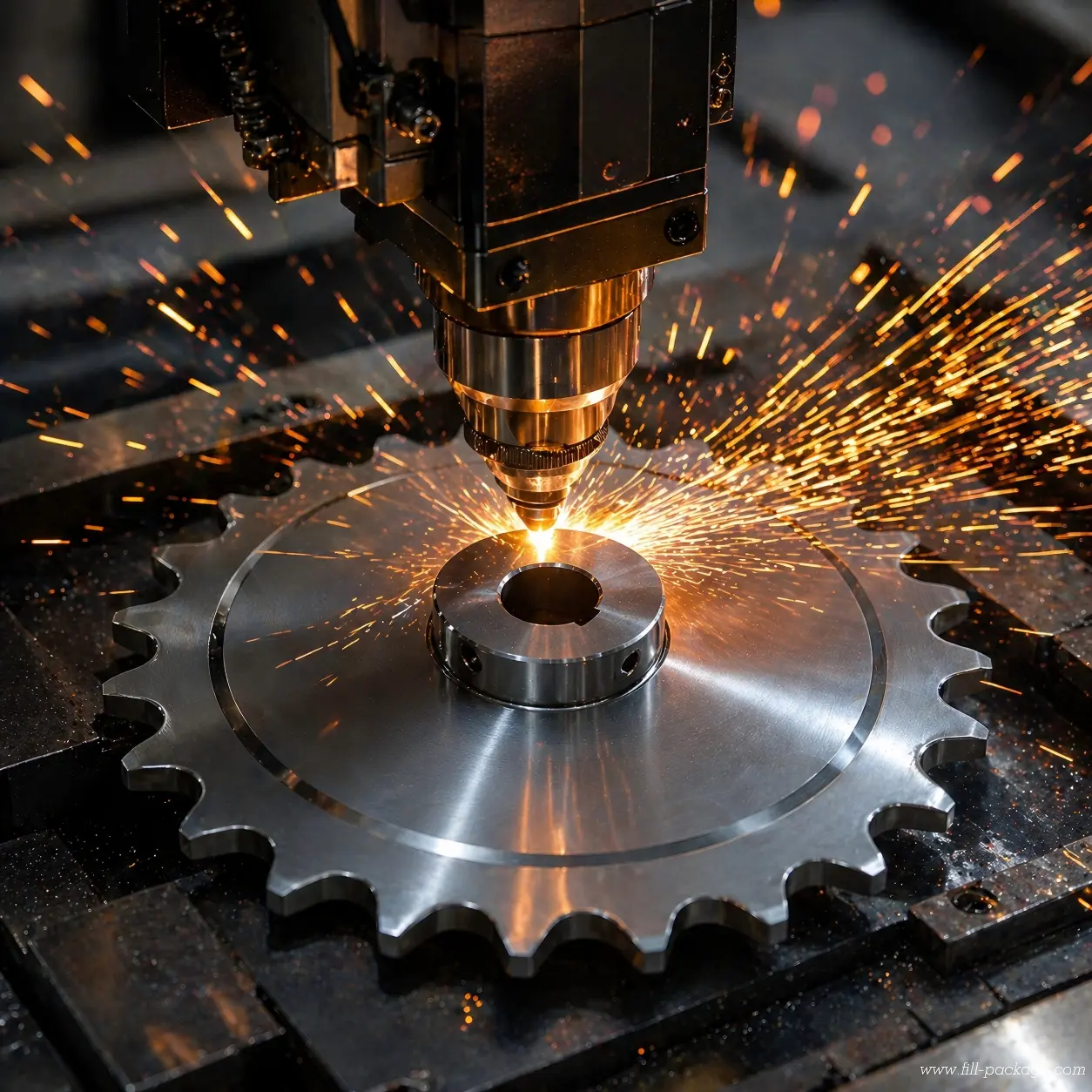
The 24-tooth C2052 sprocket is the most commonly replaced bucket elevator sprocket in Z-type elevator systems. Here is the exact measurement and verification process we use for every replacement order.
Step 1: Identify the Chain Pitch
Before measuring the sprocket, confirm the chain pitch. The chain pitch determines the sprocket tooth geometry — a C2052 sprocket (31.75mm pitch) has a different tooth profile from a C2042 sprocket (25.4mm pitch), even though both have 24 teeth. Running the wrong sprocket pitch on any chain causes immediate and severe tooth climbing.
- Measurement method: measure 10 consecutive chain links under light tension, divide by 10. This gives the pitch in mm. Match to the standard: 25.4mm = C2042, 31.75mm = C2052, 38.1mm = C2062.
- Alternative: count the teeth on the existing sprocket and measure the sprocket outer diameter. From these two values, the pitch can be calculated.
Step 2: Confirm the Key Sprocket Dimensions
For a C2052-24Z replacement sprocket, the dimensions we confirm before production are:
| Dimensión | Standard Value | Tolerance | Consequence of Error |
| Paso de cadena (P) | 31.75mm | ANSI B29.1 | Wrong pitch = immediate tooth climbing and chain damage |
| Diámetro del rodillo | ø19.05mm | ANSI B29.1 | Wrong roller engagement = uneven load distribution; rapid wear |
| Diámetro exterior | ø258mm | ±0.5mm | Too large = casing clearance issue; too small = chain disengagement |
| Eje de orificio | ø25mm | +0.03/+0.01mm H7 | Loose fit = sprocket movement under torque; wrong bore = cannot fit shaft |
| Ancho de la chaveta | 8mm | ±0.018mm | Wrong width = key cannot seat; keyway deformation under load |
| Ancho total | 30 mm | ±0.05mm | Wrong width = chain misalignment across sprocket face |
| Recuento de dientes | 24 dientes | Exact | Wrong tooth count = wrong speed ratio; incompatible with chain pitch |
Step 3: Issue Drawing Confirmation Before Production
After measuring the reference dimensions, we produce a technical drawing showing all confirmed dimensions and issue it to the buyer for approval before any machining begins. This step eliminates the most common source of aftermarket part failure: dimensional assumptions made without verification.
The drawing confirmation is not a formality — it is the document that identifies any discrepancy between the buyer’s elevator specification and the standard part. If the buyer’s shaft bore is 28mm rather than the standard 25mm, the drawing confirmation catches this before a 25mm bore sprocket is machined and shipped.
Section 3 — Industrial Elevator Cup Measurement
Bucket Elevator Bucket Types: How DS and DQ Industrial Cups Are Measured for Replacement
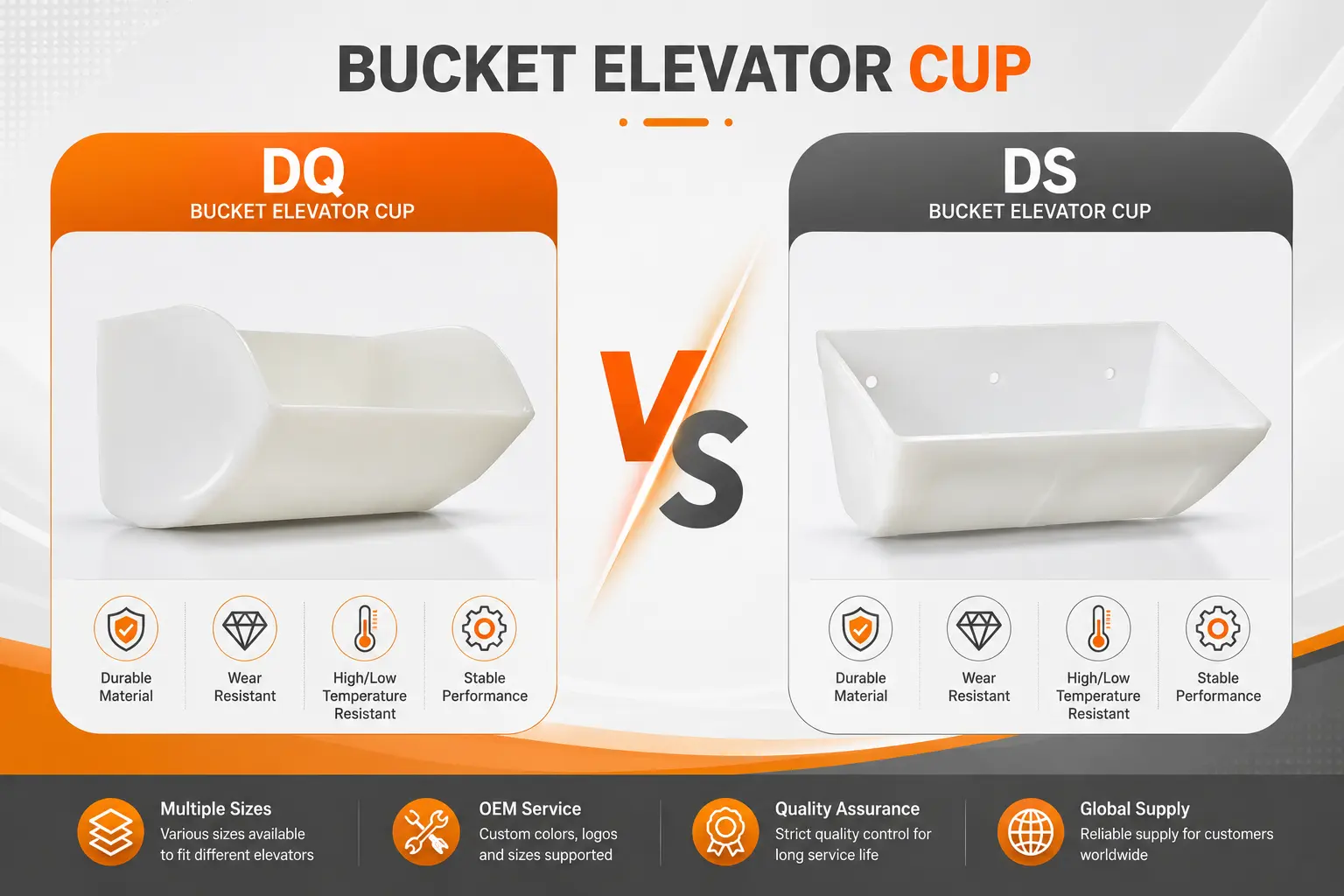
The DS (deep cup) and DQ (shallow cup) series cover the industrial elevator bucket types used in grain handling, chemical processing, and bulk material conveying. They are defined by five dimensions — the same A–E system that applies to Z-type buckets — plus two additional parameters: hole count and hole diameter.
The DS/DQ Naming System
Every DS and DQ model number encodes two of the five critical dimensions directly in the part number:
Example: DS2914 DS = Deep cup series 29 = A dimension approximately 290mm 14 = B dimension approximately 140mm Example: DQ3823 DQ = Shallow cup series 38 = A dimension approximately 380mm 23 = B dimension approximately 230mm
This encoding means that a buyer who knows the existing cup model number already has two of the five dimensions. The remaining three (C, D, E) plus hole count and diameter are confirmed from either the physical cup measurement or the elevator’s original specification sheet.
The Measurement Process for a DS/DQ Replacement
- Identify the existing cup model number from the cup body or elevator documentation
- Confirm the A and B dimensions by physical measurement (verify against the model number encoding)
- Measure C (inner cavity depth), D (back plate height), and E (hole centre-to-centre spacing)
- Count the number of mounting holes and measure the hole diameter
- Send the six values to us — we match to the standard model or identify a custom specification
- We issue a drawing confirmation showing all confirmed dimensions before production
For buyers who cannot access the existing cups directly (elevator in continuous operation, or cups already failed and discarded), the elevator height and chain specification allow us to reverse-calculate the likely bucket size range. We then provide dimensional drawings for the buyer to confirm against the elevator’s casing width and chain bolt pattern.
Full DS and DQ size charts: Bucket Elevator Cups — DS & DQ Industrial Series
Section 4 — OEM vs Aftermarket: The Real Comparison
What Actually Differs Between OEM and Aftermarket Bucket Elevator Parts
The honest comparison between OEM and well-specified aftermarket bucket elevator parts comes down to three factors — not brand, not country of origin, and not price alone.
| Factor | OEM Original | Aftermarket (precision-measured) | Aftermarket (generic, no drawing confirmation) |
| Dimensional accuracy | Confirmed to original spec | Confirmed to original spec by drawing | Assumed — may be standard deviation from nominal |
| Material certification | Usually available | Available on request — virgin resin confirmed | Often not available — recycled material risk |
| Lead time | Often 4–12 weeks for non-stock | 7–25 days depending on size and quantity | Variable |
| Precio | Premium — OEM margin included | 20–50% lower than OEM for equivalent spec | Lowest — but quality is the variable |
| Drawing confirmation | Included in OEM process | Provided before every order | Not typically provided |
| Compatibility risk | Zero — original spec | Zero — confirmed by drawing | Moderate — dimensions assumed, not confirmed |
The conclusion: The gap between OEM and precision-measured aftermarket bucket elevator parts is not in dimensional performance — it is in process. An aftermarket supplier who provides drawing confirmation before production and material certification on request is delivering the same compatibility assurance as the OEM, at lower cost and typically shorter lead time. The risk category is ‘generic, unconfirmed aftermarket’ — not ‘Chinese aftermarket’ as a category.
Next Steps
Request a drawing confirmation for your replacement parts. Send us your existing bucket, chain, or sprocket dimensions — or the part number if you have it — and we will issue a technical drawing confirmation before any production begins. Contacta a nuestro equipo técnico
Continúa leyendo: The Complete Checklist for Sourcing Bucket Elevator Replacement Parts from China →