

The Question Every Meat Processor Eventually Asks
You invested in a multihead weigher. It runs flawlessly on your nut line. Your chip bags are perfect. Then the day comes when you try to run marinated chicken thighs hoặc boneless pork belly cubes through the same machine — and the nightmare begins.
| ⚠️ The Sticky Product Nightmare Why does your multihead weigher hit 15% error rates on marinated meat when it scores < 1% on dry nuts? The answer isn’t a machine defect. It’s physics — and understanding it is the first step toward fixing your line. |
Here’s what’s actually happening on your production floor:
- Your vibrating trays shake. Dry nuts slide forward. Marinated chicken sits there and doesn’t move.
- Fat and sauce create surface tension — the product literally bonds to the stainless steel tray.
- Hoppers fill unevenly. The weigher’s combination logic is working with incomplete, stuck product — so your weight readings drift.
- A worker stops the line to manually push the product through. Your OEE (Overall Equipment Effectiveness) drops.
- You either overfill every bag (waste money) or under-fill (violate label law).
This isn’t a unique problem. It’s a structural flaw in vibration-based feeding when applied to high-fat, high-moisture, or marinated products. And there’s only one engineering solution that actually works: Forced Feeding via Screw Drive.
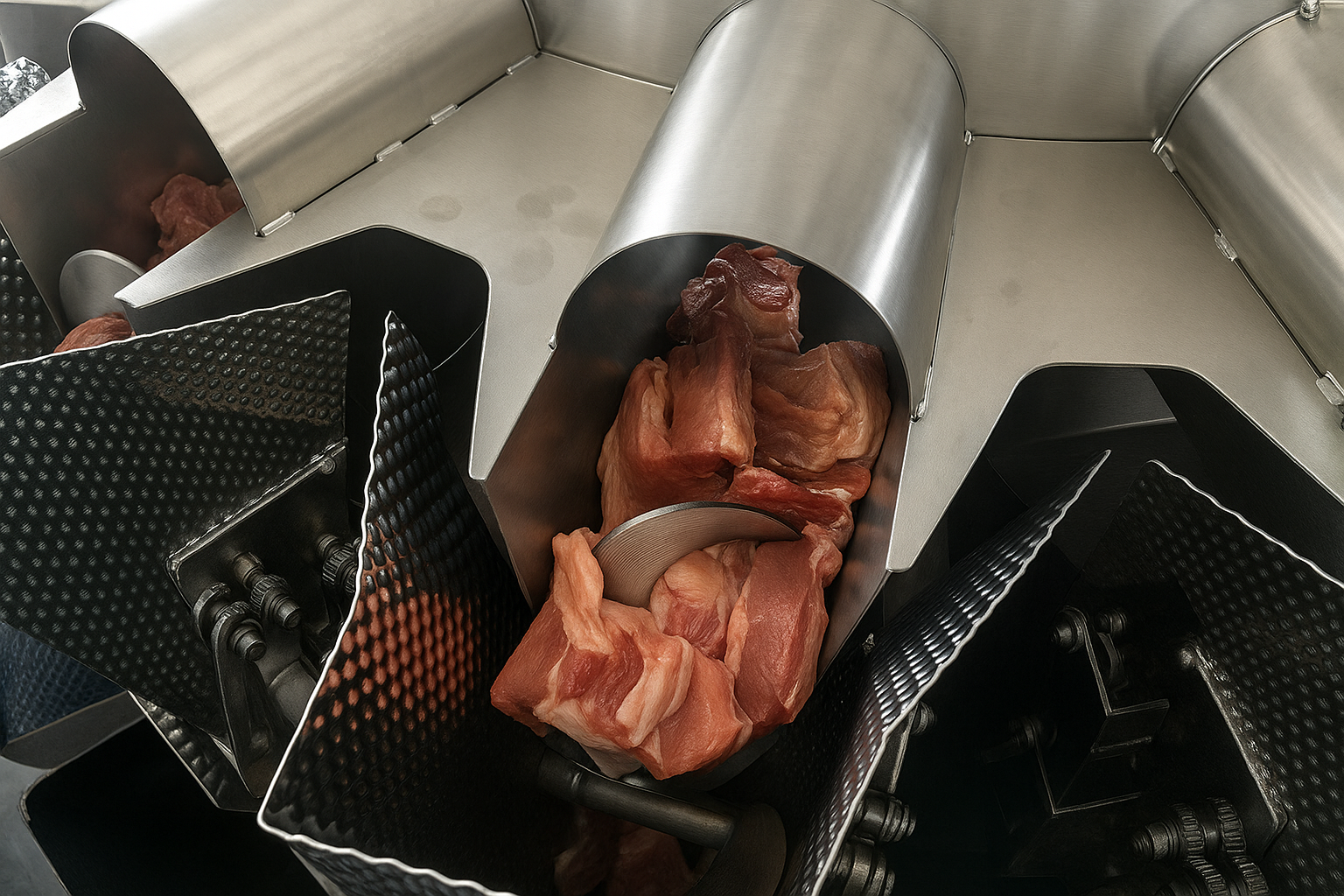
Why Vibration Fails on Sticky Products: The Physics
Standard multihead weighers were engineered for one type of material: free-flowing particulates. Nuts, chips, grains, frozen peas — anything that slides readily when shaken.
Two Forces Working Against You
Surface Tension & Fat Adhesion: Marinated meat, fresh poultry, and oily seafood have high lipid content on the surface. This creates a thin adhesion layer between the product and the stainless steel tray surface. Vibration isn’t strong enough to overcome this bond at low amplitudes — and increasing amplitude just bounces the product chaotically, reducing accuracy.
Material Bridging: Irregular-shaped pieces (chicken feet, steak cubes, shrimp) interlock and create bridges across the tray. One piece sticks, and the mass behind it stops. On a dry product, vibration breaks bridges instantly. On a sticky product, the bridge holds — and the hopper starves.
| 💡 Industry Reality Check A standard multihead weigher running marinated meat will typically see 10–15% of its weighing cycles rejected or reworked due to adhesion-related inaccuracy. At 60 bags/min on a 500g pack, that’s 6–9 bags per minute going to rework — or roughly 450 kg/hour of product at risk. |
The Screw Feeder: Forced Feeding Is the Only Scientific Solution
The screw feeder multihead weigher doesn’t try to vibrate sticky product into motion. It forces it. A rotating helical screw sits beneath the product and physically drives it forward into the weighing hoppers — regardless of fat content, marinade viscosity, or piece size.
Picture a 10°C cold-chain packaging facility processing boneless chicken feet or marinated steak cubes at 7am. The product is cold, slightly congealed, high in collagen and sauce. On a standard weigher: product sits, bridges, requires a worker to manually push it through — contaminating the food and violating your HACCP protocol. On a screw feeder: the auger turns, product loads like clockwork, the weigher runs at full speed, and the only person needed is the one doing QC checks.
Head-to-Head Comparison: Standard vs. Screw Feeder Multihead Weigher
| Tính năng | Máy cân đa đầu tiêu chuẩn | Máy cân vít nhiều đầu |
| Phương pháp cho ăn | Vibration (tray shaking) | Rotating screw rods (forced push) |
| Tốt nhất cho | Dry, free-flowing: nuts, chips, cereals | Sticky, wet, oily: marinated meat, poultry, seafood |
| Blockage Risk | HIGH — product bridges & adheres | Very Low — continuous forced movement |
| Độ chính xác cân | Degrades 10–15% with sticky product | Consistent ±1g across all runs |
| Error Rate (Sticky) | Up to 15% reject/rework rate | < 2% under normal conditions |
| Vệ sinh | Labor-intensive; sticky residue persists | IP67 washdown-ready; quick disassembly |
| OEE Impact | Frequent manual interventions needed | High OEE; minimal unplanned stops |
| Scraper Hopper Option | Not available | Yes — for extremely sticky material |
| Memory Hoppers | Tiêu chuẩn | Enhanced logic for high-speed accuracy |
| Ideal Environment | Dry ambient conditions | Cold-chain (0–10°C), wet processing areas |
Internal Link: If you are packaging poultry parts specifically, see our detailed Meat & Poultry Packaging Solutions page for application-specific configuration guidance.
Screw Feeder Multihead Weigher: Core Advantages Explained
| Lợi thế | Why It Matters in Meat & Poultry Processing |
| Screw-Driven Forced Feeding | Replaces vibration entirely. Rotating screws push product directly into weigh hoppers at a controlled, consistent rate — regardless of fat content, marinade viscosity, or surface tension. |
| Scraper Hoppers (Optional) | For extremely sticky products (boneless chicken feet, heavily marinated beef chunks), scraper blades actively clear hopper walls. Zero residue remains between cycles. |
| IP67 Waterproof Construction | The entire machine withstands high-pressure washdowns. Cold-chain meat facilities hose down equipment daily — standard weighers corrode; screw feeders are built for it. |
| Memory Hoppers | Advanced combination logic maintains accuracy at high speeds. The system learns which hopper combinations yield the most accurate weight target, compensating for variable product clumping. |
| Hygienic Material Design | All product-contact surfaces are 304/316 stainless steel with polished edges. No cavities for bacteria to harbor — critical for HACCP compliance in poultry and red meat facilities. |
Real-World Scenario: A 10°C Cold-Chain Packaging Line
To make this concrete, here’s what the two systems look like in practice at a poultry processing facility:
| ❌ Standard Multihead Weigher Boneless chicken feet loaded into vibrating trays. Product sits. Vibration increases. Pieces bridge across the tray outlet. Line stops at 7:23am. Worker opens guard, uses gloved hand to push product — food safety incident logged. Result: 18-min downtime, 3 rework batches, OEE drops to 61%. | ✅ Screw Feeder Multihead Weigher Same product loaded into screw-driven channels. Augers rotate. Product advances in orderly, controlled queues. Each hopper fills at the required rate. Combination logic fires. Bags fill at 55/min. Result: Zero stoppages. Zero food safety incidents. OEE maintained at 88%. |
How to Choose: A Simple Decision Framework
| Choose Standard Multihead Weigher if: • Product is dry and free-flowing (chips, nuts, cereals, frozen vegetables) • Moisture content < 10% • No marinade, sauce, or oil coating on surface • Budget is the primary constraint and accuracy requirement is moderate | Choose Screw Feeder Weigher if: • Product is marinated, fresh, oily, or wet • Handling: poultry parts, meat cubes, shrimp, salads, cheese shreds • Facility requires daily high-pressure washdown (IP67 minimum) • Accuracy and OEE are non-negotiable at production speed • HACCP compliance requires no manual product intervention |
Get a Free Custom Solution — Not a Generic Catalog Quote
Sticky products come in dozens of viscosity profiles, piece sizes, and temperature ranges. A marinated beef cube behaves differently from a fresh chicken wing, which behaves differently from a braised pork knuckle. Off-the-shelf recommendations don’t account for your specific product.
| Not sure if your product is sticky enough to need a screw feeder? We offer a FREE material test service. Ship us a sample — we’ll run it through our equipment and send you a full weighing accuracy report and ROI analysis. |
Our engineers will test your exact product, measure actual adhesion behavior, calculate expected weighing accuracy, and provide a full ROI model showing payback period versus your current manual/vibration-based setup. No obligation. No generic brochure.
Related pages to link internally:
- Screw Feeder Multihead Weigher (Product Page)
- Meat & Poultry Packaging Solutions (Application Page)
- Extremely Sticky Products Multihead Weigher (for extreme cases)