

In the world of automated material handling, choosing the right “pitch” is the difference between a smooth-running line and a mechanical failure. While standard belts handle everyday items, certain industries demand more muscle.
En Llenar el paquete, our mission of “Smart packing, precise filling” extends to the heaviest challenges. This starts with understanding the power and purpose of the large pitch modular conveyor belt.
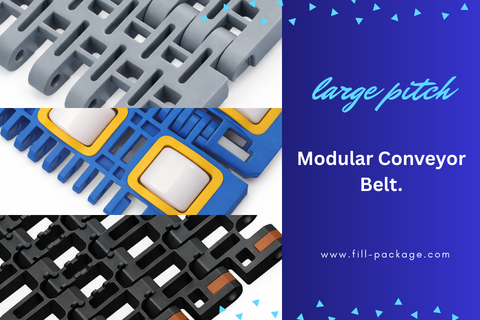
1. What Does “Large Pitch” Mean in Modular Conveyor Belts?
In conveyor terminology, “pitch” is the distance between the center points of two hinge pins. A large pitch modular belt typically refers to the 2-inch (50.8 mm) series or larger.
While small-pitch belts focus on tight transfers, large-pitch belts are engineered for structural dominance. They feature thicker modules, larger hinge pins, and more robust interlocking sections. Think of it as the “heavy-duty chassis” of the conveyor world.
2. Why Heavy Products Require Larger Belt Pitch
Why can’t you just use a standard belt for everything? It comes down to physics:
Resistencia a la tracción: Large pitch belts use thicker pins (often made of reinforced polymers) that can withstand significantly higher pulling forces without shearing or elongating.
Impact Resistance: In “Smart packing” environments where heavy crates or automotive parts are dropped onto the line, the increased mass of a 2-inch module absorbs impact that would crack a smaller belt.
Fewer Joints per Meter: With fewer hinges over a long distance, there are fewer potential points of failure, making the system inherently more stable under extreme stress.
3. Typical Load and Product Types for Large Pitch Belts
If your facility handles any of the following, a large pitch modular conveyor belt is likely your best fit:
Automotive Parts: Engines, transmissions, and heavy metal stampings.
Bulk Beverage Handling: Full crates of glass bottles or heavy kegs.
Construction Materials: Bags of cement, bricks, or large timber components.
Large-Scale Logistics: Palletized goods and oversized containers.
En www.fill-package.com, we specify these belts for environments where the “load per square meter” exceeds the limits of standard 1-inch series.
4. Large Pitch vs. Standard Pitch: Core Structural Differences
| Característica | Standard Pitch (1-Inch) | Large Pitch (2-Inch) |
| Primary Focus | General Packaging & Versatility | Heavy Loads & High Tension |
| Pin Diameter | Estándar | Reinforced / Large Diameter |
| Sprocket Size | Compact to Medium | Large (for Maximum Torque) |
| Ideal Product | Individual Pouches, Boxes | Pallets, Crates, Heavy Parts |
While standard belts are the “all-rounders,” the 2-inch series is the specialist for high-torque, high-load scenarios.

5. Conclusion: Choosing the Right Strength
Achieving “Smart packing” means using the right tool for the job. If your production line involves heavy-duty throughput, a large pitch modular conveyor belt is not just an option—it’s a necessity for longevity and safety.
Ready to upgrade to a heavy-duty solution? Explore the engineering specs of our 2-Inch Series and see how Fill Package brings precision to the heaviest loads.
👉 [Explore Large Pitch Modular Conveyor Belt (2-Inch Series) at Fill Package]
Related Blog:
How to Choose a Large Pitch Modular Conveyor Belt for Heavy-Duty Conveying
Large Pitch vs. Standard Pitch Modular Conveyor Belts: Which One Handles Heavy Loads Better?