

giriiş
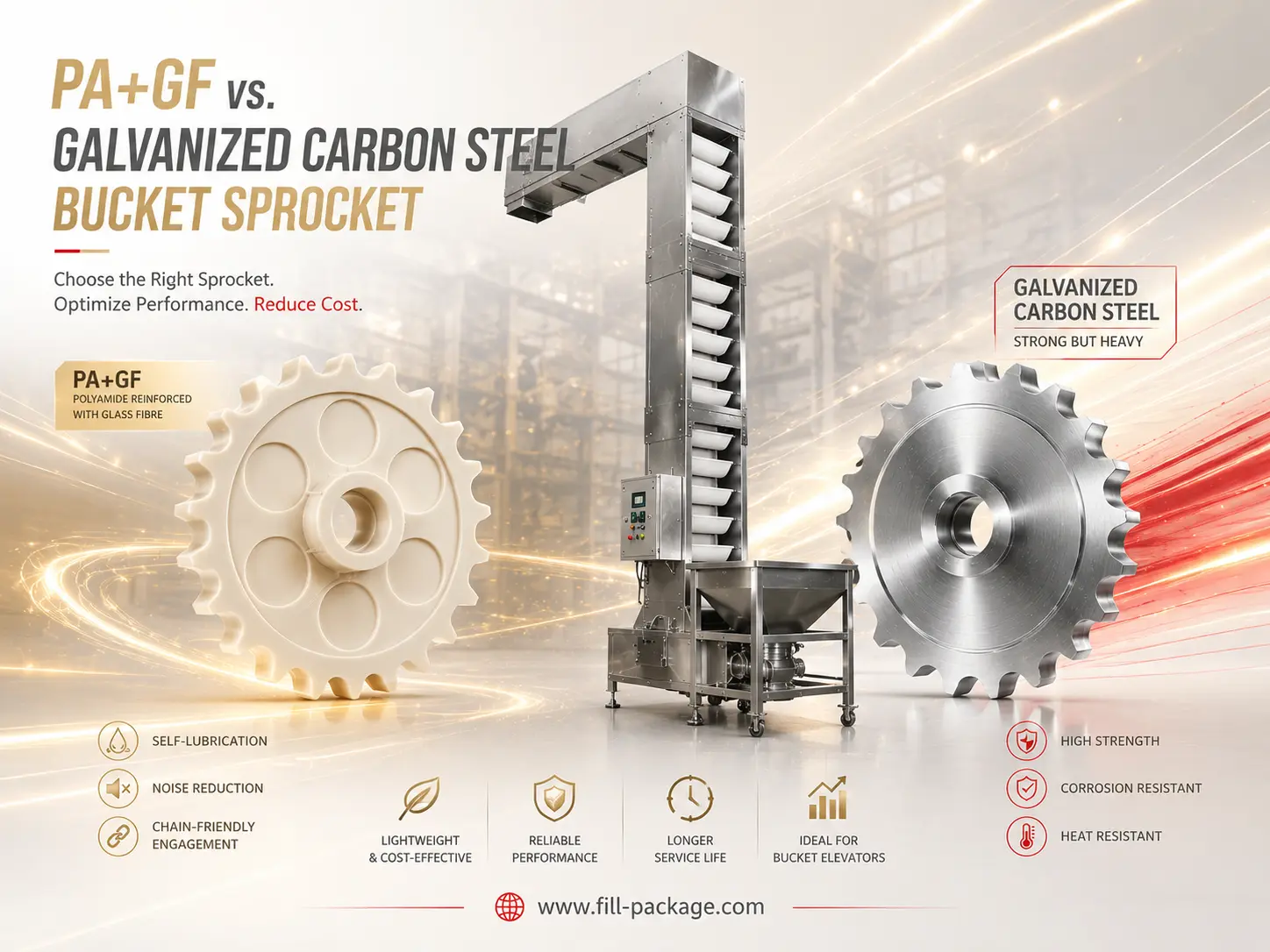
When sourcing replacement sprockets for a Z type bucket elevator, buyers frequently encounter two material options: galvanised carbon steel and PA+GF reinforced plastic. Both are available in the C2052-24Z specification — 24 teeth, 31.75mm pitch — and both are dimensionally identical. The question of which to use is not arbitrary, and the answer is not simply ‘steel is stronger, so use steel everywhere.’
The correct specification depends on which shaft position the sprocket occupies — driving (top, motor side) or driven (bottom, tensioning side) — because the two positions have fundamentally different mechanical demands. Getting this wrong does not cause immediate failure, but it does result in elevated noise, faster chain wear, and reduced service life on the component that was mis-specified.
This article is part of our bucket elevator sprocket series. If you are not yet familiar with the warning signs of sprocket wear, start with 3 Signs Your Elevator Sprockets Need Replacement Before a Catastrophic Failure.
Section 1 — The Two Shaft Positions
Understanding the Driving vs. Driven Shaft: Why the Loads Are Different
A Z tipi kovalı elevatör uses two sprockets: one on the top shaft (the driving sprocket, connected to the motor via gearbox or belt drive) and one on the bottom shaft (the driven sprocket, which provides chain tensioning and guides the chain around the bottom of the elevator loop).
The mechanical demands on these two positions are significantly different:
| Yük Türü | Driving Sprocket (Top — Motor Side) | Driven Sprocket (Bottom — Tensioning Side) |
| Primary load | Motor torque × gearbox ratio — transmitted to chain via tooth engagement | Chain tension only — the sprocket rotates as the chain pulls it, not the reverse |
| Starting load | 2–3× running torque during motor start — highest load the sprocket sees | Starting tension increase — significantly lower than drive side |
| Şok yükleri | Each bucket filling event at the boot creates a tension spike in the chain — transmitted back to the driving sprocket | Tension spikes are attenuated by the time they reach the driven side |
| Hız | Fixed by motor/gearbox ratio — constant | Driven by chain — follows chain speed exactly |
| Key requirement | Torque transmission without tooth deformation or keyway failure | Low-noise engagement, chain-friendly tooth contact, self-lubrication |
| Failure mode | Shark-fin tooth wear from asymmetric torque loading; keyway brinelling | Uniform tooth height reduction; occasional surface cracking in cold environments |
The engineering logic: The driving sprocket needs material strength to transmit torque without deforming. The driven sprocket needs material compliance to absorb engagement shock, reduce noise, and minimise chain roller wear. These are different requirements — and they point to different materials.
Section 2 — Carbon Steel Driving Sprocket
Galvanized Carbon Steel: Why It Is the Correct Specification for the Driving Shaft
Torque transmission and tooth strength
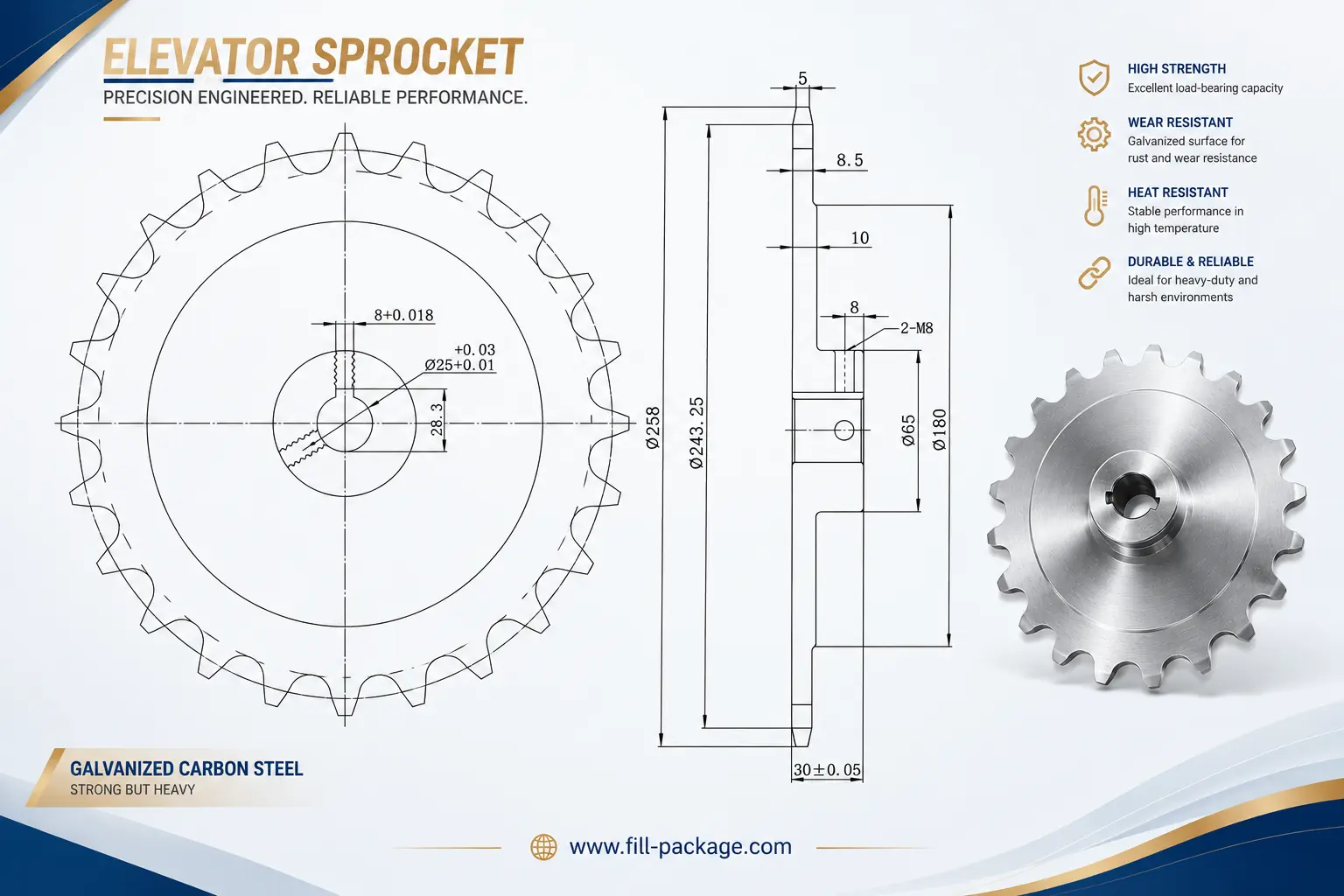
The C2052-24Z driving sprocket in galvanized carbon steel is machined from carbon steel to a tooth profile that provides the mechanical strength to transmit motor torque to the elevator chain without tooth deformation. The key performance parameter is tooth bending strength — the resistance of each tooth to the bending load applied by the chain roller during engagement.
At the rated chain tension for a C2052 chain (minimum tensile strength 21.8 kN), and the torque levels typically seen in Z type bucket elevators with 1.8L or 4L buckets, the tooth bending stress on a carbon steel tooth is well within the material’s yield strength. The same bending stress on a PA+GF tooth at the driving shaft position approaches or exceeds the material’s fatigue limit under sustained starting loads — particularly on elevators with high bucket counts or heavy product loads.
Starting torque: the critical load case
The starting torque of a bucket elevator — the torque required to accelerate the fully loaded chain and buckets from rest to operating speed — is typically 2–3× the steady-state running torque. This starting torque is the highest mechanical load the driving sprocket experiences, and it occurs every time the elevator starts.
For carbon steel, the starting torque load is within the material’s elastic range — the tooth deflects slightly under load and returns to its original geometry when the load is removed. For PA+GF plastic at the driving shaft position, sustained starting loads can cause permanent plastic deformation of the tooth profile over time, particularly in the keyway area where torque is transmitted to the shaft.
Galvanized surface treatment: why zinc, not bare steel or stainless
The carbon steel sprocket surface is zinc-plated (galvanized) rather than left as bare steel or upgraded to stainless. This is a deliberate cost-performance balance:
- Bare carbon steel corrodes in food factory environments within months — rust particles contaminate product and abrade chain link plates
- Galvanized carbon steel provides adequate corrosion resistance for spray washdown conditions in food packaging factories, at significantly lower cost than stainless steel
- Full stainless steel driving sprockets are available for immersion-cleaning or high-acid environments — but for standard food factory conditions, galvanized carbon steel is the correct and most economical specification
| C2052-24Z Carbon Steel Driving Sprocket — Key Specifications | Değer |
| Malzeme | Carbon steel — galvanized (zinc plated) |
| Outer diameter | ø258mm |
| Root circle diameter | ø243.25mm |
| Hub outer diameter | ø65mm |
| Hub length | 180 mm |
| Shaft bore | ø25⁺⁰·⁰³₊₀.₀₁ mm (H7 fit) |
| Keyway width | 8 ± 0.018mm |
| Overall width | 30 ± 0.05mm |
| Set screws | 2 × M8 |
| Tolerance standard | IT13 (unspecified dimensions) |
| Shaft bore finish | Ra 0.16 |
| Supply | 2 pieces per set |
Section 3 — PA+GF Driven Sprocket
PA+GF Reinforced Plastic: Why It Is the Correct Specification for the Driven Shaft
What PA+GF is — and why it is not standard nylon
PA+GF is polyamide (nylon) reinforced with glass fibre — typically 30% glass fibre by weight. The glass fibre reinforcement changes the material’s mechanical properties significantly compared to unfilled PA6 (standard nylon):
| Mülk | Standard PA6 (unfilled) | PA+GF (30% glass fibre) | Change |
| Tensile strength | 70–80 MPa | 130–160 MPa | +80–100% |
| Flexural modulus | 2.5–3.0 GPa | 7–9 GPa | +180–200% |
| Wear resistance | Baseline | 3–4× PA6 | +200–300% |
| Dimensional stability | Moderate | Yüksek | Glass fibre reduces thermal expansion and moisture absorption |
| Self-lubrication | Evet | Evet | Maintained — PA matrix retains lubricity despite glass fibre addition |
| Impact absorption | İyi | İyi | Glass fibre slightly reduces impact absorption vs unfilled PA — still far better than steel |
The combination of PA+GF properties — higher strength than unfilled nylon, self-lubrication, moderate compliance for shock absorption, and low friction — makes it the correct material for the driven sprocket position where the priority is smooth, quiet, chain-friendly engagement rather than maximum torque transmission.
The self-lubrication mechanism and its effect on chain life
The self-lubrication of PA+GF occurs because the PA matrix contains polar groups that attract and retain a thin film of lubricant at the tooth surface — essentially, the material creates its own boundary lubrication layer from the chain lubricant already present on the chain rollers. This layer reduces the friction coefficient between the chain roller and the sprocket tooth during engagement.
The practical consequence for chain service life is measurable. When a chain roller engages a PA+GF tooth rather than a steel tooth, the lower friction and the compliance of the PA+GF material reduce the peak contact stress at the roller-tooth interface. Lower peak contact stress means slower fatigue accumulation in the roller bearing surface — which means the chain roller retains its rolling function longer before seizing. Studies on comparable elevator systems consistently show elevator chain sprocket service life 15–25% longer when PA+GF driven sprockets are used rather than steel driven sprockets.
Noise reduction: why it matters in food factories
The noise reduction from PA+GF driven sprockets is not merely a comfort issue. Food factories running multiple packaging lines often operate under noise regulations, and sustained high noise levels increase operator fatigue and error rates. The 8–12 dB noise reduction from PA+GF engagement at the driven sprocket is equivalent to reducing the perceived noise intensity by approximately 50–60% — a material improvement in the working environment at a component cost that is typically lower than carbon steel.
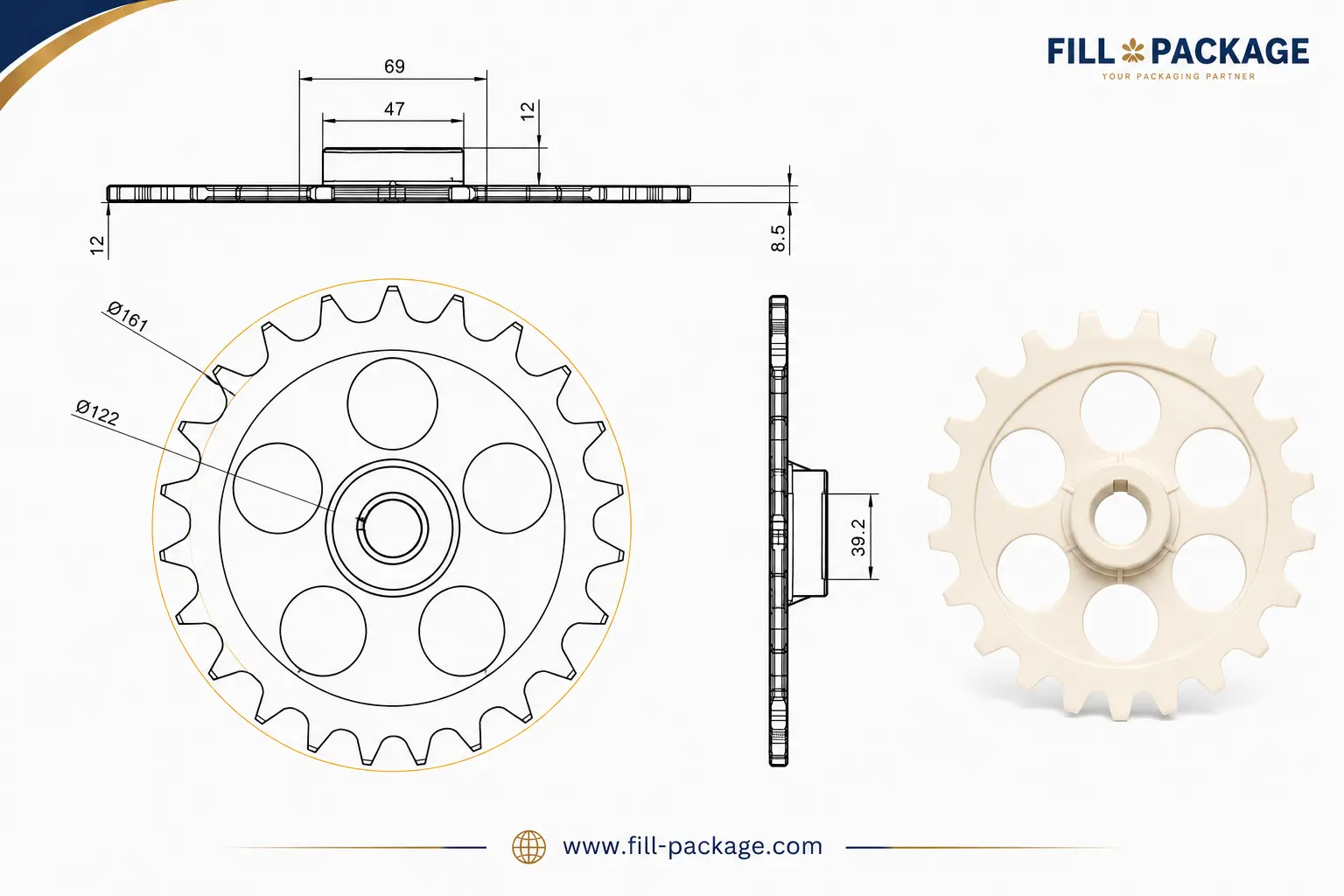
| C2052-24Z PA+GF Driven Sprocket — Key Specifications | Değer |
| Malzeme | PA+GF — polyamide + 30% glass fibre reinforced |
| Outer diameter | ≈ ø260.29mm |
| Diş sayısı | 24 teeth |
| Installation width | 30mm (matches carbon steel driving sprocket) |
| Yüzey | Natural white — no surface treatment required |
| Yağlama | Self-lubricating — no grease at sprocket interface |
| Tolerance standard | IT13 |
| Cold temperature limit | Suitable to approximately -10°C; below this, specify steel |
Section 4 — Direct Comparison
Side-by-Side: Carbon Steel vs PA+GF for Bucket Elevator Sprocket Applications
| Performance Factor | Carbon Steel (Galvanized) | PA+GF Reinforced Plastic | Recommended Position |
| Torque transmission | Excellent — handles starting and running torque without deformation | Good for low torque; risk of deformation at high starting torque | Carbon steel: driving shaft ✅ |
| Noise at engagement | Louder — metal-on-metal roller contact | 8–12 dB quieter — PA matrix absorbs engagement impact | PA+GF: driven shaft ✅ |
| Chain roller wear | Moderate — steel tooth harder than roller | Lower — PA+GF compliant surface reduces peak contact stress | PA+GF: driven shaft ✅ |
| Self-lubrication | No — grease required at tooth-roller interface | Yes — PA matrix provides boundary lubrication | PA+GF: driven shaft ✅ |
| Korozyon direnci | Good — zinc plating protects against spray washdown | Excellent — no corrosion | Equal for standard food factory |
| Cold temperature | Full performance at any operating temperature | Suitable to -10°C; brittle below this range | Carbon steel: cold storage/frozen ✅ |
| Service life (typical) | 18–30 months driving shaft (Z-type, 2-shift operation) | 24–36 months driven shaft (Z-type, 2-shift operation) | Both achieve good service life in correct position |
| Maliyet | Moderate | Slightly lower than carbon steel (material cost) | — |
| Verdict | ✅ Driving shaft — top, motor side | ✅ Driven shaft — bottom, tensioning side | Use both: steel drive + PA+GF driven |
The standard specification for Z type bucket elevators: Galvanized carbon steel C2052-24Z on the driving shaft + PA+GF C2052-24Z on the driven shaft. This combination is the specification used by the majority of Chinese Z type elevator OEM manufacturers. It delivers the optimal balance of torque strength, noise performance, chain life, and service life across both positions.
Çözüm
The Right Material for the Right Position
The material selection for bucket elevator chain sprockets is not a debate between ‘strong’ and ‘weak’ — it is a question of matching material properties to the mechanical demands of each shaft position. The driving shaft needs torque resistance: carbon steel. The driven shaft needs compliance, self-lubrication, and noise reduction: PA+GF.
Specifying PA+GF on both shafts creates a risk of tooth deformation at the driving position under starting loads. Specifying carbon steel on both shafts produces unnecessary noise and accelerated chain roller wear at the driven position. The combined specification — steel driving, PA+GF driven — is the solution that addresses both positions correctly.
Order your C2052-24Z sprocket set. We supply galvanized carbon steel driving sprockets and PA+GF driven sprockets as matched sets, confirmed to your shaft diameter and keyway specifications before production. View Bucket Elevator Sprockets →
Continue reading: A Technical Guide to Ensuring 100% Sprocket Compatibility: Pitch, OD, and Bore Dimensions →