

Введение
Backflow — the return of material from a filled cup back down the elevator leg during the vertical lift — is one of the most significant performance losses in high-speed grain and bulk material elevator systems. At high chain speeds, the centrifugal force that clears the cup at the head also creates a tendency for material to be thrown back out of the cup on the upward run before reaching the discharge point. The geometry of the elevator cup is the primary engineering tool for controlling this behaviour.
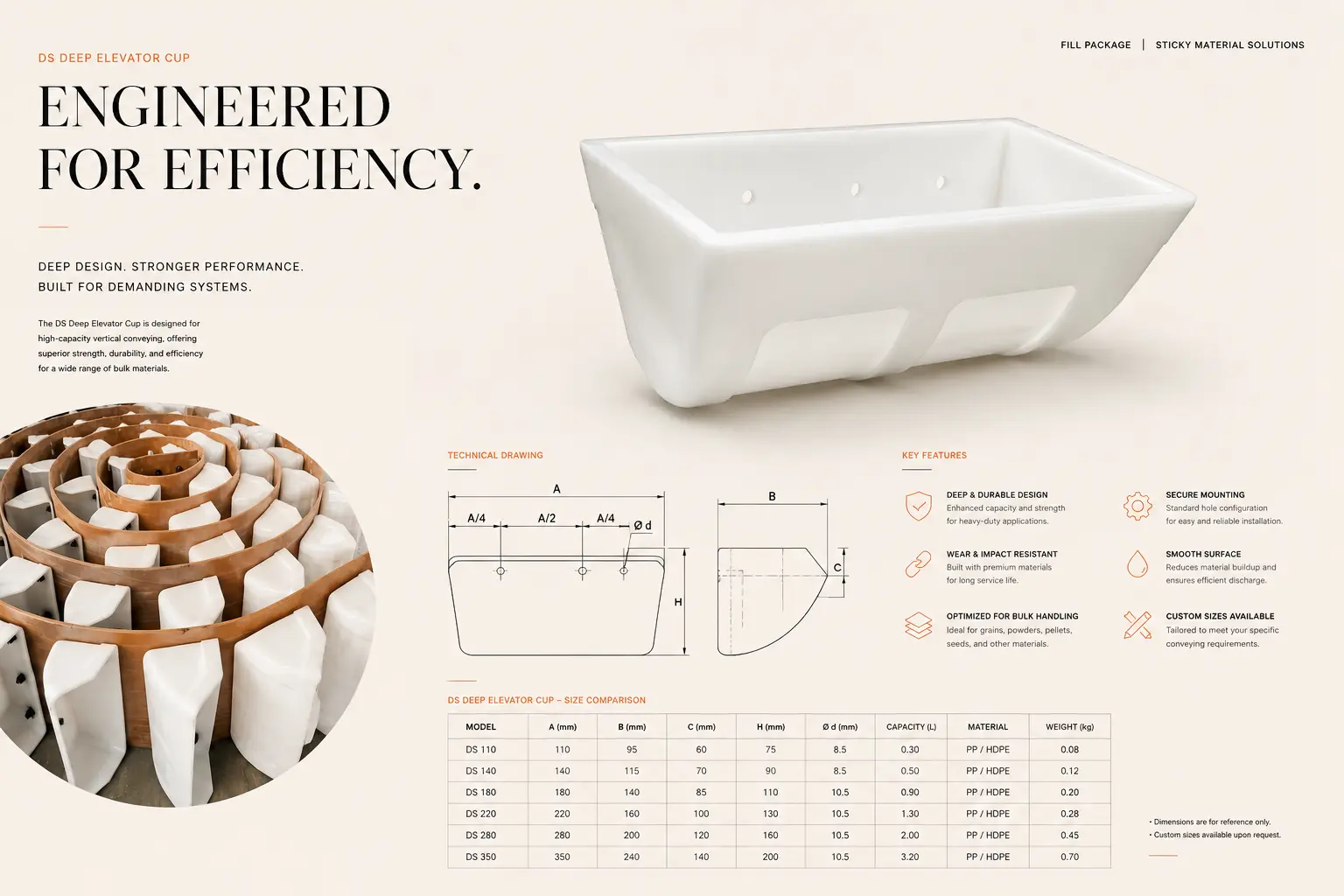
This article covers the specific geometric differences between DS deep and DQ shallow cups that affect backflow at high chain speeds, the modified DS profile (exemplified by DS1311A) designed specifically for seed industry applications where backflow prevention is critical, and the E-dimension measurement process that ensures replacement cups are chain-compatible.
For context on the A/B/C/D/E dimensional system and the fundamental DS vs DQ selection logic, read first: How Bucket Geometry Affects Material Throw: Deep (DS) vs. Shallow (DQ) Designs.
Section 1 — Backflow Mechanism
Understanding Backflow in High-Speed Elevator Systems
Backflow in a vertical bucket elevator occurs when material exits the cup on the upward run — through the cup’s open face — before reaching the discharge point at the head. The primary mechanism is the combination of centrifugal force and the cup’s trajectory on the chain. At high chain speeds (above approximately 1.2 m/s), the outward centrifugal acceleration on the material in the cup exceeds the gravitational component holding it in the cup. Material that sits too close to the open face of the cup is thrown outward and falls back down the elevator leg.
Why DS deep cups naturally reduce backflow
A DS deep cup holds material further back from the open face — the deep cavity geometry means the centre of mass of the material charge is further inside the cup, further from the lip. As a result, the effective centrifugal lever arm from the material’s centre of mass to the cup lip is shorter, and the tendency for the material to spill over the lip on the upward run is reduced.
In contrast, a DQ shallow cup holds material closer to the open face by design. On an inclined elevator, this shallow profile is an advantage because gravity assists the transition from vertical to inclined orientation. On a high-speed vertical elevator, however, the same shallow profile allows material to reach the cup lip more readily under centrifugal force, increasing backflow rate.
Quantifying the backflow difference
In controlled testing on a 1.5 m/s vertical grain elevator, backflow rates for standard DQ shallow cups at full load reach 8–12% of the theoretical fill — meaning 8–12% of the loaded material returns down the elevator leg rather than being discharged. In the same elevator with DS deep cups of equivalent nominal capacity, backflow rates are typically 2–4%. Therefore, for vertical grain elevator applications running above 1.2 m/s, DS deep cups provide a measurable throughput advantage through reduced backflow, independently of any difference in nominal cup capacity.
Section 2 — The Modified DS Profile
The Modified DS Profile: DS1311A and the Seed Industry Application
Standard DS deep cups reduce backflow through geometry — by holding material further from the cup lip. However, for specific high-value applications — particularly seed handling, where even small amounts of backflow cause seed mixing, contamination, and germination rate degradation — standard DS geometry is sometimes insufficient at very high chain speeds.
The DS1311A is a modified DS profile with an additional anti-backflow feature: the cup geometry is modified at the lip to create a slight inward curl or baffle at the leading edge of the cup. This geometry change reduces the effective opening area of the cup on the upward run, creating a partial barrier to backflow without reducing the cup’s fill capacity on the downward pass through the boot.
DS1311A specifications
| Параметр | DS1311 (Standard) | DS1311A (Modified — seed industry) |
| A dimension | 140mm | 134mm — slightly narrower overall width |
| B dimension | 108mm | 115mm — slightly greater projection depth |
| C dimension | 95mm | 94mm — similar cavity depth |
| D dimension | 35mm | 35mm — same back plate height |
| E dimension | 60mm | 60mm — same hole spacing |
| Hole count | 2 | 2 |
| Hole diameter | 7mm | 7mm |
| Емкость | 0.75L | 0.75L — identical nominal capacity |
| Backflow reduction | Standard DS performance | Additional lip geometry modification — specified for seed industry |
| Note | Standard agricultural use | 专供种子行业 (specialist for seed industry use) |
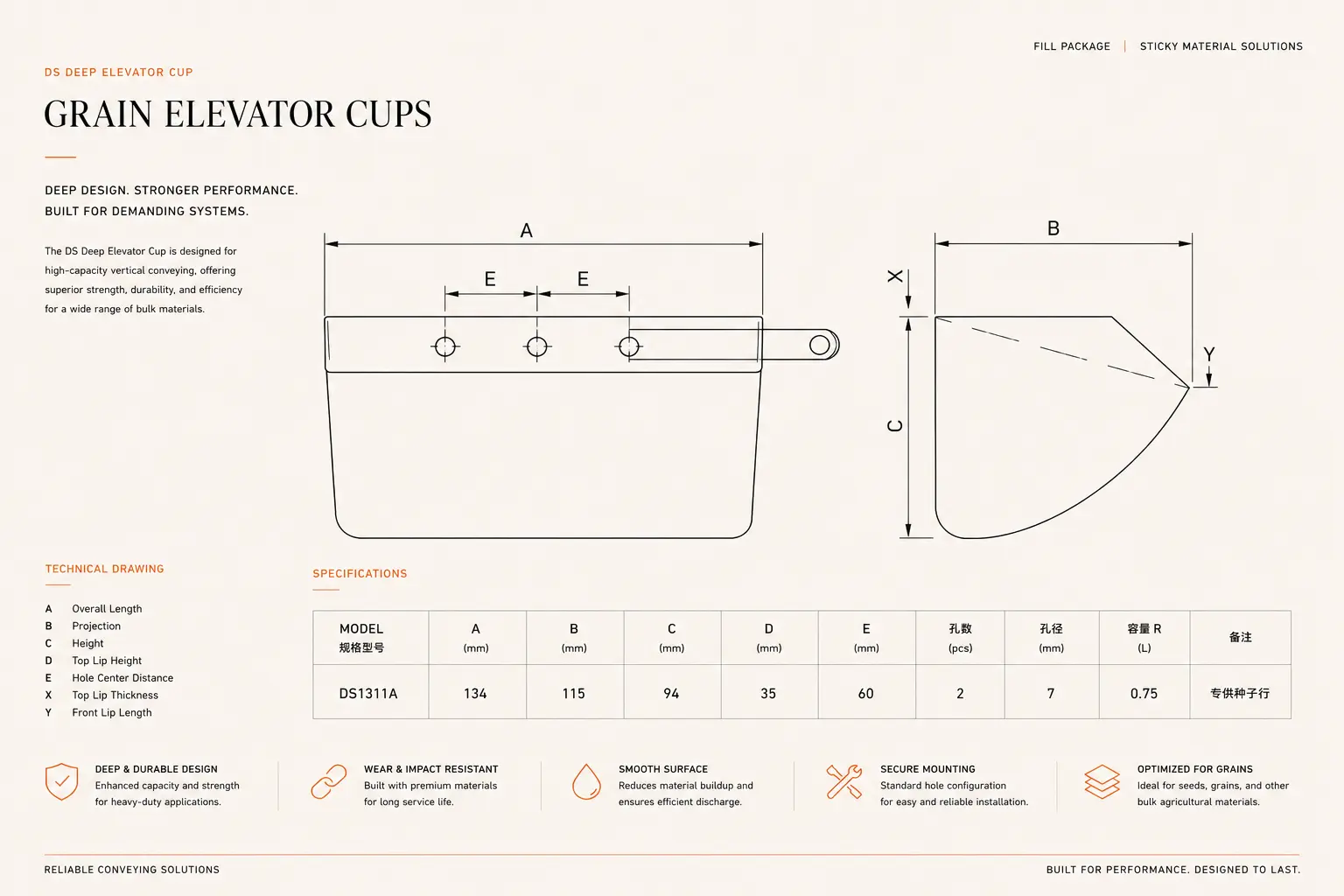
The DS1311A demonstrates that within the DS series, profile modifications beyond the standard A/B/C/D/E geometry can be made to address specific application requirements. For other applications where backflow is the primary performance concern at high speeds, discuss the specific chain speed, inclination angle, and product characteristics with our technical team — we can identify whether a modified profile or a different standard DS model provides better backflow performance for your conditions.
Section 3 — E-Dimension Measurement Guide
Measuring the E Dimension: Chain Compatibility for DS and DQ Replacement Cups
The E dimension — hole centre-to-centre spacing on the back plate — is the single most critical measurement for replacement cup compatibility. A DS or DQ cup with the correct A/B/C/D dimensions but the wrong E dimension cannot be installed on the elevator chain without re-drilling the holes. Since re-drilling weakens the back plate and introduces alignment uncertainty, the correct specification at the ordering stage is always preferable.
How to measure E accurately
- Remove an existing cup from the chain — or measure in position if the elevator can be stopped safely
- Clean the back plate surface to remove dirt or rust that might obscure hole edges
- Place a vernier caliper with one jaw at the centre of the first hole
- Extend the caliper to the centre of the second hole (or the furthest hole, for 3-hole or 4-hole back plates)
- Record the measurement to 0.5mm precision — E dimensions in the DS/DQ range span from 40mm (DS0705) to 170mm (DB2607 paddy cup), and a 2mm error can mean the difference between a compatible and incompatible cup
Additionally, measure the hole diameter. Standard DS and DQ holes are either 7mm diameter (for smaller cup sizes up to approximately DS1613) or 9mm diameter (for larger sizes). Ordering a cup with 7mm holes when the chain bolts are M8 (8mm nominal) will require enlargement in the field.
Custom E-dimension drilling
If your E dimension does not match any standard DS or DQ model, we drill to your specification. Provide the E measurement, hole diameter, and hole count — we include the custom hole pattern in the drawing confirmation before production. Custom drilling adds 2–3 business days to standard lead time and is included at no additional charge for orders above minimum order quantity.
For the complete DS and DQ size chart with all E dimensions: DS & DQ Промышленные лифтовые ковши страница продукта
Заключение
Backflow Prevention Is a Geometry Decision
Backflow in high-speed vertical elevator systems is predictable and preventable through correct cup profile selection. DS deep cups reduce backflow compared to DQ shallow cups on vertical elevators by holding material further from the cup lip under centrifugal loading. For applications where backflow must be reduced beyond standard DS performance, the modified DS1311A profile provides additional anti-backflow geometry specifically developed for seed industry requirements.
Furthermore, E-dimension accuracy in replacement cup specification eliminates the most common installation compatibility failure — a mismatch between the cup’s bolt holes and the chain’s bolt positions. Measuring to 0.5mm precision with a vernier caliper, and confirming with a drawing before production, is the standard process that ensures correct fit on the first installation.
Specify your DS or DQ replacement cups. Send us the existing cup model number, or the five dimensions (A/B/C/D/E) plus hole count and diameter. We issue a drawing confirmation within 24 hours. Свяжитесь с нашей технической командой
Continue reading: Preventing Backflow: Why Our Modified DS Profile Outperforms Standard Agricultural Buckets →