

Введение
In a food packaging or processing facility, the challenge is rarely how to package the product. Instead, the real difficulty lies in moving the product — reliably, continuously, without damage — from one stage of the line to the next. From the weigher to the bagger. From the processing area to the packaging floor. From floor level to an elevated discharge point that feeds the next machine.
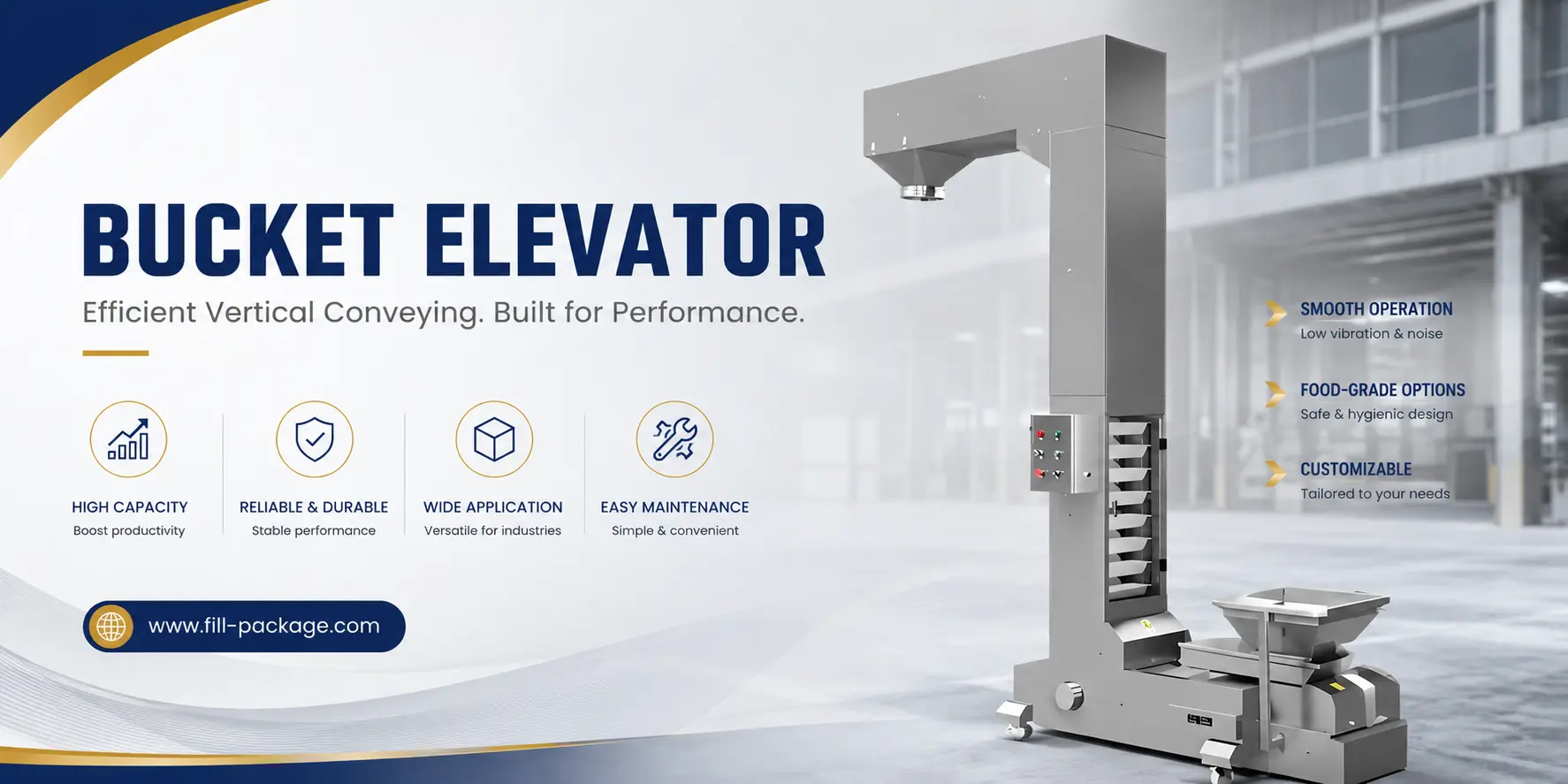
The Z type bucket elevator solves this problem in a way that no flat belt conveyor or inclined conveyor can. Specifically, it combines vertical lifting with horizontal travel in a single compact footprint, using a continuous chain of elevator buckets to carry product through a Z-shaped path that connects two different horizontal levels at two different floor positions.
This article explains the spatial logic of the Z type bucket elevator design, how the standard bucket sizes — 1.8L, 4L, and 6L — map to different throughput requirements, and why Z type elevator buckets have become the standard infeed solution for multihead weigher packaging lines across food, agricultural, and industrial processing industries.
For full specifications on Z type elevator buckets, visit our Z-Type Elevator Buckets product page.
Section 1 — The Z-Type Design Advantage
The Z-Type Elevator: Combining Vertical and Horizontal Travel in One Footprint
A conventional inclined belt conveyor lifts product from a lower level to a higher level along a straight inclined path. This works well for large, stable products — however, for granular food products, the incline creates a spillage problem: product that is not fully contained rolls back down the belt, particularly at steep angles. Moreover, the inclined conveyor requires floor space proportional to the height change — a 2-metre height gain at 45° requires roughly 2 metres of horizontal floor space.
The Z type bucket elevator, by contrast, solves both problems simultaneously. The Z shape — horizontal infeed section at the bottom, vertical lift section in the middle, horizontal outfeed section at the top — delivers three specific advantages:
- Steep vertical sections: the enclosed buckets contain product completely during the vertical lift, with no spillage regardless of inclination angle
- Horizontal inlet and outlet: the infeed and outfeed positions are horizontal, allowing the elevator to connect two machines at different heights and different floor positions without requiring a diagonal floor path between them
- Compact footprint: the vertical section of the Z occupies only the cross-section of the elevator casing — typically 300mm to 600mm wide depending on bucket size — rather than a long inclined floor run
As a result, for a packaging line where a floor-level batch hopper or processing output needs to feed an elevated multihead weigher, the Z type bucket elevator is the standard solution. It achieves the height change in minimum floor area, with fully enclosed product handling throughout.
The Spatial Advantage in Numbers
A 2-metre height gain on a standard inclined conveyor requires approximately 3–4 metres of horizontal floor space at 30–45° inclination. A Z type bucket elevator, in comparison, achieves the same 2-metre height gain in a footprint of approximately 0.8m × 0.4m for the vertical section, plus the inlet and outlet horizontal runs — typically less than 1.5 metres total floor length. For a food factory where every square metre of floor space carries a cost, this difference is operationally significant.
Section 2 — Bucket Sizes and Throughput
Z-Type Elevator Bucket Sizes: Matching Capacity to Throughput
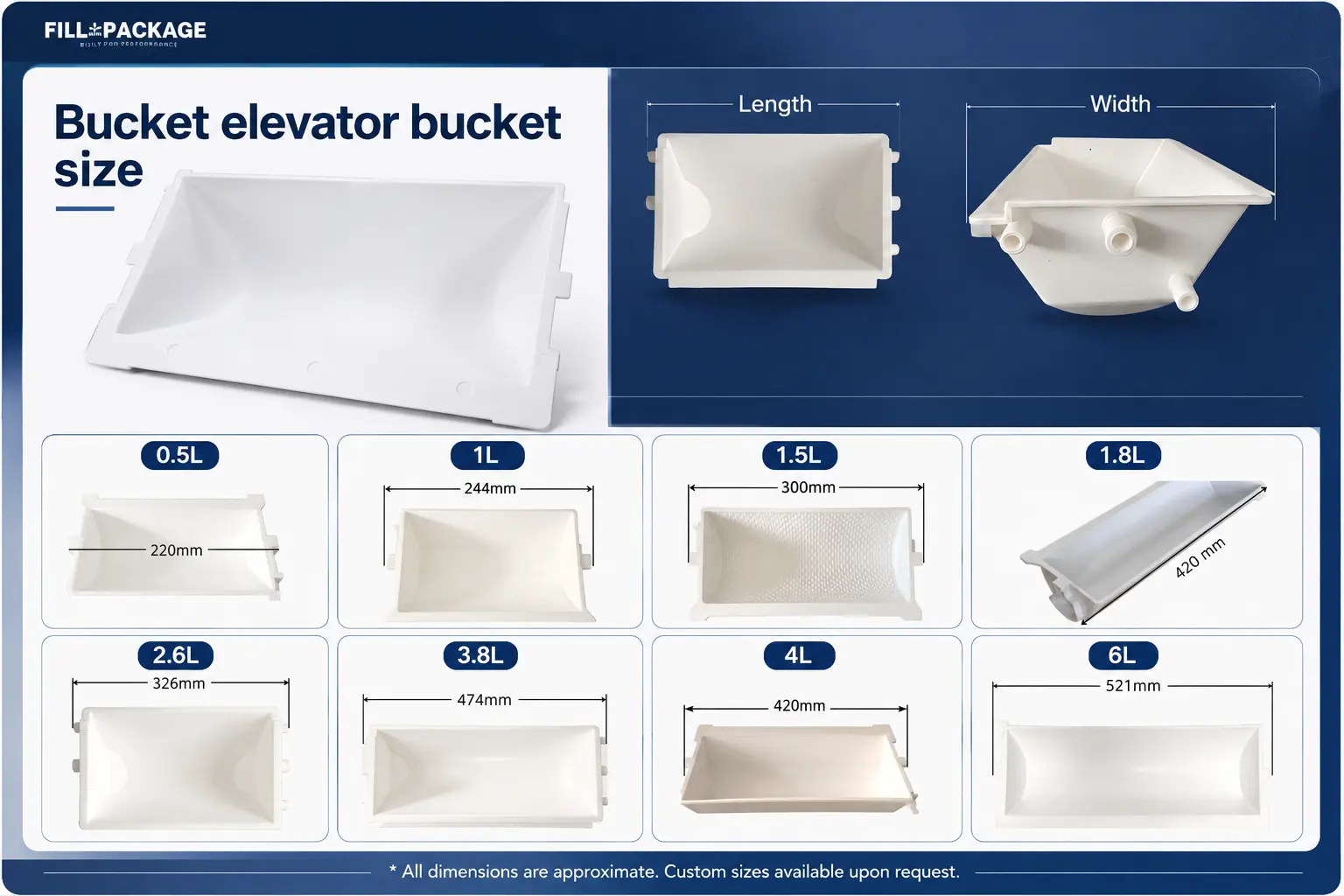
The three main Z type elevator bucket sizes — 1.8L, 4L, and 6L — are not arbitrary choices. Rather, each covers a specific range of throughput requirements, and the correct size for a given line depends on the product bulk density, the target throughput in kg/hour, and the chain speed the elevator runs at.
The calculation is straightforward: throughput (kg/hour) = bucket capacity (L) × bulk density (kg/L) × buckets per hour. Buckets per hour is determined by chain speed and bucket spacing. Consequently, for a given chain speed and bucket spacing, a larger bucket delivers proportionally more product per hour.
| Bucket Size | Typical Capacity Range | Mounting Width | Best Application | Typical Throughput (at 30 cycles/min) |
|---|---|---|---|---|
| 0.5L – 1.5L (compact) | Compact lines, precision volume | 220mm – 380mm | Coffee capsule filling, pharmaceutical granules, small seeds | 50–200 kg/hr (product-dependent) |
| 1.8L (standard) | Most common — versatile | 412 / 416 / 418 / 420mm | Snacks, nuts, coffee beans, spice seeds, dal — standard food packaging line infeed | 150–400 kg/hr |
| 4L (high throughput) | Higher volume, lower bulk density | 420mm | Puffed snacks, freeze-dried fruit, large-format food products | 300–700 kg/hr |
| 6L (high capacity) | Industrial or large-format | 491mm (Type B) / 521mm (Type A) | Grain, large nuts, high-volume agricultural products | 500–1,200 kg/hr |
Note: throughput figures are indicative and depend heavily on product bulk density. For dense products (e.g., steel hardware at 4.5 kg/L bulk density), a 1.8L bucket delivers far more mass per cycle than for puffed snacks at 0.08 kg/L. Therefore, always calculate throughput for your specific product density and required kg/hour.
Why the 1.8L Bucket Is the Most Commonly Specified Size
The 1.8L Z type elevator bucket has become the de facto standard for food packaging line infeed elevators for three reasons. First, it matches the consumption rate of 10–16 head multihead weighers running at typical operating speeds. Second, its mounting width range (412–420mm) covers the chain pitch standards used by the majority of Chinese Z type elevator OEM manufacturers. Third, its physical dimensions allow it to be sourced as a direct replacement for virtually any Z type elevator currently operating in food packaging lines.
Furthermore, the availability of four mounting widths (412mm, 416mm, 418mm, 420mm) for the 1.8L size means that a single bucket design covers the dimensional variation across elevator brands. As a result, the correct mounting width is the only dimension that needs to be confirmed for a standard replacement order.
Section 3 — Multi-Stage Line Integration
How Z-Type Elevators Connect Multi-Stage Production Lines
In a multi-stage food processing and packaging line, the Z type bucket elevator typically appears at one or more key transition points. The table below summarises the most common positions and explains why Z type is selected for each:
| Line Position | От | To | Why Z-Type Is Used Here |
|---|---|---|---|
| Raw material infeed | Floor-level bulk hopper or delivery point | Elevated multihead weigher infeed | Height change in minimum floor space; enclosed handling for hygiene |
| Inter-stage transfer | Processing output (e.g., fryer, coater, cooler) | Packaging machine infeed weigher | Bridges height and horizontal distance between machines in different positions |
| Secondary packaging infeed | Primary packaging line output | Case packer or carton filler infeed | Lifts finished primary packs to the infeed height of the secondary line |
| Multi-line distribution | Single bulk hopper at floor level | Multiple weighers on elevated platform | Multi-outlet buckets (2.6L, 3.8L) distribute to multiple lines from one elevator |
The Multi-Outlet Capability
The multi-outlet bucket design — covered in detail in the next article in this series — is particularly valuable in the fourth scenario: where a single elevator needs to distribute product to multiple downstream weighers or filling heads simultaneously. In contrast to a conventional conveyor, the Z type elevator achieves this distribution within the bucket cycle itself, without requiring a separate distribution conveyor between the elevator discharge and the individual weigher infeeds. This is the Z type elevator’s most distinctive capability.
Заключение
The Z-Type Elevator Bucket: The Standard Solution for a Reason
The Z type bucket elevator design has become the industry standard for food packaging line infeed because it addresses the space, hygiene, and reliability problems that alternatives cannot. Specifically, the enclosed bucket design eliminates spillage, the Z path minimises floor footprint, and the standardised bucket sizes — 1.8L, 4L, 6L — cover the full range of food packaging line throughput requirements. Additionally, the compatibility of bucket dimensions across Chinese elevator brands means that replacement buckets can be sourced precisely and quickly, without elevator-specific custom tooling.
Find the right Z type elevator bucket for your line. Visit our Z-Type Elevator Buckets product page for full size charts, mounting width options, and material specifications. Or browse the complete bucket elevator parts range.
Continue reading: Z-Type vs. Industrial Buckets: Choosing the Right Volume and Design for Your Material →