

When designing or upgrading a packaging line, conveyor selection directly impacts space usage, line efficiency, and long-term operational stability. Two commonly considered solutions are spiral flat top chain conveyors Ve straight flat top chain conveyors.
While both use flat top chain technology, they are designed to solve different layout and production challenges. Understanding the differences between spiral and straight conveyors helps packaging engineers choose the most effective solution for their specific application.
How Straight Flat Top Chain Conveyors Work
Straight flat top chain conveyors transport products horizontally along a single plane. They are widely used for machine-to-machine transfer, take-away conveyors, and accumulation sections where sufficient floor space is available.
Straight conveyors are commonly selected for:
Horizontal product transfer
Simple conveyor layouts
Stable handling of upright containers
Easy integration between packaging machines
Because of their simplicity, straight flat top chain conveyors are often the first choice in packaging lines with minimal space constraints.
How Spiral Flat Top Chain Conveyors Work
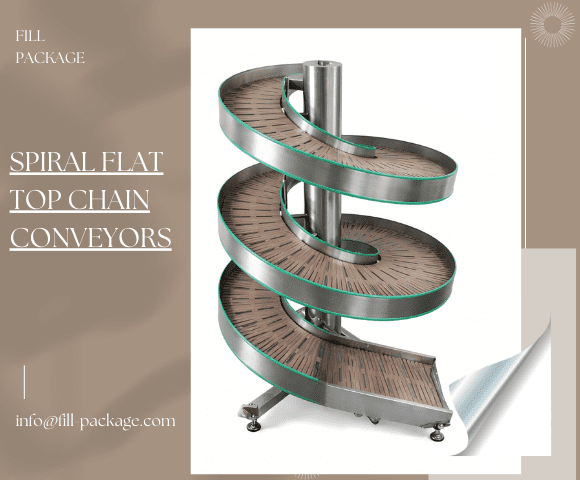
Spiral flat top chain conveyors transport products vertically along a continuous spiral path. Instead of extending horizontally, products move upward or downward while maintaining stable orientation on the same conveying surface.
Plastic spiral flat top chains are specifically designed to:
Combine vertical conveying and accumulation
Maximize use of vertical space
Reduce overall conveyor footprint
Maintain continuous product flow
This makes spiral conveyors particularly valuable in packaging facilities where floor space is limited.
Space Utilization Comparison
Space efficiency is one of the most significant differences between spiral and straight conveyors.
Straight conveyors require sufficient horizontal space to achieve accumulation or elevation changes. As production speed increases, the required conveyor length can grow quickly, consuming valuable floor area.
Spiral flat top chain conveyors use vertical space to achieve the same or greater accumulation capacity. By stacking conveying paths vertically, spiral systems dramatically reduce the footprint required for buffering and elevation.
When space is limited, spiral conveyors often provide a more practical and scalable solution.
Accumulation Capacity and Line Buffering
Accumulation plays a critical role in maintaining continuous production flow, especially when packaging machines operate at different speeds.
Straight conveyors provide accumulation by extending conveyor length. While effective, this approach requires additional floor space and may complicate line layouts.
Spiral flat top chain conveyors provide vertical accumulation within a compact footprint. Products accumulate along the spiral path, allowing packaging lines to absorb downstream interruptions without stopping upstream equipment.
This buffering capability helps improve overall line efficiency and reduce unplanned downtime.
Layout Flexibility and Integration
Straight flat top chain conveyors are well suited for simple, linear packaging line layouts. They integrate easily with filling, labeling, and inspection equipment where machines are aligned on the same level.
Spiral conveyors offer greater flexibility when packaging lines involve:
Multiple height levels
Space constraints
Complex routing requirements
Expansion within existing facilities
By reducing the need for long horizontal conveyors, spiral flat top chain systems simplify layout design and support future line modifications.
When a Straight Conveyor Is the Better Choice
Straight flat top chain conveyors are typically preferred when:
Floor space is sufficient
Conveying is primarily horizontal
Accumulation requirements are minimal
Line layout is simple and linear
In these cases, straight conveyors provide a cost-effective and straightforward solution.
When a Spiral Flat Top Chain Is the Better Choice
Spiral flat top chain conveyors are typically preferred when:
Floor space is limited
Vertical conveying is required
Accumulation capacity is critical
Packaging lines operate at high speed
Future line expansion is expected
Spiral systems help packaging lines achieve higher efficiency without expanding facility footprints.
Choosing the Right Conveyor for Your Packaging Line
Selecting between spiral and straight conveyors depends on a careful evaluation of:
Available floor and vertical space
Required accumulation capacity
Production speed and throughput
Packaging line layout and expansion plans
Understanding these factors helps packaging engineers select conveying solutions that support both current production needs and future growth.
Explore Spiral Flat Top Chain Solutions
If your packaging line requires space-efficient accumulation or vertical conveying, spiral flat top chain conveyors may provide the right solution.
👉 Learn more about Plastic Spiral Flat Top Chain Conveyors
👉 Explore Flat Top Chains for Packaging Lines
👉 Discover Plastic Flat Top Chains for straight conveying applications