

The Cold-Chain Packaging Line That Never Quite Works
Picture your facility at 6am: a 6°C chill room, a production target of 3,000 bags before noon, and a multihead weigher that looked perfect in the supplier’s video. Then the first tray of boneless chicken feet arrives.
| ⚠️ The Poultry Packaging Bottleneck In a 4°C–10°C low-temperature facility, handling fresh or marinated poultry — chicken wings, boneless feet, marinated drumstick chunks — is the number one bottleneck on automated packaging lines. Water activity, natural collagen, and marinade viscosity combine to defeat vibration-based feeding within minutes of startup. The result: uneven hopper fill, weight drift, manual intervention, HACCP incidents, and an OEE that never climbs above 60%. |
This article is written specifically for poultry processing facility managers, meat packaging line engineers, and procurement teams evaluating automatic weighing equipment for fresh, marinated, or bone-in protein products. If you package dry snacks or frozen vegetables, a standard multihead weigher will serve you well. If you package anything that was alive recently and still contains moisture, keep reading.
Why Standard Multihead Weighers Fail on Poultry Lines
Standard multihead weighers operate on a single physical principle: vibration moves product. A vibrating top cone distributes material outward; vibrating linear pans carry it to weigh hoppers. For dry, free-flowing material, this works flawlessly.
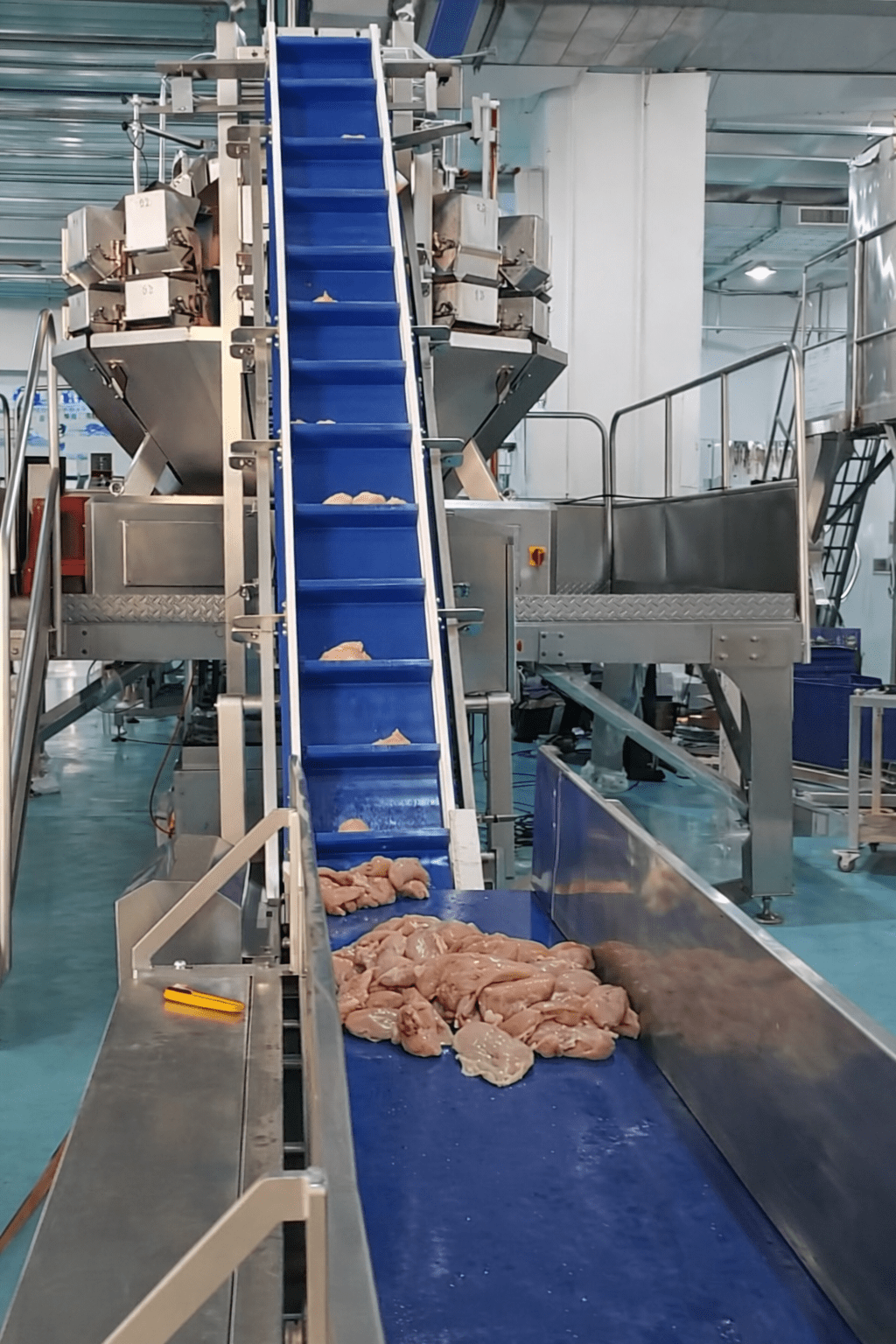
Three reasons vibration fails on poultry:
- Collagen & Skin Adhesion: Fresh poultry skin contains collagen that acts as a natural adhesive at temperatures below 10°C. The surface of chicken feet, wings, or skin-on thighs bonds directly to stainless steel pans. Vibration cannot overcome this bond — it compresses the adhesion layer instead of breaking it.
- Marinade Vacuum Effect: Thick sauces on marinated meat form a partial vacuum seal between the product and the hopper wall when the hopper closes. When the door opens to release the product, some material stays behind. That residue is weighed in the next cycle — corrupting your combination accuracy by 3–8g per hopper.
- Irregular Geometry & Bridging: Bone-in cuts, whole chicken feet, and large steak cubes have irregular shapes that mechanically interlock across the pan outlet, creating bridges. On dry product, the next vibration cycle breaks the bridge. On sticky protein, the bridge holds. Hoppers starve. The machine’s combination logic runs with empty buckets and produces underweight bags.
| 📊 What This Costs You Every Shift A 14-head weigher targeting 500g packs at 55 bags/min. If 4 hoppers average 40% starving time due to bridging and adhesion, effective throughput drops to ~43 bags/min. That’s 720 bags/hour lost — 7,200 bags per 10-hour shift. At £0.40 margin per bag, that’s £2,880 of production capacity evaporated. Every. Single. Day. |
Three Poultry Products, Three Failure Modes — One Engineering Solution
These are the three product types we encounter most frequently on poultry packaging lines. Each has a specific failure mode on standard equipment — and a specific mechanical solution:
| Ürün | ❌ Standard Weigher Failure Mode | ✅ Screw Feeder Solution |
| 🐔 Boneless Chicken Feet (无骨鸡爪) | EXTREME: collagen-rich skin creates near-glue adhesion. Vibration compacts pieces into solid mass. Hoppers jam within 3 min. Workers must stop line and manually separate — HACCP violation every time. | Screw auger with wide-pitch geometry physically separates each foot during transport. Dimpled hoppers prevent re-adhesion. Scraper option available for worst-case batches. Sustained 50+ bags/min without intervention. |
| 🥩 Marinated Steak Cubes | HIGH: thick sauce creates vacuum adhesion on hopper walls. At 60 bags/min, sauce splash contaminates sensors. Product falls in irregular clumps — weight variation ±8–12g per combination cycle. | Splash-guard covers contain sauce within the feed zone. Screw delivers cubes in controlled single-layer flow. Memory hoppers compensate for sauce-weight variation. Accuracy restored to ±1g. |
| 🍗 Fresh Chicken Breast | MODERATE: large, irregular cuts (150–400g each) are too heavy for vibration pans to move without bounce-damage. Muscle fibres tear at impact points. Drip loss increases. Product value degrades. | Low drop-height architecture limits fall distance to < 80mm. No bounce. Muscle integrity preserved. Large-format hoppers (3–5L volume) handle full-breast portions without crowding or compression. |
The common thread across all three: vibration is the wrong physics for wet protein. The only solution is Forced Mechanical Displacement — a rotating screw auger that pushes product regardless of adhesion, viscosity, or piece geometry. This is not a product feature. It is the fundamental engineering requirement for meat packaging automation.
2026 Industry Context: Why Washdown Design Is Now Non-Negotiable
Global food safety audit standards have tightened considerably entering 2026. FDA FSMA Rule 21 CFR Part 117, BRCGS Issue 9, and SQF Edition 9 all place increased audit weight on:
- Equipment cleanability— can every product-contact surface be reached, verified clean, and documented within a shift?
- Elimination of manual product contact— every instance of a worker touching product on an automated line is a HACCP critical control point failure.
- Water and chemical resistance— machines running in wet-meat environments must withstand high-pressure hot-water sanitisation daily without seal degradation.
Standard multihead weighers are rated IP54 at best — splash-proof, not washdown-proof. In a poultry facility running 80-bar pressure wash at 65°C twice daily, IP54 enclosures begin failing within 3–6 months. The corrosion pathway is direct: water ingress → PCB board corrosion → sensor drift → inaccurate weighing → full machine replacement.
IP67 construction — full submersion-rated — is the minimum standard for any equipment in a fresh or marinated meat facility. This is not a premium option. It is the cost of operating in this environment without a replacement machine budget.
Meat-Grade Screw Feeder Multihead Weigher: The Engineering Stack
Every component of a meat-grade screw feeder weigher is engineered for one environment: cold, wet, sticky, and subject to daily chemical sanitisation. Here is what that means in practice:
| Feature / Component | Engineering Detail for Meat & Poultry | Primary Application |
| Dimpled Surface Hoppers | 304 / 316 SS with electro-polished dimple pattern. Reduces product-to-metal contact area by ~40%, cutting adhesion force proportionally. No flat surfaces for sauce to pool on. | Boneless chicken feet, glazed wings, marinated pork belly |
| IP67 Full Washdown Construction | Every enclosure, motor housing, junction box and cable entry sealed to IP67. Withstands daily pressure-wash at 80 bar / 70°C. Eliminates the corrosion pathway that destroys standard machines within 6 months in wet-meat facilities. | All fresh poultry & red meat environments |
| Vidalı Zorla Besleme | Stainless helical auger physically pushes product into weigh hoppers at a controlled, adjustable rate. Eliminates vibration-based feeding entirely — the only engineering solution for materials that will not slide. | All sticky / wet / marinated proteins |
| Splash-Guard Hopper Covers | Enclosed feed zone with fitted covers prevents sauce splatter during high-speed drops. Keeps the weighing area clean between wash cycles, reduces inter-cycle contamination risk. | Marinated steak cubes, sauced ready-meal portions |
| Tool-less Disassembly (< 5 min) | Every screw shaft, hopper and trough section releases by hand-quarter-turn clamps. No spanners. Full strip-down for deep cleaning in under 5 minutes per shift change. Meets HACCP audit requirements without slowing production. | Any facility with shift-change cleaning protocols |
| Low Drop-Height Architecture | Hopper discharge points are positioned to minimise fall distance to the collection chute. Reduces impact force on delicate muscle fibres in chicken breast and large pork cuts, preserving texture and reducing drip loss. | Fresh chicken breast, large-format portions |
| 📷 Visual Recommendation Insert a close-up photograph of the Dimpled Surface (麻面板) hopper here, showing the texture pattern on the stainless steel surface. Macro lens preferred. Industrial buyers respond strongly to component-level evidence of engineering decisions. Alt text: “Dimpled stainless steel hopper surface — screw feeder multihead weigher for poultry packaging” |
The ROI Case: Manual vs. Automated Screw Feeder Weighing
When your production line moves from manual portioning to automated screw feeder weighing, these are the measurable outcomes:
| Metrik | Manual / Standard Weigher | Vida Besleyici Çok Kafalı Tartıcı |
| Weighing accuracy | ±3 – 5g (manual portioning) | ±0.5 – 1g (screw feeder weigher) |
| Bags per minute | 8 – 12 (manual) | 45 – 65 (automated) |
| Giveaway per bag (500g target) | 4 – 6g overfill to avoid short-weights | < 1g with combination logic |
| Giveaway cost (10 hr shift, 50 bags/min) | ~72 – 108 kg product wasted daily | < 18 kg — saving 54+ kg/shift |
| Workers required at weighing station | 3 – 5 (incl. manual feeders) | 1 (QC monitoring only) |
| HACCP manual-intervention incidents | Frequent (hand contact with product) | Zero (fully enclosed process) |
| Daily washdown time | 45 – 90 min (standard machine) | < 15 min (tool-less IP67 design) |
| 💡 The Giveaway Calculation At ±5g average giveaway per 500g bag on a manual or standard-weigher line: 50 bags/min × 5g × 600 min/shift = 150,000g = 150 kg of free product given away daily. At £4/kg for chicken breast, that is £600/shift — £150,000+ per year — simply from inaccurate portioning. Screw feeder combination logic reduces giveaway to < 1g, recovering > £120,000 of that annually. That is typically a payback period of under 14 months on the capital investment. |
İlgili Kaynaklar
For a full technical comparison of vibration-based vs. screw feeder multihead weigher architecture, including head count selection, speed benchmarks, and accuracy data across 12 product categories, see our companion guide: Standart Çok Başlı Tartı mı Vidayla Besleyici mi: Yapışkan Et İçin Hangisi Daha İyi?
For details on the full Kimchi and fermented vegetable packaging use case, including corrosion-resistance requirements and brine drainage design: Solving the “Sticky” Problem: Why Your Packaging Line Clogs and How to Fix It
Next Step: Get a Custom Layout for Your Meat Packaging Line
No two poultry facilities are the same. A boneless chicken feet line at 70 bags/min in a Korean export facility has different requirements from a marinated steak cube line at 35 bags/min in a UK retail-ready operation. We engineer to your product — not to a catalog.
| Looking for a Turnkey Meat Packaging Solution? We don’t supply individual machines. We deliver complete infeed-to-bagging lines engineered around your specific product — boneless chicken feet, marinated steak cubes, fresh breast fillets, or anything in between. Download our Meat Packaging Automation ROI White Paper or request a custom layout for your facility. |
Our engineering team will specify the correct screw geometry, hopper volume, head count, and washdown configuration for your exact product and throughput target. We will provide a complete integration schematic — infeed elevator to bagging machine — with projected accuracy, OEE uplift, and ROI payback timeline.
Internal links to configure in WordPress:
Screw Feeder Multihead Weigher (Product Page) — primary product link
Et ve Kümes Hayvanları Ambalaj Çözümleri (Uygulama Sayfası)
Standard Weigher vs. Screw Feeder — Best for Sticky Meat?
Solving the Sticky Problem — Kimchi, Oily Food, Wet Pet Treats
Extremely Sticky Products Multihead Weigher (for extreme-viscosity materials)