

Your multihead weigher is running. The line is moving. But the numbers are off — underweight packs, inconsistent output, operators stopping to manually clear the hoppers. If you are running chicken breast packaging, fresh meat, marinated poultry, or kimchi, there is a very high chance the root cause is the same: product is sticking inside the hoppers, and the machine is fighting it every cycle.
This is not a settings problem. It is an engineering problem. And it starts with understanding why it happens in the first place.
It’s Not a Calibration Problem — It’s a Physics Problem
Multihead weigher hopper: The individual bucket at each weighing head that holds product until the machine’s algorithm selects it for a target-weight combination. The hopper door opens to discharge product into the collection chute below.
When customers first call about this issue, they rarely say “product is sticking.” They say: “the accuracy is off” or “we’re getting too many light packs.” The sticking is invisible to them at first — what they see is the result.
Here is what is actually happening: fresh chicken pieces are large, dense, and moist. Each piece makes full surface contact with the stainless steel hopper wall. Stainless steel and wet protein have a natural adhesion to each other. The piece does not slide cleanly on discharge — it leaves a residue. That residue accumulates over cycles. The load cell reads the residue as part of the next charge. The hopper appears to contain more product than it does. The machine compensates by adding less — and the pack comes out light.
This is not something you can calibrate away. You cannot adjust a parameter to make wet chicken stop adhering to flat stainless steel. The physics does not change because you updated a setting. What changes it is the surface the product touches and the mechanical action of the hopper door.
Why Fresh Chicken Is One of the Hardest Products to Weigh Automatically
Not all meat behaves the same way inside a multihead weigher. Understanding the differences matters when specifying a machine for chicken packaging, poultry packaging, or mixed protein lines.
| Ürün Türü | Stickiness Level | Primary Challenge |
|---|---|---|
| Fresh chicken breast (bone-out) | Yüksek | Large contact surface per piece, natural moisture adhesion |
| Bone-in poultry cuts | Yüksek | Irregular shape + bone edges catching on hopper joints |
| Fresh pork / beef cubes | Orta | Less surface moisture than poultry, smaller contact area |
| Marinated chicken (Korean BBQ, teriyaki) | Çok Yüksek | Sauce coating dramatically increases adhesion to all surfaces |
| Kimchi / pickled vegetables with brine | Yüksek | Brine residue accumulates and affects both stickiness and corrosion |
| Seasoned meat with oil and spice rubs | Çok Yüksek | Oil fills surface texture, Teflon becomes less effective |
Fresh chicken breast is particularly challenging because of two combined factors: the physical size of each piece (individual pieces commonly run 150–400g with large flat contact surfaces) and the natural protein-to-metal adhesion that occurs with moist poultry. The piece does not behave like a nut or a frozen IQF product that bounces cleanly off the hopper wall on discharge.
Marinated and seasoned meat raises the difficulty further. Sauce, oil, and spice coatings increase the adhesive force between product and surface significantly. A machine configured adequately for fresh chicken may struggle with the same customer’s marinated product line running on the same equipment.
For kimchi packaging and Korean kimchi packaging applications, brine adds a third variable: the liquid does not just cause sticking — it pools in hopper seams, affects weighing accuracy through residue, and over time causes corrosion if the machine is not specified with appropriate stainless steel grade and sealed hopper joints.
What Happens Inside the Hopper When Meat Gets Stuck
The failure sequence is gradual, which is exactly why it is easy to miss until it becomes a serious accuracy problem.
Cycle 1–10: A thin film of moisture and protein transfers from the chicken piece to the hopper wall on discharge. The door opens, most of the product falls, a small amount adheres. The load cell auto-zeros at its next interval and compensates. Packs are within tolerance.
Cycle 10–50: Residue layers build. The auto-zero function — which the machine uses to periodically reset the hopper’s baseline weight reading — compensates for some of the drift. Operators do not notice because the machine is correcting itself. But the physical residue is still there.
Cycle 50+: Residue accumulates beyond what auto-zero can compensate for. The machine begins combining hopper charges that are actually lighter than registered. Underweight packs appear in volume. At this point, the operator typically stops the line to manually clear hoppers — losing production time that accumulates across every shift.
The auto-zero function is a useful feature, and customers can set its interval based on their product and production conditions. But it is a compensation tool, not a solution. It manages the symptom. It does not remove the residue.
The Hopper Design Decisions That Make or Break Your Line
This is where the real engineering happens. There are three layers of design intervention for sticky meat products, applied in order of severity.
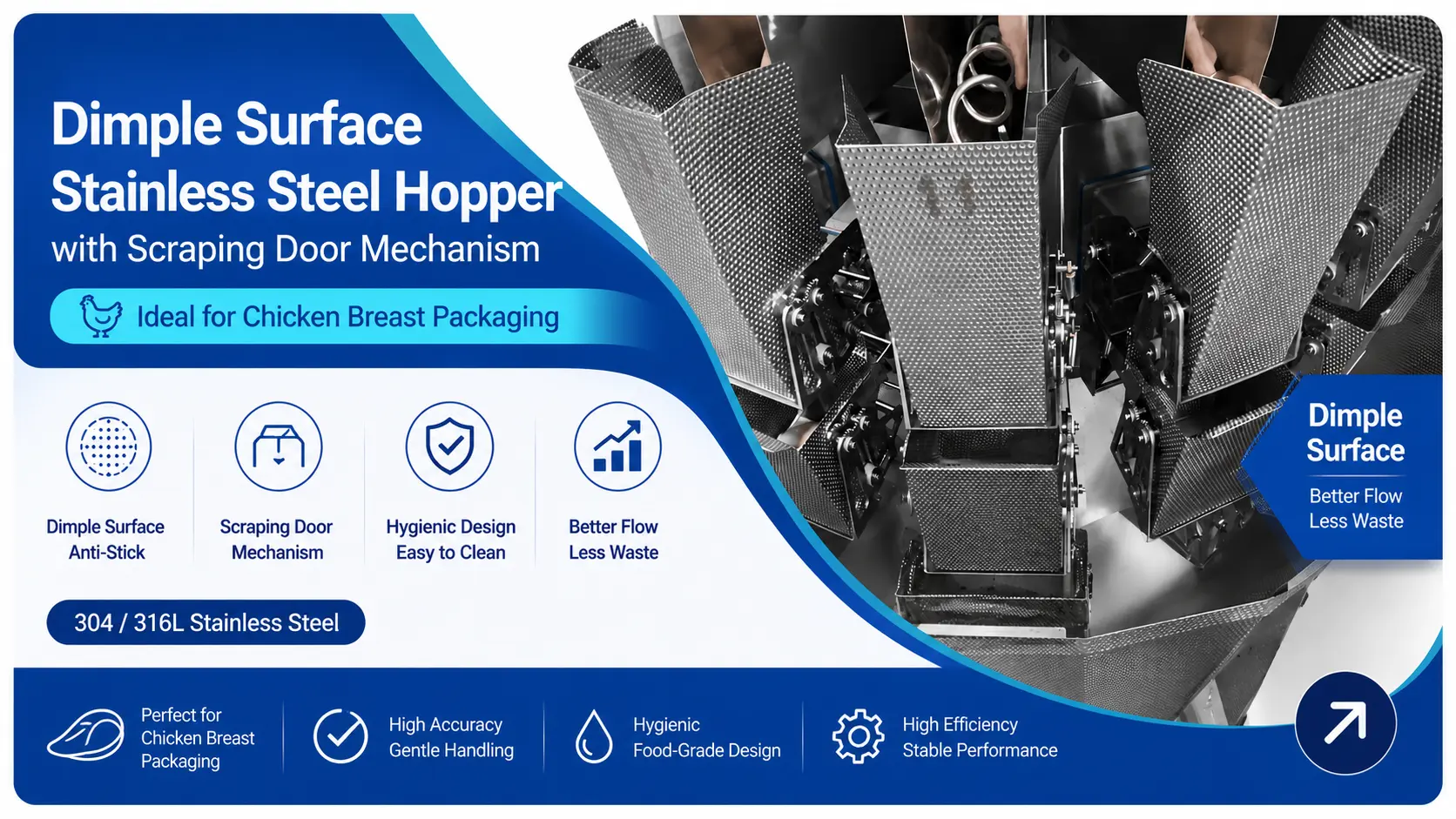
Caption: Dimple surface stainless steel hopper with scraping door mechanism — designed for chicken breast packaging and marinated meat applications.
Layer 1 — Dimple Surface Stainless Steel
Dimple surface (embossed plate): A stainless steel surface with a regular pattern of raised contact points, reducing the flat contact area between product and hopper wall to a series of small points rather than a continuous surface.
The principle is straightforward: the less surface area in contact, the less adhesion. A dimple surface reduces the effective contact area between a chicken piece and the hopper wall dramatically compared to smooth plate. Product that would adhere to a flat surface can release cleanly from a dimple surface because the adhesion points are small and distributed.
For most fresh chicken breast packaging and standard poultry packaging applications, a dimple surface alone provides a significant improvement in discharge consistency and residue reduction.
Layer 2 — Teflon (PTFE) Coating
Applied on top of the dimple surface for products with higher adhesion requirements. Teflon reduces the surface energy of the stainless steel, making it harder for moisture and protein films to form a bond.
For fresh chicken, marinated meat, and most kimchi packaging applications, dimple surface combined with Teflon coating handles the sticking problem reliably. This combination covers the majority of real-world poultry packaging and fresh meat packages scenarios.
Teflon is not unlimited in its effectiveness. For extremely sticky products — certain heavily sauced preparations, specific coated snack foods, or some high-starch cooked products — Teflon alone cannot maintain clean discharge over a full production shift. In these cases, the hopper door mechanism becomes the critical variable.
Layer 3 — Hopper Door Mechanism
This is the most important and most overlooked design decision in the entire machine specification process. There are three configurations, each matched to a different level of product stickiness:
Standard dual-door (双开门): Both hopper doors open outward symmetrically. Product falls by gravity. Suitable for moderately sticky products on a dimple + Teflon surface. Not recommended for fresh bone-out chicken breast or marinated products without additional surface treatment.
Scraping door (刮斗式): The door mechanism includes a scraping edge that sweeps across the hopper interior surface as it opens. This physically removes product that has adhered to the wall rather than relying on gravity alone. Recommended for marinated chicken, seasoned meat, products with light sauce coatings, and packaging of meat and poultry products where residue is a consistent issue.
180-degree flip hopper (反斗式 / 翻斗式): The entire hopper bucket inverts — rotating a full 180 degrees — to discharge product. When the hopper is upside down, gravity works against any residue remaining on what is now the upper surface. This is the most aggressive mechanical discharge mechanism available and is specified for the most challenging sticky applications.
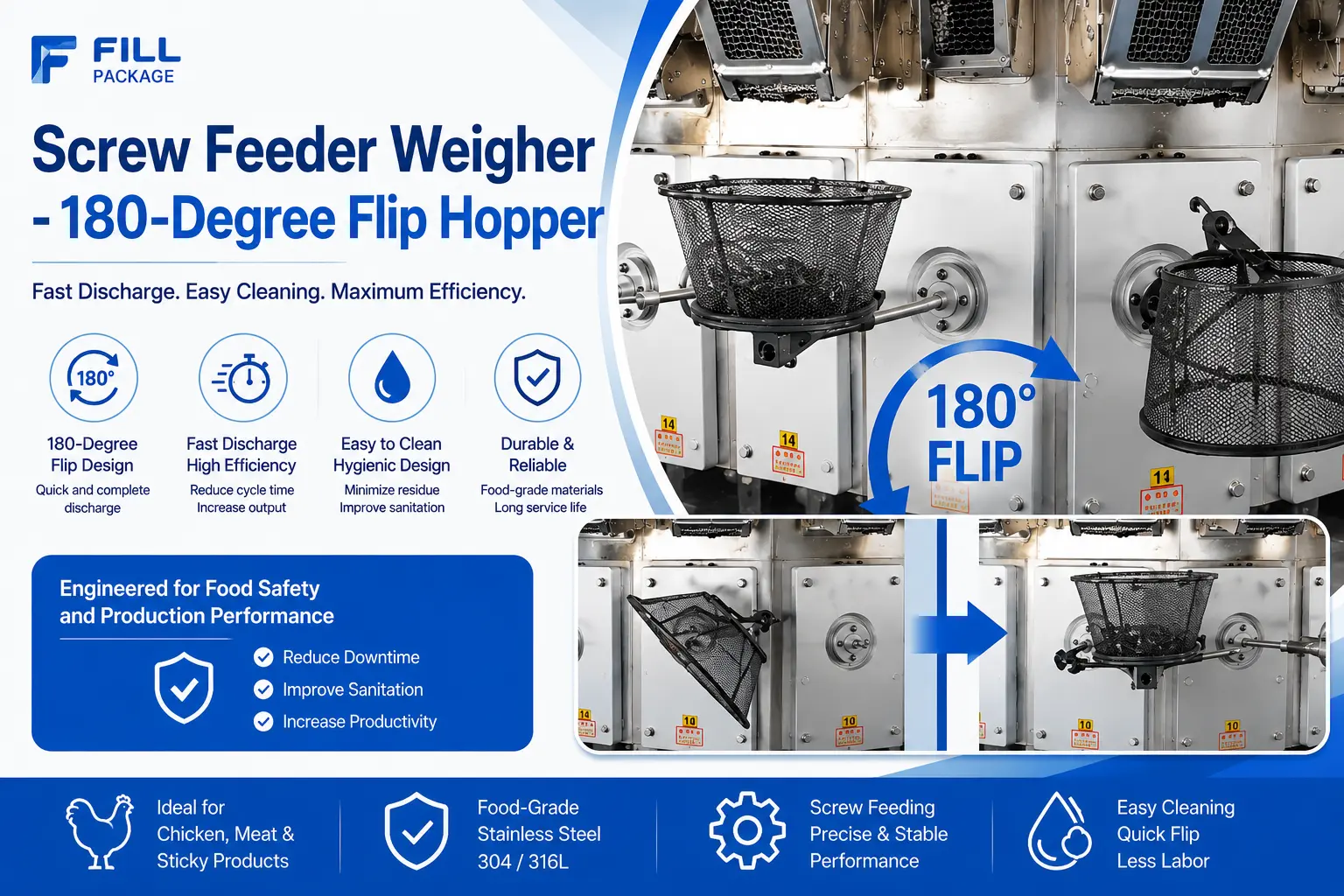
Caption: Fill Package 180-degree flip hopper in operation — full bucket inversion ensures complete discharge for the most challenging sticky meat and kimchi packaging applications.
| Hopper Type | Mekanizma | Recommended For |
|---|---|---|
| Standard dual-door | Gravity discharge | Free-flowing, lightly sticky products |
| Scraping door | Door sweeps hopper wall on open | Marinated meat, light sauce coating, seasoned poultry |
| 180° flip hopper | Full bucket inversion | Heavily marinated product, maximum sticky applications |
When Teflon Is Not Enough
Teflon coating solves the problem for most fresh meat and standard marinated product applications. But there are real-world scenarios where it reaches its limits, and knowing them in advance saves a failed line installation.
Products where Teflon coating alone is insufficient:
- Heavily sauced preparations where sauce pools and sets in the dimple texture between cycles
- Certain cooked and seasoned snack products with high starch or sugar content that caramelize on the hopper surface under production heat
- Products with oil-based coatings where the oil fills the dimple relief and eliminates its surface-area-reduction benefit over time
In these cases, the solution moves beyond surface treatment into hopper mechanism design (scraping or flip) and, for the most challenging products, into the feeding system itself. When the sticking problem exists not just at the hopper but throughout the feeder pans and dispersion table, the correct solution is a Vida Besleyici Çok Kafalı Tartıcı — which replaces vibration-based feeding with active mechanical pushing across every surface the product touches.
For a detailed explanation of when to make that transition, see our guide on how to handle sticky products on a multihead weigher.
The Mistake Most Buyers Make Before They Order
This is the most common situation we encounter, and it is worth being direct about it.
A customer contacts us with a product list: fresh chicken breast, marinated teriyaki thighs, bone-in drumsticks, and kimchi pouches. They want one machine. They want it to handle all four products. They want the best price.
The request is completely understandable — fewer machines means lower capital cost, smaller floor space, simpler maintenance. The problem is engineering reality: each of those four products has a different stickiness level, a different piece size, a different moisture content, and a different behavior on a discharge surface. A machine configured optimally for fresh chicken breast will not be configured optimally for heavily marinated teriyaki thighs. A hopper that handles kimchi brine correctly may be over-specified for bone-in drumsticks.
A machine that is supposed to handle everything usually handles nothing particularly well.
The correct process is this: before specifying any machine, send us the actual product — a photo at minimum, a physical sample when possible. We evaluate each material’s surface behavior, flow characteristics, and adhesion level individually. We then specify the machine around the most demanding product in your range and confirm through testing whether it handles the others adequately. If it does not, we tell you — before you have signed a purchase order, not after.
Customers do not always want to hear this. They typically believe it until the machine arrives and the problem they were warned about is exactly what they experience. The honest conversation before the order is always easier than the expensive one after.
Sıkça Sorulan Sorular
Why does my multihead weigher keep producing underweight packs with chicken?
The most common cause is product residue building up inside the weigh hoppers. Fresh chicken breast adheres to stainless steel surfaces due to surface moisture and the large contact area of each piece. Over time, residue accumulates and the hopper registers less product than it actually holds, producing consistently underweight packages. The machine’s auto-zero function compensates temporarily, but it does not remove the residue. Only correct hopper design and regular cleaning address the root cause.
What is a scraping hopper and when do I need one?
A scraping hopper uses a door mechanism that sweeps across the hopper interior as it opens, physically removing product that has adhered to the wall. It is recommended for moderately sticky products — marinated chicken, seasoned meat, products with light sauce coatings. For extremely sticky products, a 180-degree flip hopper, which inverts the entire bucket to discharge, is the stronger solution.
Does Teflon coating last long in a meat packaging environment?
Teflon (PTFE) coating is effective and durable for most chicken packaging and standard marinated meat applications. It does wear over time in high-throughput environments and does not fully solve adhesion for extremely sticky products — heavily sauced items or high-starch cooked foods. For fresh chicken breast packaging and standard poultry packaging, dimple surface combined with Teflon coating is typically sufficient across normal service intervals.
Can one multihead weigher handle both fresh chicken and marinated meat?
In practice, a machine configured for one product rarely performs optimally across very different products. Fresh chicken and heavily marinated meat have different stickiness levels, moisture content, and hopper discharge behavior. A single machine can sometimes cover a range of similar products, but a machine that is supposed to handle everything usually handles nothing particularly well. We always recommend material testing for each specific product before finalizing the machine specification.
How do I know if my hopper design is right for my product?
The clearest signal is the residue pattern after a production run. If hoppers consistently show visible product adhesion after discharge, your current hopper design is not matched to your material. Send us a product photo or physical sample. We will evaluate the surface behavior and recommend the appropriate configuration: standard, dimple surface, Teflon-coated, scraping door, or 180-degree flip hopper.
Çözüm
Meat sticking to multihead weigher hoppers is one of the most common and most misdiagnosed problems in chicken breast packaging, poultry packaging, and fresh meat packaging lines. It looks like an accuracy problem. It presents as light packs and inconsistent output. But the root cause is engineering: the wrong surface material, the wrong surface treatment, or the wrong hopper door mechanism for the product being run.
The fix is not a parameter adjustment. It is a design decision — made before the machine is ordered, based on the actual physical behavior of your specific product.
If your current line is producing underweight packs, stalling on marinated chicken, or struggling with kimchi brine residue, the starting point is simple: send us a photo of the product. We will tell you honestly what hopper design it needs — and whether the feeding system needs to change as well.
Explore our full range of Çok Kafalı Tartıcılar or go directly to the Vida Besleyici Çok Kafalı Tartıcı if your product has already proven too sticky for standard vibratory feeding.