

Introduction: The Bottleneck Is Upstream of the Weigher
Here is a conversation that happens regularly in meat processing facilities: a production manager identifies that giveaway and labour cost at the portioning station are too high, specifies a new multihead weigher, installs it — and finds that the problem has not gone away. The weigher is accurate. The weigher is fast. But the infeed conveyor cannot keep up.
In a high-volume fresh meat portioning and packaging line handling several tonnes of chicken legs, marinated beef chunks, or pork ribs per hour, the conveyor that feeds product into the weigher is carrying a load that most standard food conveyors were not engineered for. Fresh bone-in poultry pieces are dense and irregular. Marinated cuts in bulk are heavy, oily, and abrasive to belt surfaces. At high throughput, these products generate belt slip, chain stretch, and eventually — mechanical failure that shuts the entire line down.
This article addresses the system-level problem that single-component thinking misses: in a high-volume automatic meat weighing and bagging system, the conveyor and the weigher must be specified together, as a matched pair, or the weakest link will define the line’s real throughput ceiling.
This article is part of our meat processing automation series. For the cold-chain integration piece covering spiral freezing discharge, see Blog #49: Space-Saving Meat Portioning: Integrating Spiral Freezing with Automatic Weighing.
A. Breaking the Assumption: Why One Machine Is Not a System
The standard procurement logic for a meat weighing upgrade goes like this: measure the giveaway problem, find the weigher that reduces it, buy the weigher. This logic works in a dry snack facility where the conveyor is moving lightweight, free-flowing product and the belt load per metre is modest.
In a high-volume meat processing environment, this logic breaks down at the infeed stage — and the breakdown is predictable once you understand what the conveyor is actually carrying.
What ‘heavy load’ means in fresh meat handling
Consider a practical example: a fresh meat portioning and packaging line processing bone-in chicken legs at 2,000 kg/hour. To feed a 14-head screw feeder weigher running at 40 portions per minute (at 400g target portion weight), the infeed conveyor must deliver approximately 960 kg of product per hour continuously — approximately 16 kg per minute, concentrated on a belt section of 1.5 to 2.0 metres at any given moment.
Now add the physical characteristics of the product: bone-in chicken legs are irregular, with sharp bone ends that catch on belt seams and module joints. The surface is wet and oily from natural fat and processing moisture. The pieces are dense — significantly heavier per unit volume than snacks, granules, or dry food products. And the line runs continuously across multiple shifts, meaning the belt is under load for 16 to 20 hours per day.
What standard conveyors cannot handle here: A standard 1-inch pitch modular belt or a light-duty PU flat belt running under these conditions will exhibit three failure modes within weeks of installation: (1) belt slip under load on inclined sections, because the friction between the belt surface and the drive sprocket is insufficient for the load; (2) hinge pin wear and chain elongation from the sustained heavy load, causing tracking problems and eventual jam; (3) surface contamination of the belt modules from fat and marinade residue that is not fully removed in standard washdown, creating a hygiene non-conformance on the next food safety audit.
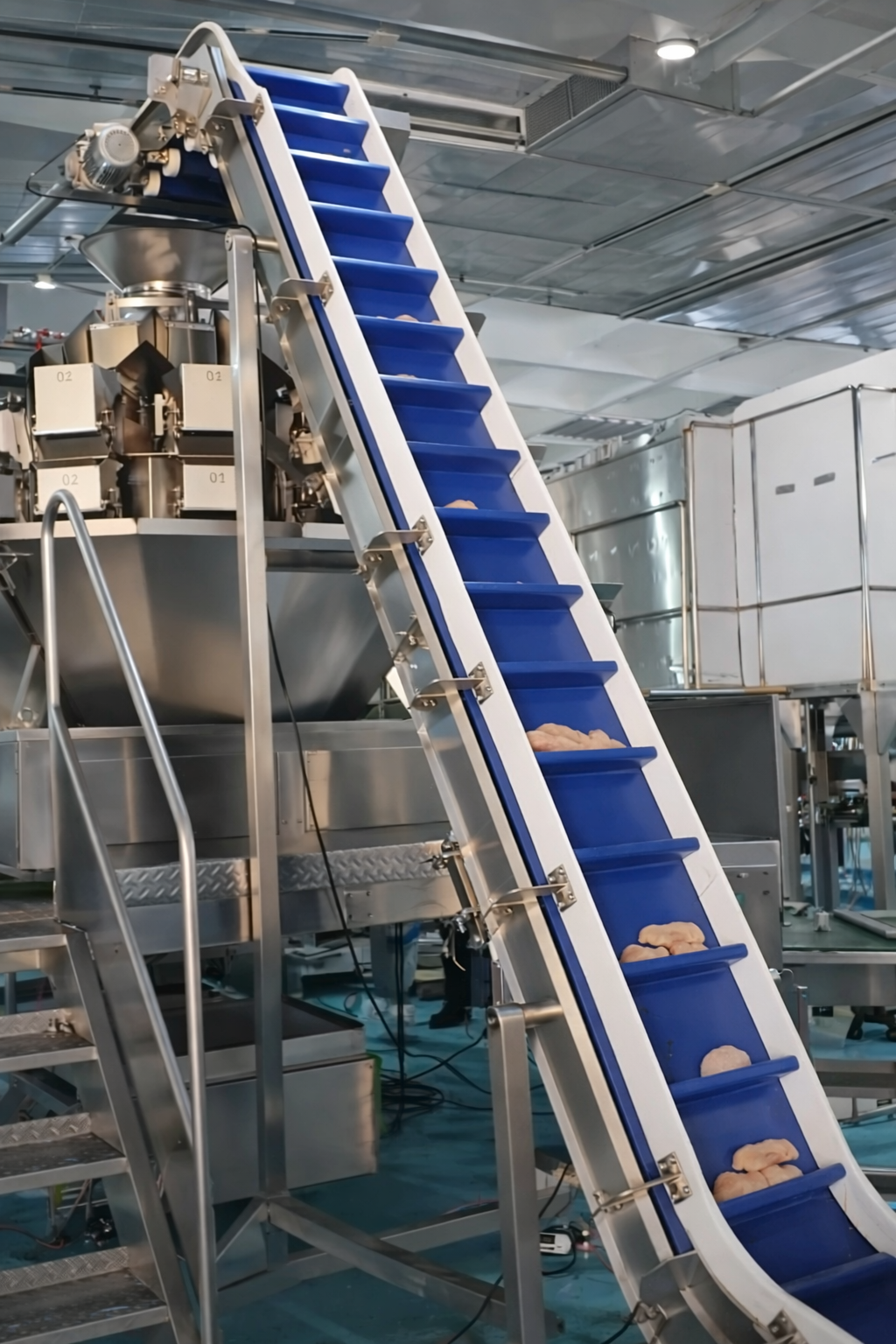
B. The Large Pitch Modular Belt: Engineered for Structural Dominance
The engineering answer to high-load meat conveying is the large pitch modular belt — specifically the 2-inch (50.8mm) pitch series. The pitch dimension refers to the distance between hinge pin centres, and it determines the structural characteristics of the belt in ways that directly address the failure modes described above.
How large pitch changes the load equation
A large pitch modular belt has thicker individual modules, larger diameter hinge pins, and a significantly greater cross-sectional area at each hinge joint compared to a 1-inch pitch belt. The practical effects:
- Higher tensile strength — the belt can sustain greater pulling force along its length without elongating. Chain stretch, the primary cause of tracking problems on loaded inclines, is reduced proportionally to the increase in cross-sectional area at the hinge joints.
- Greater load distribution — the larger module footprint distributes the weight of each piece of product across a greater belt area, reducing the point load on individual hinge joints. This extends the service life of the belt by a factor of 2 to 3 compared to a 1-inch belt running the same product at the same throughput.
- Higher sprocket engagement — larger pitch means larger sprocket tooth engagement at the drive end, increasing the grip between the belt and the drive sprocket. This directly addresses belt slip on inclined conveyor sections — the condition that causes the most frequent unplanned stops on heavy-load meat infeed lines.
For a detailed technical explanation of when large pitch modular belts are the correct specification, see our guide: Büyük Adımlı Modüler Konveyör Bant Nedir ve Ne Zaman Kullanılmalıdır?
Surface specification for fresh meat and marinated products
Beyond pitch, the surface texture of the belt module determines how well the conveyor handles the specific adhesion characteristics of fresh and marinated meat:
| Belt Surface Type | Fresh Bone-In Poultry | Marinated Meat Chunks | Ground Meat / Mince |
| Flat top (smooth) | Acceptable on horizontal runs; slip risk on incline | High slip risk — marinade acts as lubricant on smooth surface | Not recommended — product spreads and blocks joints |
| Friction top (textured) | Good grip on incline, easy to clean | Best choice — texture grips product without trapping marinade | Acceptable for short transfer runs |
| Open grid / flush grid | Good drainage for wet product | Excellent — marinade drains through grid, reducing surface build-up | Not recommended — mince passes through grid |
| Roller top | Reduces product jamming at transfers | Not recommended — rollers trap marinade | Not applicable |
For most fresh bone-in poultry and marinated meat applications, a friction-top large pitch modular belt on inclined sections and a flush-grid large pitch belt on horizontal transfer sections gives the optimal combination of grip, drainage, and cleanability.
For the full range of modular belt configurations for food processing environments, see our modular conveyor belt systems page.
C. System Synergy: How the Conveyor and Screw Feeder Weigher Work Together
The large pitch modular belt and the screw feeder multihead weigher are not simply two components that happen to sit next to each other on the line. In a well-integrated automatic meat weighing and bagging system, they operate as a coupled system — the conveyor’s delivery rate and the weigher’s consumption rate are continuously matched to maintain the weigher hoppers at their optimal fill level.
Why hopper fill level determines weighing accuracy
A multihead weigher’s combination algorithm works best when all weighing heads have product available for selection. If the infeed conveyor delivers product inconsistently — surges followed by gaps — some heads will be empty during the combination calculation, reducing the number of combinations the algorithm can evaluate and degrading the achieved accuracy toward the target weight. On a 14-head weigher with six empty heads, the effective number of combination options drops by more than 80%.
Conversely, if the infeed delivers product too fast, hoppers overflow and product falls outside the weighing path — generating waste and requiring manual intervention to clear.
The correct infeed behaviour is continuous, metered delivery at a rate that keeps all weighing heads consistently filled without overflow. This is the conveyor’s job — and it requires speed synchronisation with the weigher’s consumption rate.
Speed synchronisation: VFD-controlled conveyor linked to weigher output
In an integrated system, the infeed conveyor’s Variable Frequency Drive (VFD) receives a signal from the weigher’s PLC indicating the current hopper fill level. When fill level drops below the setpoint, the conveyor speed increases slightly. When fill level approaches the overflow threshold, the conveyor speed reduces. This closed-loop control maintains the weigher at peak performance throughout the shift without manual adjustment.
The practical effect of this synchronisation on a high-volume fresh meat portioning and packaging line:
- Weighing accuracy is maintained at ±0.5% consistently across the full shift, not just during steady-state operation
- Infeed conveyor stoppages (due to belt slip or chain jam) trigger an immediate weigher pause, preventing hopper overflow that would require manual clearing
- Line speed changes — for example, switching from a 400g target to a 250g target portion — are accommodated automatically by the VFD adjusting infeed rate to match the new consumption rate
The integration principle: A conveyor that merely transports product to the weigher is a component. A conveyor whose speed is actively managed by the weigher’s fill-level signal is part of a system. The difference in line efficiency between these two configurations, on a high-volume meat line running two shifts per day, is typically 15–25% in effective throughput — the difference between a line that runs at its rated speed and one that runs at the speed of its slowest manual adjustment.
D. Application Scenario: Processing 2+ Tonnes Per Hour of Fresh Chicken Legs
To make the system architecture concrete, here is a step-by-step description of a high-volume automatic meat weighing and bagging system for bone-in chicken legs — a product that combines the heaviest load characteristics (dense, bone-in, wet surface) with the highest throughput requirements in fresh poultry processing:
| Sahne | Teçhizat | Design Consideration for Heavy Load |
| 1. Bulk receiving | Floor-level receiving hopper or bin tipper | Hopper capacity sized for 10–15 min uninterrupted operation at rated throughput to buffer supplier delivery variation |
| 2. Primary elevation | Z-type large pitch modular belt conveyor, inclined | Large pitch (2-inch series), friction-top surface, VFD-controlled. Lifts product from floor level to weigher infeed height without slip or chain stretch |
| 3. Distribution / spreading | Horizontal large pitch modular belt with sidewalls | Distributes product evenly across the full belt width before entering the weigher hopper, preventing channelling that causes uneven hopper loading |
| 4. Weigher infeed hopper | Screw feeder multihead weigher hopper | Fill level sensor feeds signal back to Z-conveyor VFD for closed-loop speed control |
| 5. Screw feeding & weighing | 10–14 kafa vidalı besleyici çok kafalı tartı makinesi | Screw forced displacement handles wet, oily chicken leg surfaces without slip. Combination algorithm achieves ±0.5% accuracy at 35–45 portions/min |
| 6. Portion discharge | Timed discharge to VFFS or premade pouch bagger | Portion drops by gravity into bagger below — no intermediate conveyor required at this stage |
| 7. Sealed bag discharge | Inclined takeaway conveyor with cleated belt | Cleated belt grips sealed bags on incline to metal detector and check weigher without sliding back |
Total line footprint for this configuration is approximately 3m × 6m from receiving hopper to bagger discharge — comparable to the floor area of the manual portioning station it replaces, with output capacity 4 to 6 times higher and labour requirement reduced from 4–6 operators to 1–2 monitors.
This is the same system logic applied in our marinated meat and kimchi packaging lines. For the marinated meat application, where the conveyor must also handle the adhesion challenges of sauce-coated products, see Mastering Wet & Marinated Food Packaging (#12). For the ready-meal assembly application with scraper hopper integration, see Kimchi & Ready-Meal Packaging Automation (#43).
E. Labour-Saving Meat Weighing: The 2026 Recruitment Reality
The ROI case for automating fresh meat portioning and packaging has always been measurable in giveaway reduction and throughput per labour hour. In 2026, a second driver has become equally or more significant for many processors: the difficulty of recruiting and retaining workers for cold, wet, physically demanding portioning roles.
Manual portioning of fresh bone-in chicken legs is one of the highest-turnover roles in food manufacturing. Workers stand for extended periods in 4°C to 10°C conditions, handling cold, wet, heavy product. The physical demands are high, the work is repetitive, and the role requires sustained concentration to avoid weight deviation that causes giveaway or underfill.
An automatic meat weighing and bagging system does not merely reduce headcount at the portioning station — it changes the nature of the remaining role from physically demanding manual work to machine monitoring and quality oversight. The monitor role has significantly lower turnover, lower injury rate, and is easier to staff. For facilities that have struggled with portioning station turnover rates above 40% annually, this operational benefit can exceed the giveaway savings in total financial value within the first year.
| Operating Metric | Manual Portioning (5 operators) | Automatic System (1 monitor) |
| Throughput (kg/hour) | 500–800 kg | 1,500–2,500 kg |
| Giveaway (%) | 3–6% | 0.5–1.5% |
| Annual labour cost | 5× operator wage × working days | 1× monitor wage × working days |
| Annual turnover cost | High — cold, physical, repetitive | Low — monitoring role, normal conditions |
| Consistency end-of-shift | Degraded — fatigue effect | Unchanged — machine performance |
| 2026 recruitment difficulty | High — shortage of portioning workers | Low — easier to staff monitoring roles |
F. Integrated Heavy-Duty Meat Packaging Line: Key Specifications
The following specifications define the critical engineering parameters for a high-volume fresh meat portioning and packaging line that will perform reliably under heavy load conditions:
Large Pitch Modular Belt (2-inch series): Tensile strength 2–3× standard 1-inch belt. Friction-top surface on inclined sections for grip under load. Open-frame stainless steel conveyor structure with sloped drain surfaces. Tool-free module replacement — individual damaged modules replaced in under 5 minutes without belt removal. FDA/USDA-compliant plastic modules. VFD-controlled drive for speed synchronisation with weigher.
Screw Feeder Multihead Weigher (10–14 head): Forced displacement screw feeding for sticky, wet, heavy product. Fill accuracy ±0.5% on fresh bone-in poultry and marinated meat at production throughput. IP67 sealed construction — full washdown rating. Tool-free screw and hopper disassembly in under 5 minutes for daily deep cleaning. PLC integration with infeed conveyor VFD for closed-loop fill-level control. 304 stainless steel all product-contact surfaces as standard; 316L available for high-chloride or high-acid marinade environments.
System Control Integration: Single HMI interface controls conveyor speed, weigher target weight, and bagger parameters. Speed changes (e.g., portion size changeover) are applied system-wide from one point — no manual adjustment of individual machine parameters required. Alarm integration: conveyor jam or belt slip triggers weigher pause and operator alert before product overflow occurs.
Easy-Clean Structure (2026 Food Safety Audit Standard): All conveyor and weigher product-contact components accessible without tools for daily cleaning. No dead-end cavities, no threaded fasteners in the product zone, no horizontal surfaces that collect debris. Compatible with high-pressure washdown and food-grade sanitiser. Cleaning validation documentation provided on request for BRC, SQF, and FSSC 22000 audit purposes.
For the full specification sheet and configuration options for our integrated heavy-duty meat packaging line, visit our Meat & Poultry Packaging Equipment page. For technical details on the conveyor integration principles that make the system work as a unit rather than a collection of components, see our Food-Grade Conveyor Integration guide.
Çözüm
The gap between a multihead weigher specification and a working automatic meat weighing and bagging system is the conveyor — and in high-volume fresh meat processing, that gap is wider than most procurement processes account for.
A large pitch modular belt conveyor, specified for the load, surface characteristics, and hygiene requirements of fresh bone-in poultry or marinated meat, and integrated with a screw feeder multihead weigher through closed-loop VFD speed control, is the engineering combination that makes high-volume labor-saving meat weighing viable. The weigher provides the accuracy. The conveyor provides the consistent, heavy-duty infeed that allows the weigher to deliver that accuracy at full throughput, across a full shift, without manual intervention.
In 2026, with food safety audit standards tightening and the recruitment environment for cold-room portioning roles deteriorating, this system integration is not a nice-to-have for large meat processors — it is the operational baseline for a facility that wants to run competitively on cost, quality, and staffing resilience simultaneously.
Don’t let your conveyor limit your weigher’s performance. Send us your current line configuration — product type, throughput target in kg/hour, available floor area, and shift pattern — and our engineers will design a complete heavy-duty layout for your automatic meat weighing and bagging system. Get My Heavy-Duty Packaging Layout →
Explore our integrated meat packaging machine range. Visit our Meat & Poultry Packaging Equipment page for screw feeder weigher specifications, large pitch conveyor configurations, and full-line integration options for fresh and marinated meat processing.
Related reading — the full cold-chain and meat automation series:
#43 — Kimchi ve Hazır Yemek Paketleme Otomasyonu: Vidalı Besleyici + Sıyırmalı Hazne Entegrasyonu
#49 — Space-Saving Meat Portioning: Integrating Spiral Freezing with Automatic Weighing