

When planning a new production line or retrofitting an old one, selecting a “suitable” conveying system is often underestimated.
Facing a market full of belt types, drive options, and supplier promises, decision-makers often fall into the trap of comparing basic parameters (like length and width) while ignoring the core logic: A belt conveyor system must be customized based on your “product flow” and “process flow,” not just matched to machine dimensions.
In this guide, we act as a line planner to outline the four key dimensions you must consider. This framework will help you make a one-time investment decision and avoid expensive retrofitting costs later.
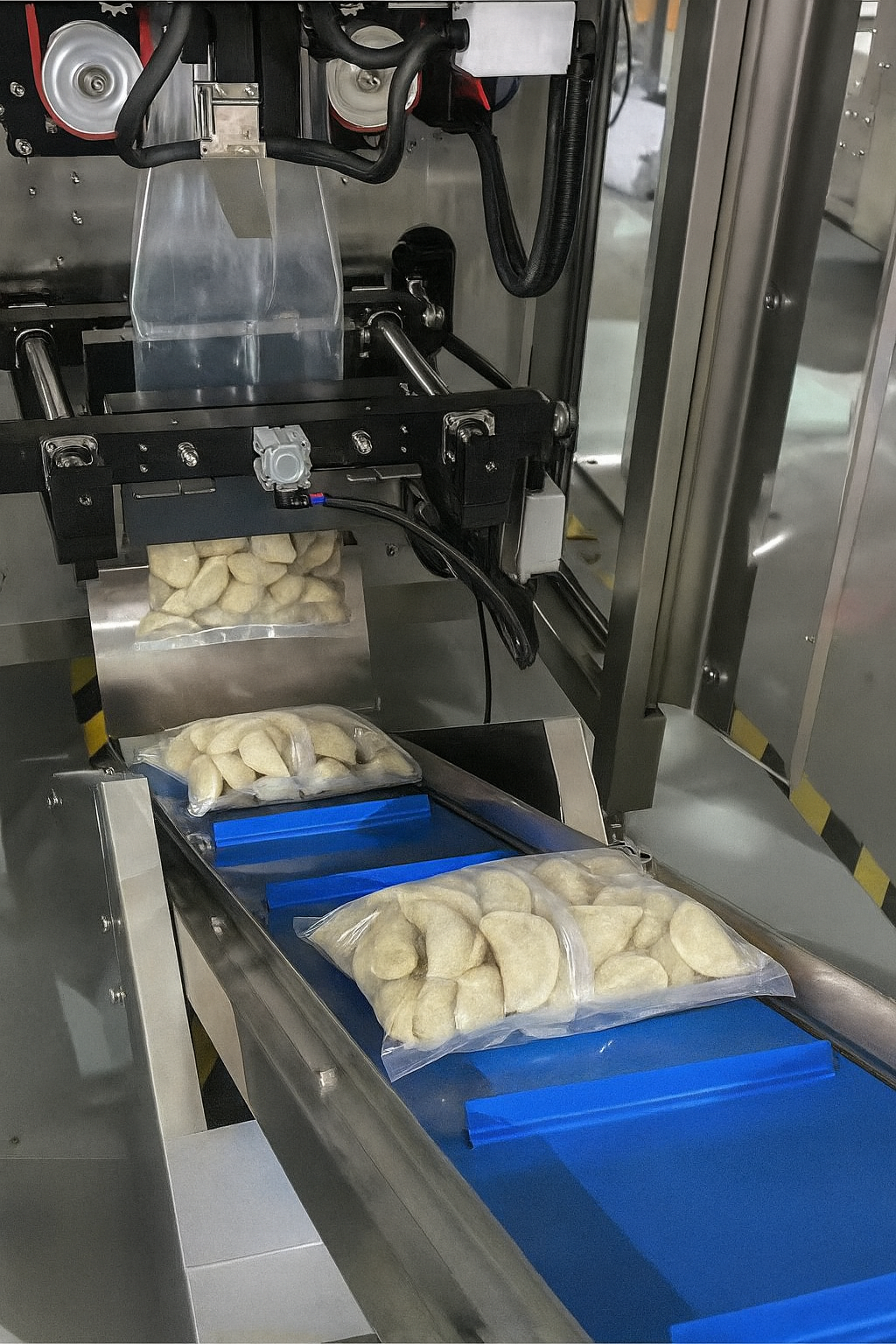
1. The Starting Point: Product Characteristics Determine Basic Configuration
Everything starts with the product itself. Before asking “what is a belt conveyor”, evaluate your product:
Physical Form & Flowability
Rigid Items (Canned drinks, boxed snacks): These cause little wear. Focus on stability and positioning accuracy. A standard flat belt or timing belt with moderate friction is ideal.
Fragile Items (Bread, cakes, puffed snacks): These require gentle handling to prevent crushing. Choose a soft, flat food-grade PVC/PU belt, possibly with shock-absorbing designs.
Fine Granules/Powders: Dust containment is priority #1. You need a sealed konveyör sistemi or one equipped with dust covers and recovery trays.
Oily/Wet Products (Fried food, frozen seafood): The belt must be oil-resistant, waterproof, and non-stick. Stainless steel wire mesh belts or Teflon-coated belts are often the best belt conveyor for food packaging.
Packaging Form
Bags (Pillow bags, Doypacks): To prevent bags from slipping or falling, you may need high-friction belts or flighted conveyors for incline sections.
Boxes/Bottles: These require precise spacing for downstream casing or labeling. Consider chain conveyors or timing belts paired with guide rails.
2. The Blueprint: Capacity Targets & Factory Layout
Once you know “what” to convey, plan “how” and “how fast.”
Speed & Capacity Matching
Quantitative Calculation: The belt conveyor system design speed must be slightly higher than your line’s maximum theoretical capacity (e.g., 120 packs/min), leaving a 10-15% margin for surges.
Sectional Speed Control: Different sections have different needs. The exit of a VFFS machine requires high speed to clear products, while the entry to a robotic packer requires deceleration for stable positioning. This demands independent drives and VFDs for each section.
Layout & Space Constraints
Incline vs. Horizontal: Incline conveyor applications require calculating static friction to choose the right belt texture or cleats.
Curves: Turning designs must calculate the minimum turning radius to prevent products from flying off or jamming.
Interface Heights: Measure the centerline heights of upstream and downstream equipment (e.g., VFFS exit vs. Robot gripper). The conveyor must connect seamlessly, often requiring adjustable legs or modular Z type conveyor for packaging sections.
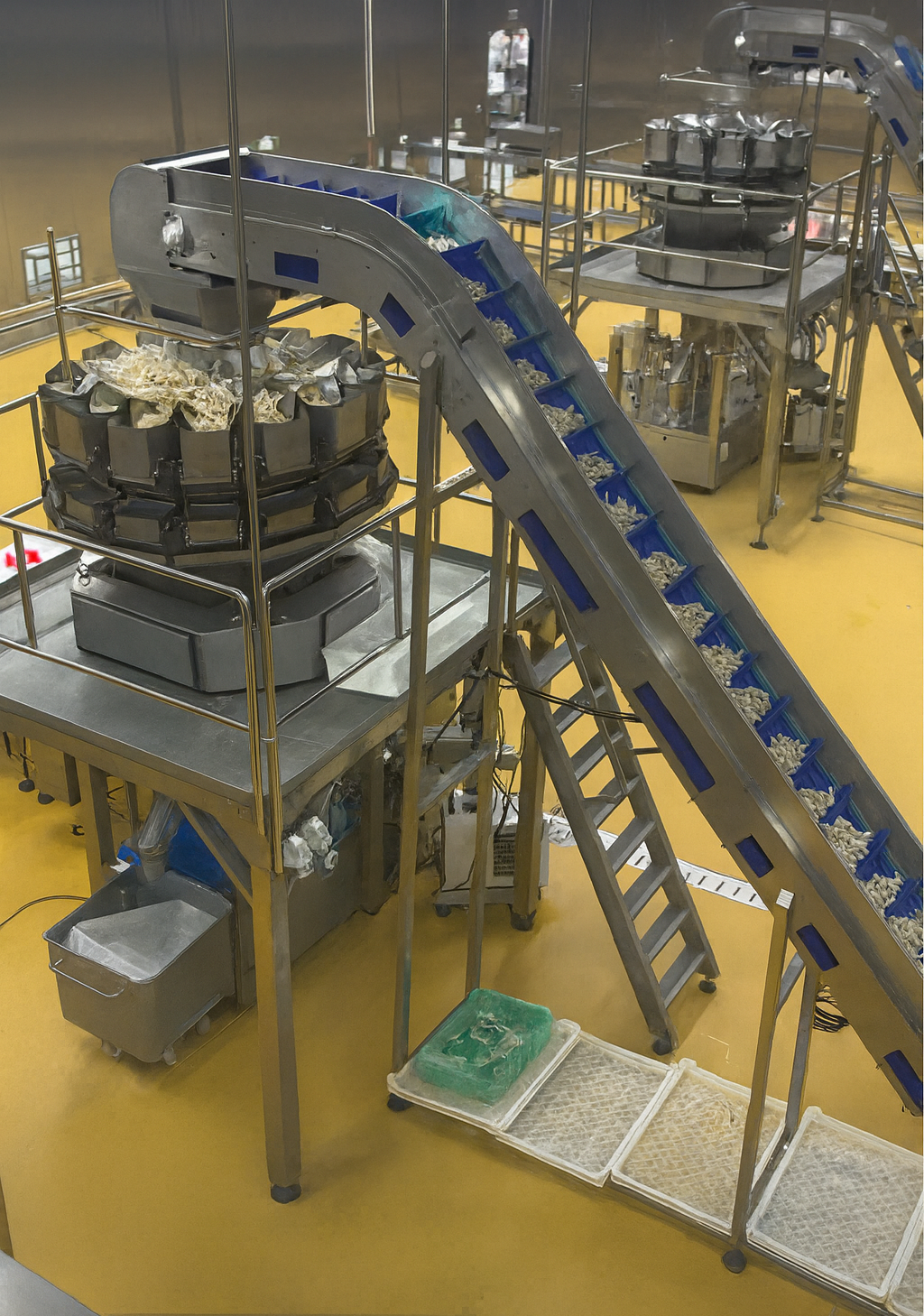
3. The Core: Seamless Integration with Upstream & Downstream
The value of a conveyor system for packaging lies in connection. It must be a smart node in the control network.
Electrical & Signal Integration
Hard Connection: Ensure mechanical interfaces (chutes, transfer plates) are smooth with no gaps or drops that cause jams.
Soft Connection: This is critical. The start/stop and speed of the automated belt conveyor must be interlocked with the upstream Multihead Weigher or VFFS machine.
Typical Mode: VFFS releases bag → Photoeye detects product → Conveyor starts → Product leaves → Conveyor creates gap for next bag. This requires standard I/O signals or Ethernet protocols.
Acting as the “Dispatch Center”
For merging, diverting, or buffering, the system needs to integrate pneumatic pushers or diverters controlled by a central PLC.
Örnek: After a Checkweigher, the conveyor must automatically route pass/fail products to different paths. This requires conveyor integration with packaging machines that can “think,” not just move.
4. The Future: Hygiene, Maintenance & TCO
Selection must consider the entire equipment lifecycle.
Hygiene Design Standards
İçin belt conveyor for food processing, choose FDA/USDA-compliant materials. Prioritize tool-free disassembly, open-frame designs (like round tubes), and easy-clean belts. This drastically reduces cleaning time during changeovers.
Maintenance & Reliability
Components: Check the brand of motors and gearboxes. High-quality brands cost more upfront but reduce long-term belt conveyor cost through lower failure rates.
Serviceability: Is the structure easy to tension or track? Good modular vs flat belt conveyor designs allow a standard operator to perform basic maintenance in ten minutes.
Conclusion: Designing a “Material Flow Solution”
Selecting a conveyor isn’t about buying a machine; it’s about designing a flow. It requires a bantlı konveyör üreticisi who understands process logic, not just hardware.
A wrong choice means continuous efficiency loss. We strive to be your strategic partner in line planning.
Plan a “Zero-Bottleneck” Future
Our engineering team offers full support, from site surveys and 3D simulation to integrated control schemes. We supply not just high-quality belt conveyor for packaging line hardware, but intelligent logistics solutions that ensure your core machines perform at 100%.
Ready to optimize your flow? → [Book a Line Logistics Assessment] to get a customized belt conveyor 3D proposal. Let us help you build a smooth, efficient, and smart packaging line today.