

Введение
A bucket elevator stops when one component fails — not when several fail, but when one does. The bucket that cracks at the mounting hole. The chain stretched 3% past its service limit. The sprocket with a shark-fin tooth profile can no longer hold the chain under load.
None of these failures is sudden. They all develop gradually and produce warning signs that are detectable with a basic inspection routine. The problem is that most facilities do not have a structured inspection process for bucket elevator parts — the elevator is treated as infrastructure rather than as a machine with a maintenance schedule.
This checklist covers the three core bucket elevator components — buckets, chain, and sprockets — and gives you a practical inspection protocol for each, including the specific measurements that tell you whether a component has useful life remaining or needs replacement.
For the complete replacement parts range: Bucket Elevator Parts hub.
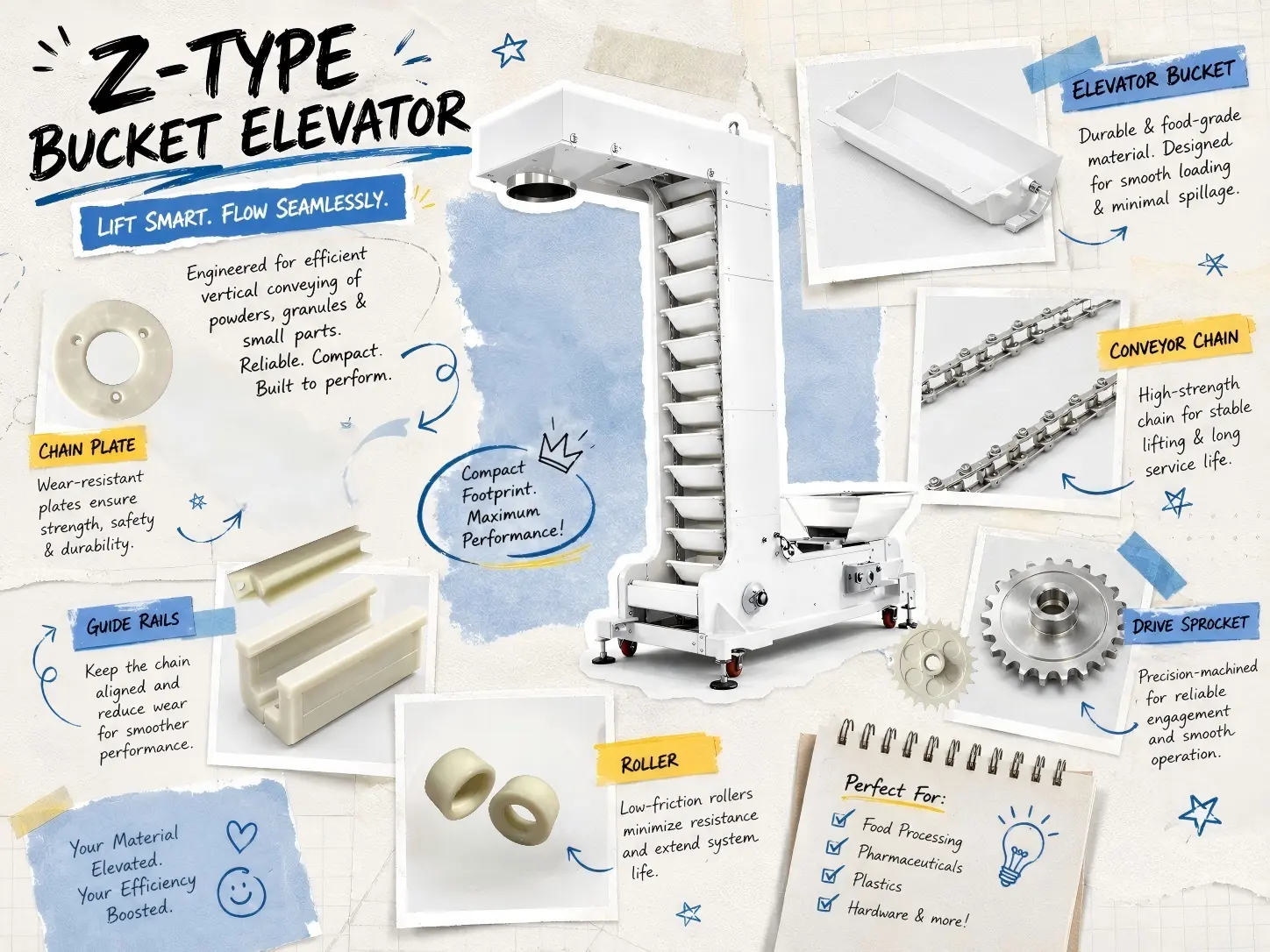
Section 1 — How a Bucket Elevator Works
How Does a Bucket Elevator Work? The Three Core Components
A Z-type bucket elevator works on a simple principle: buckets attached to a continuous chain loop scoop product at the bottom (the boot), carry it upward, and discharge it at the top (the head) through centrifugal force or gravity as the buckets travel around the top sprocket. Three components make this work — and all three degrade over time.
| Компонент | Функция | Primary Failure Mode | Consequence |
| Elevator buckets | Carry product from boot to head on every cycle | Cracking at mounting holes; surface wear; deformation | Product spillage; inconsistent fill weight at the downstream weigher |
| Conveyor roller chain | Connects and spaces buckets; transmits drive force | Elongation (pin-bushing wear); roller seizure; plate fatigue | Tooth climbing on sprocket; chain jump; full line stop |
| Drive sprockets | Engage the chain; transmit motor torque to the system | Tooth profile wear (‘shark-fin’); bore wear; key damage | Chain slip; irregular speed; accelerated chain wear; sudden stop |
These three components form a system. When one wears faster than expected, it accelerates wear in the others. A stretched chain causes tooth climbing on the sprocket, which accelerates sprocket wear, which causes the chain to jump, which creates impact loads that crack bucket mounting holes. The checklist addresses all three together.
Section 2 — Elevator Bucket Inspection
Elevator Bucket Checklist: 5 Checks
Check 1: Mounting Hole Condition
The mounting holes — where the bucket attaches to the chain — are the highest-stress point. Fatigue cracks initiate here because the hole concentrates stress from both product weight and the shock load when the bucket fills at the boot.
- How to check: remove a sample of buckets (every 20th bucket minimum) and inspect the hole perimeter under good lighting. Run your fingertip around the inside of the hole — a crack deep enough to matter is usually palpable before it is visible.
- Replace when: any crack is visible at the mounting hole, regardless of length. A cracked mounting hole will propagate to full failure within days to weeks under normal load.
Check 2: Body Deformation
Buckets deform gradually under load — the base sags outward, the side walls spread. Measure the bucket width at the widest point (dimension A) and compare to specification. Deformation over 5mm from nominal warrants replacement.
Check 3: Surface Condition
For smooth-surface buckets: visible scoring or roughening causes product adhesion. For dimpled-surface buckets: dimples worn flat over more than 20% of the bucket base means the anti-adhesion function is lost. Replace when carry-back (product remaining in the bucket after discharge) is measurable.
Check 4: Abnormal Vibration
Irregular vibration — a knock or pulse that does not repeat at a consistent interval — almost always means a loose, cracked, or missing bucket. Stop the elevator and inspect all buckets for missing, cracked, or loose mounting hardware.
Check 5: The 5-Dimension Specification (A–E) for Ordering Replacements
When ordering replacement buckets, confirm these five dimensions from your existing buckets or elevator drawings:
| Измерение | What It Measures | Почему это важно |
| A — Overall width | Widest face of the bucket | Must fit inside the elevator casing without contacting the walls |
| B — Projection depth | Back plate to leading lip | Determines how far the bucket reaches into the boot for filling |
| C — Inner cavity depth | Usable internal depth | Determines bucket capacity |
| D — Back plate height | Height of the flat mounting surface | Must match the chain attachment geometry |
| E — Hole centre spacing | Distance between mounting holes | Must match the chain bolt pitch exactly — wrong E = bucket cannot be fitted |
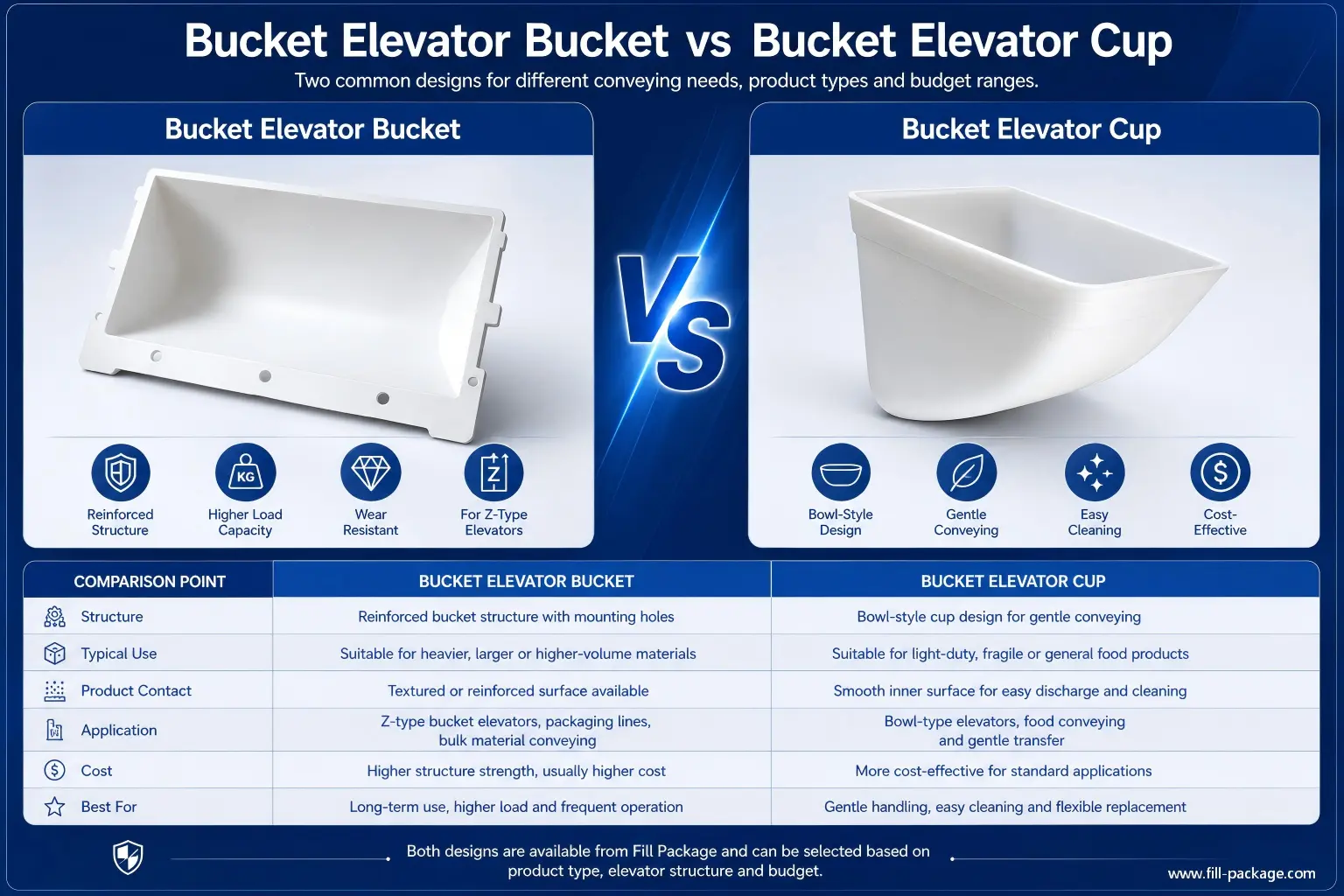
Bucket size charts: Z-Type Elevator Buckets · DS & DQ Industrial Elevator Cups
Section 3 — Chain Inspection
Conveyor Roller Chain Checklist: 4 Checks
Check 1: The 10-Link Elongation Measurement
Measure 10 consecutive links under light tension. Compare to nominal pitch × 10:
| Тип цепи | Nominal 10-link | Monitor closely at | Replace at |
| C2042 (25.4mm) | 254.0mm | 258.1mm (1.5%) | 261.6mm (3%) |
| C2052 (31.75mm) | 317.5mm | 322.3mm (1.5%) | 326.9mm (3%) |
| C2062 (38.10mm) | 381.0mm | 386.7mm (1.5%) | 392.4mm (3%) |
| C2082 (50.80mm) | 508.0mm | 515.6mm (1.5%) | 523.2mm (3%) |
At 3% elongation — replace immediately: The chain no longer matches the sprocket tooth pitch. Tooth climbing begins, creating impact loads that destroy both chain and sprocket rapidly. Do not continue running — the next failure may be sudden.
Check 2: Roller Rotation
With the elevator stopped, press each roller and check it spins freely. A seized roller creates a high-friction drag point that causes rapid wear on both the chain link plate and the carrying roller beneath it. Replace when more than 3 consecutive rollers are seized.
Check 3: Side Plate Condition
Lateral grooves on side plates (from guide rail contact) indicate misalignment or over-tensioning. Replace when any groove exceeds 0.5mm depth, or when fatigue cracking is visible. Resolve the root cause before fitting a new chain.
Check 4: Lubrication and Corrosion
For carbon steel chains: dry pins appear silver-grey rather than oily. Apply food-grade NSF H1 lubricant at the pin-bushing interface. For stainless chains: check for pitting at the pin-bushing interface in aggressive washdown environments.
Full chain specification: C2052 Conveyor Roller Chain
Section 4 — Sprocket Inspection
Bucket Elevator Sprocket Checklist: 3 Checks
Check 1: Tooth Profile — Shark-Fin Wear
On a new sprocket, each tooth has a symmetrical profile. As it wears, the engagement side erodes into a hooked ‘shark-fin’ shape. A shark-fin tooth cannot seat the chain roller properly — the roller rides up the hooked tip, creating chordal action that cracks bucket mounting holes and accelerates chain elongation.
- Replace when: shark-fin wear is visible on 3 or more consecutive teeth. Always replace chain and sprocket together at this point — new chain on worn sprockets fails within weeks.
Check 2: Bore and Keyway Condition
Attempt to rock the sprocket radially on the shaft with the elevator stopped. Any detectable movement indicates bore wear. Check the keyway for brinelling — indentation marks from repeated shock loading. Replace when any radial movement is detectable.
Check 3: Plastic Sprocket Tooth Height (PA+GF)
For PA+GF plastic driven sprockets, tooth tips wear progressively shorter rather than developing shark-fin profiles. Measure the outer diameter and compare to specification (ø260.29mm for standard C2052-24Z plastic sprocket). Replace when outer diameter has reduced by more than 3mm from nominal.
Sprocket specifications: Bucket Elevator Sprockets — C2052-24Z
Section 5 — Compatibility Logic
How Chinese Replacement Parts Achieve 100% Dimensional Compatibility
The key insight for sourcing bucket elevator parts from China: bucket elevator components are standardised by dimension, not by brand. The same ANSI chain pitch standards, the same tooth geometry for a given pitch and tooth count, and the same dimensional logic for bucket mounting apply regardless of which country manufactured the original elevator.
When you provide the five bucket dimensions (A–E), the chain pitch, and the sprocket bore diameter, we can confirm compatibility for any replacement part before production. This is the basis of our drawing confirmation process — and the reason our parts fit correctly the first time.
Dimension is compatibility. Brand is not. A Chinese-manufactured replacement bucket, chain, or sprocket confirmed to the correct A–E dimensions and chain pitch will fit and perform identically to the original part — regardless of which country manufactured the elevator.
Section 6 — Maintenance Schedule
Recommended Inspection Intervals
| Частота | Проверять | Компонент | Action if Problem Found |
| Ежедневно | Listen for irregular vibration or knocking | Buckets / chain | Stop and inspect at shift end if vibration is severe |
| Еженедельно | Visual bucket inspection for cracks or deformation | Ведра | Remove and replace cracked or deformed buckets immediately |
| Еженедельно | Chain tension — 2–3% sag from sprocket centre distance | Chain | Adjust tension; remove links if elongated |
| Ежемесячно | 10-link elongation measurement | Chain | Order replacement if approaching 2% elongation |
| Ежемесячно | Roller rotation check on accessible chain sections | Chain | Note seized rollers; replace at next chain replacement |
| Ежемесячно | Guide rail wear — groove depth check | Guide rails | Replace rails when groove exceeds 3mm depth |
| Every 3–6 mths | Full bucket sample inspection (mounting holes) | Ведра | Replace batch if cracks found on any sample bucket |
| Every 3–6 mths | Sprocket tooth profile check | Звездочки | Replace if shark-fin wear on 3+ consecutive teeth |
| Each chain replacement | Full sprocket inspection | Звездочки | Replace worn sprocket — never fit new chain on worn sprocket |
Next Steps
Need replacement bucket elevator parts? Visit our Bucket Elevator Parts hub for the complete range — Z-type buckets, DS/DQ industrial cups, bowl-type buckets, C2052 chain, and 24-tooth sprockets. Drawing confirmation before every order. Contact our technical team →
Continue reading: Original vs. Aftermarket Parts: Why Precision Measurement Is the Key to Compatibility →