

Prologue: Born in a Land That Favored Sons
I was born in the 1980s in Shunde, Guangdong, a typical rural area. It was an era and a place where the preference for sons was deeply ingrained, a land where ancient clan orders were maintained by ancestral halls.
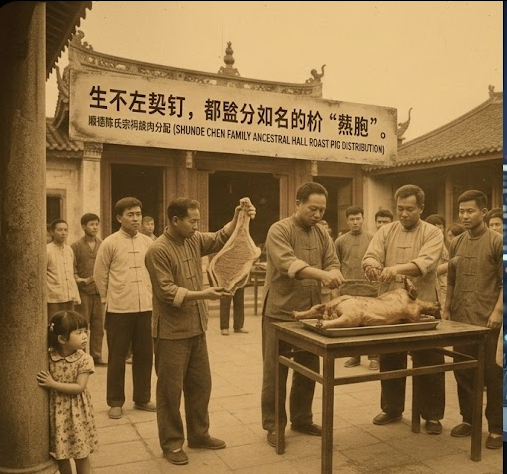
This order was most visibly demonstrated during festival ceremonies. Every household had to contribute money to buy whole roasted pigs as offerings to the ancestors. But after the money was paid, only families with male heirs were entitled to a piece of the symbolic roasted pork. And only boys’ names could be solemnly recorded in the clan genealogy. As for the girls? They were considered “bound to be married off sooner or later,” belonging to “someone else’s family.” The bride price here has always been among the lowest in the country, which seemed to further validate the notion that “raising a daughter is a losing venture.” Only by raising a son could one secure their old age.
Consequently, families whose firstborn was a daughter began to panic. The names given to girls thus bore the mark of the era: Liandi (Continuous Brother), Daidi (Bring a Brother), Youdi (Have a Brother), Pandi (Hope for a Brother)… all hopes revolved around having a son. The most common family structure was several older sisters plus one younger brother; in extreme cases, it took nine sisters to finally get a brother. A childhood friend of mine grew up in such a classic family. She had four younger sisters. As a child, if I didn’t see her mother for a few days, it was almost certain she had gone to secretly give birth again. In the 80s and 90s, the family planning policy was strictly enforced, so her mother could only migrate like a bird to give birth elsewhere before quietly returning.
I once asked my father why he was so insistent on having a boy. He was silent for a long while before saying, “If you can’t produce a son, people look down on you. I want to stand up straight and be a man.” I personally witnessed two old men in the village arguing, one pointing at the other’s nose and shouting, “My family has three sons, yours only has one. How can you possibly win against me?”
In such a deeply patriarchal culture, the level of education among girls of my age was generally not high. Graduating from junior high was the norm, few finished high school, and university students were a rarity. I was one of the few lucky ones. An idea my father had changed my life.
Chapter One: My Father, an Atypical Feminist
My father was an ordinary worker with no extraordinary skills. He loved his little bit of liquor, enjoyed the company of friends, loved to eat, and loved to “blow water” (chat). He was tall, strong as an ox, and fiercely loyal. When I was a child, his most common refrain during arguments with my mother was: “A wife is like clothing, but brothers are like limbs. If you’re not happy, you can leave.” Had he been born in the era of the Three Kingdoms, he probably would have been a sworn brother of Guan Yu.
Regarding my education, he adopted a “free-range” policy. As long as I didn’t break the law, studied well, and occasionally played or watched TV, it was all fine. But starting from my junior high years, he began to tell me things I couldn’t comprehend at the time. Our rare heart-to-heart talks, which happened only a few times a year, surprisingly revolved around the same theme:
“I’m paying for your education so you can support yourself in the future. Don’t count on a husband to provide for you. No matter how sweet his promises are when he marries you, he won’t mean them two years later.”
At that time, I was engrossed in TV dramas like My Fair Princess and various Hong Kong series, my head filled with romantic fantasies. My father’s words were like something from another planet. Fortunately, this didn’t stop me from pursuing my studies. I later majored in economics and trade, just in time to catch the wave of the state’s push for manufacturing exports. I finally fulfilled my father’s wish and achieved financial independence.
It was only after I got married that I truly understood my father’s words. He was practically an undercover expert on marital problems. Don’t expect anyone to be your lifelong support, or you might end up sacrificing your entire life. Earning your own money and spending it as you please is the greatest security a marriage can offer a woman.
To this day, I still can’t understand why narratives on platforms like TikTok, which praise women for scrimping and saving to manage a household, gain so much traction. It looks exhausting. When a person’s emotional and financial well-being is entirely dependent on another, that’s not happiness; it’s a complete failure. Yes, I admit, I benefited from the dual dividends of education and the era. That’s why I firmly believe that for a girl, education truly matters.
Chapter Two: My Aunt’s Resentment, an Unfulfilled Dream of Education
My paternal aunt was born in the earlier 1950s. Unfortunately, she didn’t have an “atypical” father like mine.
In my memory, every time my aunt came back to her maternal home, she would repeat an almost identical complaint: “I was so good at my studies when I was young, but your grandpa only let me study for two years before making me quit to earn work-points for the family. My younger brother was so bad at school, yet they insisted on sending him through junior high. If he hadn’t run away from school himself, they would have made him continue. I contributed to the family’s finances, it’s so unfair!”
From a modern perspective, this was undoubtedly a great injustice. But my aunt’s fate was just a microcosm of most rural women of that era. If she had been born before the founding of the People’s Republic, she might have been illiterate, without even those two years of schooling. My grandfather once told me that the school he attended as a child was a private tutorial school. His father had sent him for two years, but they didn’t accept girls. I naively asked, “So girls didn’t have to study back then?” Grandpa replied, “The daughters of wealthy families would have tutors come to their homes. Girls from ordinary families didn’t.”
I should add that when my teachers visited our home, my grandparents were always incredibly respectful, showering them with thanks. This proved that they fundamentally revered knowledge and respected education. But this reverence was something they were unwilling to bestow upon their own daughter.
Carrying this unfulfilled dream of education, my aunt lived a life full of resentment. I feel she was filled with hatred for the world. Because of her low level of education, her mind became narrow, unable to accommodate anything but complaints. I often wonder, if she had been able to continue her studies, perhaps she would have had more understanding and gratitude for the world, instead of filling her life with bitterness.
Before my grandfather passed away, he specifically told us: “Don’t call your aunt back. She’s a troublemaker, and I don’t want to see her.”
Like a prophecy, my aunt did come back. And my grandfather passed away on the very day she returned.
Chapter Three: My Other Aunt’s “Love Brain,” a Life of Farce
My other paternal aunt was the other extreme. She didn’t complain all day like the first aunt, but she had a fatal flaw—a “love brain.” In all matters, big or small, her husband came first. If she couldn’t make a decision, she’d ask her husband; if you invited her to dinner, you had to invite her husband first.
When I was about twelve or thirteen, she suddenly appeared at our door one day, bruised and swollen, with her two children in tow. She cried that her husband was having an affair, wanted a divorce, and had beaten her. The miserable sight is still vivid in my memory. My father, as her brother, couldn’t stand it and rushed over that night to “deal with” the man.
The divorce, in the end, didn’t happen. But the outcome was even more absurd: my aunt had to move to Shenzhen to live under the same roof with her husband, his mistress, and their daughter. This completely shattered our understanding of the world. But my aunt actually persevered. Perhaps that was what she understood as “true love.”
It wasn’t until my father passed away that my aunt, completely out of character, suddenly came back to fight with my younger brother over the dilapidated ancestral house my grandfather had left behind. She demanded 200,000 yuan for her “inheritance rights” and even brought her long-estranged husband to cause a scene. Wasn’t this a twisted, delayed case of “the son paying the father’s debt”? A revenge for my father’s interference in her “family affairs” years ago?
Of course, she came up with some high-sounding excuses, claiming we didn’t care for our elders and only looked after our own children. But when we prepared to take legal action and presented the evidence, she disappeared. In truth, she was foolish. She should have sued my father for assaulting her husband back then, and the fact that I did hit her on the day she came to fight for the property—that was an undeniable fact.
Epilogue: Read, So You Can See Yourself Clearly in the Fog
So, girls, be grateful for this era. Nine years of compulsory education is your birthright.
Read more books. They may not necessarily fill your wallet, but they will certainly enrich your spirit. Don’t spend your days consumed by romance; love is a ghost, many have heard of it, but few have ever seen it. And don’t get lost in mobile phones and games; those are just tools created by smart people to harvest the time and money of the less fortunate.
Spend your time on reading and self-cultivation.
Reading has one crucial benefit: it allows you, in your finite life, to experience countless lives you’ve never lived, to draw wisdom from them, and to understand certain truths. It will make you wiser, so you won’t lose yourself in the fog of life.
Уведомление: vidalista black 80 uk
Уведомление: orlistat cap 120mg
Уведомление: levitra generic price
Уведомление: famotidine dosage
Уведомление: levitra headache
Уведомление: rogaine eyebrow growth
Уведомление: minoxidil when pregnant
Уведомление: acyclovir cream lips
Уведомление: bupropion side effects sexually female
Уведомление: toradol analgesic overview
Уведомление: terbinafine side effects overview
Уведомление: terbinafine for dermatophyte nail infections
Уведомление: ivermectin knowledge base
Уведомление: minoxidil pk scientific data
Уведомление: PDE5 inhibitor risk groups
Уведомление: avanafil food interaction notes
Уведомление: avanafil safe access guidelines
Уведомление: vardenafil safety profile
Уведомление: vardenafil compared to sildenafil
Уведомление: orlistat meal timing
Уведомление: insurance coverage denial reasons
Уведомление: sinusitis medical guide