

In the logistics and manufacturing sectors, a common mistake is assuming that “a conveyor belt is just a conveyor belt.” This misconception often leads to stretched belts, broken pins, and costly downtime.
When your production involves heavy crates, pallets, or automotive parts, the choice boils down to two options: the versatile Standard Pitch or the robust Большой шаг.
В Заполнить пакет, our philosophy of “Smart packing, precise filling” extends to the structural integrity of your line. Today, we compare large pitch vs. standard pitch modular belts to help you decide which one has the muscle your facility needs.
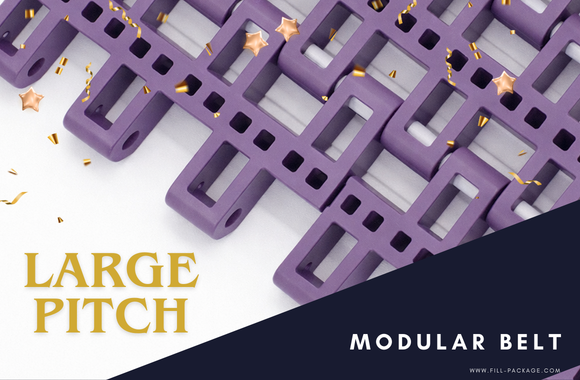
1. Structural Differences Between Large and Standard Pitch Belts
To understand performance, you must look at the geometry.
Standard Pitch (1-Inch / 25.4 mm): The industry standard. It features moderate pin thickness and module density. It is excellent for general purpose, but its components are designed for versatility, not brute force.
Large Pitch (2-Inch / 50.8 mm): Built like a tank. The modules are thicker, the hinge eyes are wider, and most importantly, the connecting pins have a significantly larger diameter.
The Engineering Reality: In heavy-duty conveying, the pin is the weak link. By doubling the pitch, we allow for a much thicker pin, which exponentially increases the belt’s shear strength.
2. Load Capacity and Belt Strength Comparison
When moving heavy loads, Allowable Belt Pull (ABP) is the most critical metric.
Standard Pitch: Under extreme tension (e.g., a fully loaded 50-meter line), standard belts may experience “elongation” or “stretching.” Over time, this messes with sprocket engagement and tracking.
Large Pitch: The 2-inch series is engineered to handle high-torque starts and heavy accumulation. The robust design distributes the tensile load across a larger surface area, ensuring the belt maintains its shape and length even under maximum load.
Fill Package Insight: If you are moving loads exceeding 1,000 kg across a long conveyor, a standard belt is a risk. A large pitch belt is an investment in security.
3. Stability and Wear Performance Under Heavy Loads
Heavy products (like abrasive construction materials or metal parts) are tough on plastic.
Износостойкость: Standard pitch belts have thinner top plates. Constant friction from heavy, sliding products can wear them down relatively quickly. Large pitch belts feature a thicker “wear zone,” meaning they can endure years of abuse before needing replacement.
Beam Stiffness: Place a heavy battery on a standard belt, and it might bow slightly between wear strips. A Large Pitch belt offers superior rigidity, providing a flat, stable platform that ensures your “Smart packing” processes downstream—like robotic pick-and-place—remain accurate.
4. When Large Pitch Is the Better Choice
While we love our 1-Inch Standard Series for general packaging, Заполнить пакет strongly recommends upgrading to the Large Pitch (2-Inch Series) if:
You are moving Pallets or Crates: Any load that requires “heavy-duty” support.
The Environment is Abrasive: Sand, dirt, or glass shards will destroy a thin belt; a thick belt will survive.
Long Conveyor Runs: You want to drive a long conveyor with a single motor (requiring high belt pull capability).
Impact Loading: Products are dropped onto the belt from a height.
5. Conclusion: Don’t Compromise on Strength
Choosing between large pitch vs. standard pitch modular belts isn’t about price; it’s about physics. For heavy loads, the standard option is a gamble, but the Large Pitch Modular Belt is a guarantee.
В Заполнить пакет, we ensure your heavy-duty lines run as smoothly as your precision filling lines. Invest in the strength your facility deserves.
Ready to equip your line for heavy lifting? Check the specs, load ratings, and material options for our heavy-duty series.
👉 [Shop Large Pitch Modular Conveyor Belt (2-Inch Series) Now]
Related Blog
1.What Is a Large Pitch Modular Conveyor Belt and When Should You Use It?
2.How to Choose a Large Pitch Modular Conveyor Belt for Heavy-Duty Conveying