

مقدمة
Pesticide powder packaging is one of the most demanding applications in the sachet filling and sealing machine industry — and one of the most unforgiving. A seal failure on a food sachet is a quality complaint. A seal failure on a pesticide powder sachet is a safety incident: product exposure, regulatory violation, and potential liability that follows a brand for years.
The engineers who specify powder sachet filling machines for agrochemical applications have a different set of priorities from those packaging milk powder or seasoning: corrosion resistance comes before aesthetics, fill accuracy is measured against regulatory thresholds rather than consumer expectations, and zero dust leakage is not a selling point — it is a non-negotiable requirement.
This article covers the three engineering factors that determine whether a powder sachet filling machine is genuinely fit for pesticide powder packaging — and what to look for when evaluating equipment for this application.
If you are packaging food-grade powders such as milk powder, probiotic powder, or seasoning and want a broader overview, see our powder sachet filling machine product page for the full application range.
Key 1: Auger Filler Technology — Precision That Keeps Powder Out of the Seal Zone
The single most common cause of seal failure in powder sachet production is contamination of the seal zone — the strip of film where the horizontal jaw closes to form the top or bottom seal of the sachet. Fine powder particles that land in this zone before the jaw closes prevent a complete heat bond, creating a leak path that may be invisible until the sachet is handled or compressed.
For regular food powders, seal contamination is an efficiency problem. For pesticide powder, it is a safety problem: a leaking agrochemical sachet exposes handlers, contaminates adjacent products, and triggers regulatory action.
Why a standard volumetric filler fails with fine powder
Standard volumetric cup fillers — excellent for granules like Dhana Dal — discharge product in a single drop from height. For coarse, heavy granules, gravity pulls the product cleanly to the bag bottom. For fine powder, particularly powders with low bulk density or high surface area (common in wettable powder and dust formulations used in agrochemicals), the discharge creates an airborne cloud that drifts upward and settles on the film above the fill level, directly in the path of the sealing jaw.
This is precisely the problem that auger filler technology was designed to solve.
How auger filler technology eliminates seal contamination
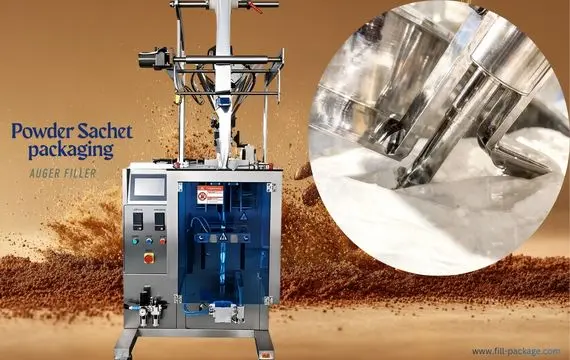
An auger filler uses a precision-machined helical screw — the auger — rotating inside a sealed filling chamber. The rotation of the auger moves powder from the hopper downward and dispenses it through a nozzle directly into the bag. The key engineering differences from a cup filler are:
- Controlled discharge velocity — the auger delivers powder at a low, controlled speed, avoiding the impact and splash that generates airborne particles
- Below-seal-zone nozzle positioning — the filling nozzle extends into the bag, delivering powder below the future seal area rather than from above
- Sealed filling chamber — the auger housing is sealed from the atmosphere, preventing dust from escaping upward into the film tube
- Programmable dose — the number of auger revolutions per fill cycle determines the dose, adjustable to ±0.5% accuracy for pharmaceutical-grade applications
Pesticide powder note: Wettable powder (WP) and water-dispersible granule (WDG) formulations used in agrochemicals typically have very fine particle sizes (5–50 microns) and low bulk density. These are the most challenging powders for any filling system. Our BY-JLB160P uses a high-precision auger with a sealed dust extraction collar at the nozzle, capturing any residual airborne particles before they reach the seal zone.
| Filling Technology | Discharge Method | Dust Generation | Seal Contamination Risk | الأفضل لـ |
| Volumetric cup filler | Single-drop from height | High for fine powders | عالي | Granules, coarse powders |
| Standard auger filler (BY-JLB160X) | Controlled screw rotation | قليل | منخفض جدًا | Milk powder, seasoning, probiotic powder |
| High-precision auger (BY-JLB160P) | Servo-controlled rotation + dust extraction | Near zero | Near zero | Pharmaceutical powder, pesticide powder, fine chemical powders |
Key 2: Material Compatibility — Corrosion Resistance for Agrochemical Environments
Most powder sachet filling machines are built for food production environments. The cleaning protocols, chemical exposure, and material requirements of agrochemical production are significantly more demanding.
Pesticide powders — particularly fungicides, insecticides, and herbicides in wettable powder formulations — contain active ingredients that are corrosive to standard 304 stainless steel over repeated exposure. The acidic or alkaline pH of some formulations attacks surface finishes, leading to pitting and corrosion that becomes impossible to clean and creates contamination risk in subsequent production runs.
316L stainless steel: the minimum standard for agrochemical contact parts
316L stainless steel differs from 304 in its molybdenum content — approximately 2–3% by weight. This addition dramatically increases resistance to chloride corrosion, acidic environments, and the organic solvents present in many pesticide formulations. For all product-contact parts — the auger, auger housing, filling nozzle, and hopper interior — 316L is the correct material specification for pesticide powder packaging.
The BY-JLB160P uses 316L stainless steel for all product-contact surfaces as standard. For particularly aggressive formulations, we offer a surface passivation treatment that further increases chemical resistance by enriching the chromium oxide layer on all contact surfaces.
Sealing jaw material and temperature control
Pesticide powder sachets are typically packaged in aluminum foil composite laminate — the same film used for pharmaceutical sachets. This film requires precise sealing jaw temperature control: too low and the seal is incomplete; too high and the film delaminates or burns through.
The jaw temperature range for aluminum foil composite is typically 140–180°C, narrower than for standard PE film. The BY-JLB160P uses PID temperature controllers on all sealing jaws, maintaining jaw temperature within ±2°C of the setpoint across the full production run — eliminating the temperature drift that causes intermittent seal failures on long shifts.
| عنصر | Standard Machine (304 SS) | BY-JLB160P (Pesticide Grade) |
| Auger & housing | الفولاذ المقاوم للصدأ 304 | 316L stainless steel — molybdenum-enhanced corrosion resistance |
| Filling nozzle | الفولاذ المقاوم للصدأ 304 | 316L stainless steel + passivation treatment |
| Hopper interior | الفولاذ المقاوم للصدأ 304 | 316L stainless steel, mirror-polished Ra ≤ 0.4μm |
| Sealing jaw temperature | ±5°C tolerance | PID control, ±2°C tolerance |
| Dust extraction | Not standard | Integrated collar at fill nozzle |
| Film compatibility | PE, OPP laminates | Aluminum foil composite, pharmaceutical laminates |
Key 3: Fill Accuracy & Regulatory Compliance — Why ±1% Is Not Enough for Pesticides
In food powder packaging, fill accuracy of ±2% by volume is generally acceptable — a slightly underfilled sachet of milk powder or seasoning is a minor quality deviation. In pesticide powder packaging, fill accuracy has regulatory and efficacy implications.
The regulatory context
Most major agricultural markets — the EU, US EPA, and their equivalents in South Asia, Southeast Asia, and Latin America — require that pesticide products be filled to within a defined tolerance of the stated label weight. In the EU, Regulation (EC) 1907/2006 and related biocidal product regulations require that packaging content meets declared quantity within tolerances that vary by product weight but are typically tighter than general consumer goods standards.
Underfilling means the end-user applies insufficient active ingredient for effective pest control — a field performance complaint. Overfilling means you are giving away product and increasing regulatory exposure for average net quantity violations. Both create commercial and legal risk.
How servo-controlled auger filling achieves ±0.5% accuracy
The fill dose in an auger filler is determined by the number of auger revolutions per fill cycle, controlled by the servo motor. Servo motors provide position feedback — they know exactly how many degrees they have rotated — making the dose repeatable to a precision that pneumatic or gear-driven systems cannot match.
For the BY-JLB160P, the fill accuracy specification is ±0.5% by weight when calibrated for a specific product and fill weight. This is achieved through:
- Initial calibration — a sample run of 50 sachets is weighed, and the servo parameters are adjusted to bring the mean fill weight to target
- In-line check weighing — an optional integrated check weigher samples every Nth sachet and feeds weight data back to the PLC, which automatically adjusts the auger speed to compensate for density variation
- Environmental compensation — the sealed auger chamber prevents ambient humidity from affecting powder bulk density during a production run, maintaining calibration stability over a full shift
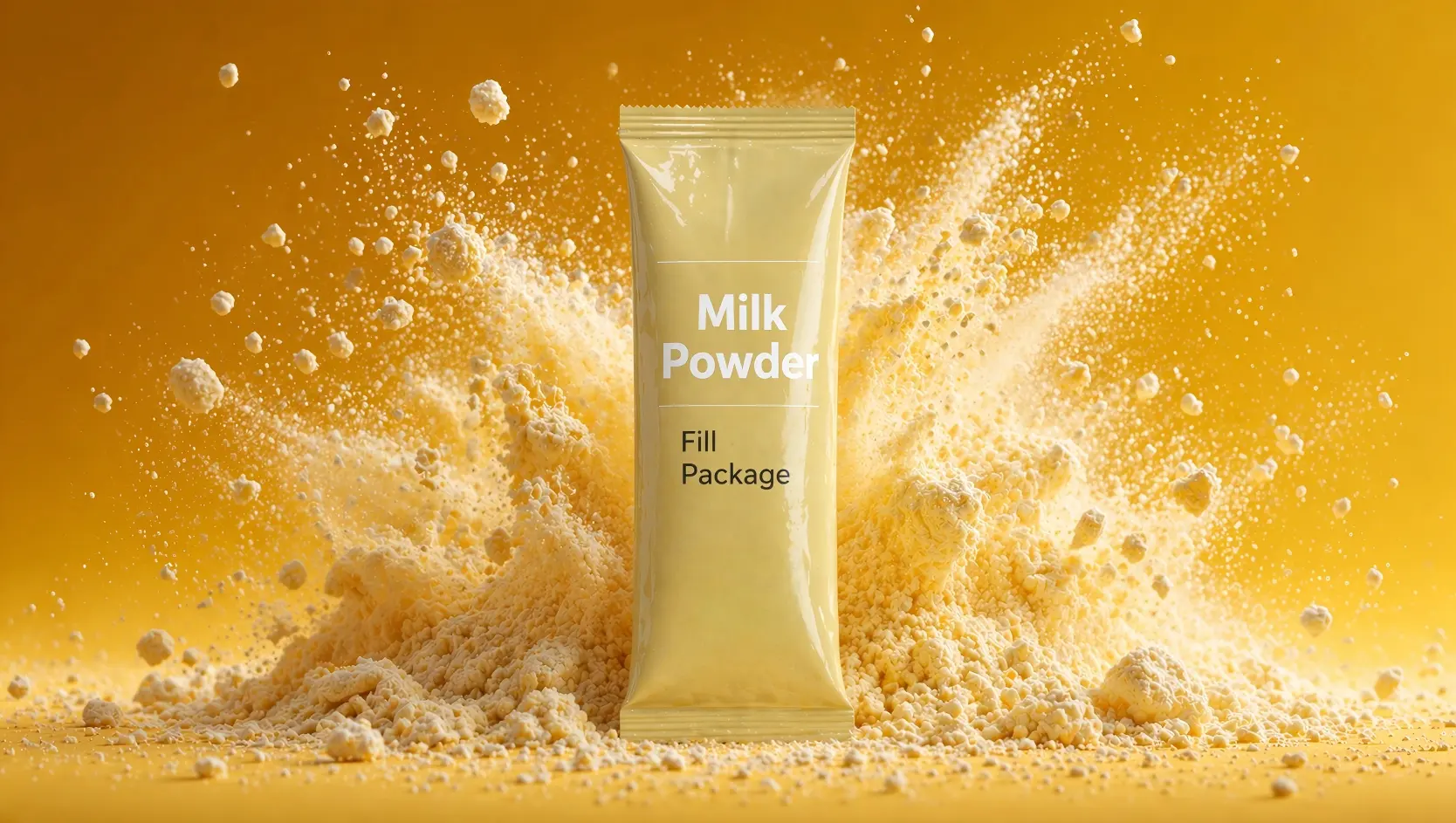
For food-grade powder applications — milk powder, probiotic powder, protein powder, seasoning — where ±1% accuracy is sufficient and GMP compliance rather than agrochemical compliance is the priority, the BY-JLB160X is the correct model. See our powder sachet filling machine range for the full model comparison.
Powder Sachet Filling Machine: Application Reference
Both models in the BY-JLB series handle a wide range of powder applications beyond pesticide powder. The table below shows the full application range and the recommended model for each:
| منتج | Particle Size | التحدي الرئيسي | Recommended Model |
| Pesticide powder (WP/WDG) | 5–50 microns | Corrosion resistance, dust containment, fill accuracy | BY-JLB160P |
| Pharmaceutical powder | 10–100 microns | GMP compliance, cross-contamination prevention, ±0.5% accuracy | BY-JLB160P |
| مسحوق الحليب | 50–200 microns | Hygroscopic — dust control and moisture-sealed chamber | BY-JLB160X |
| Probiotic powder | 20–100 microns | Live culture — temperature-controlled environment | BY-JLB160X |
| مسحوق البروتين | 50–300 microns | High surface area — anti-bridging agitator required | BY-JLB160X |
| Seasoning powder | 100–500 microns | Mixed particle sizes — consistent dose at high speed | BY-JLB160X |
| Chinese herbal powder | 20–150 microns | High oil content — anti-clogging nozzle geometry | BY-JLB160P |
Expert Tips: Running a Powder Sachet Line Safely and Efficiently
1. Dedicate the machine to a product family — or plan for deep cleaning
For pesticide powder packaging, we strongly recommend a dedicated machine — or at minimum, a rigorous validated cleaning procedure between product changes. Residual agrochemical powder in the auger housing or hopper can contaminate subsequent food-grade production runs. If the machine must run both food-grade and agrochemical products, the cleaning validation protocol should include swab testing of all product-contact surfaces.
2. Film selection determines your seal performance ceiling
For pesticide powder sachets, aluminum foil composite laminate is the standard — it provides the oxygen, moisture, and UV barrier required for active ingredient stability. The foil layer also makes the seal zone visible: a properly formed foil seal has a smooth, uniform appearance; an imperfect seal shows as a dull or wrinkled area that experienced QC operators can spot visually before it becomes a leak.
Avoid transparent PE film for pesticide sachets — it provides insufficient barrier protection for most active ingredients and does not give you the visual seal quality indicator that foil provides.
3. Auger changeover between products
The auger is the product-specific component of the filling system. Different products — particularly those with very different particle sizes or bulk densities — require different auger geometries to achieve accurate fill weight. Our auger filler uses a tool-less auger removal system: the auger can be withdrawn, cleaned, and replaced in under 10 minutes, without tools and without disassembling the hopper. For a contract packer running multiple powder products on one machine, this is the changeover time that determines your production flexibility.
خاتمة
Pesticide powder packaging places engineering demands on a sachet filling machine that food powder applications do not. Corrosion resistance, fill accuracy to regulatory standards, and near-zero dust leakage are not optional features — they are the minimum specification for a machine that will run agrochemical products safely and consistently.
The BY-JLB160P addresses all three requirements: 316L stainless steel throughout the product-contact path, servo-controlled auger filling at ±0.5% accuracy, and an integrated dust extraction collar that captures airborne particles at the source. For food-grade powder applications where ±1% accuracy and 304 stainless construction are sufficient, the BY-JLB160X delivers the same auger filling principle at a lower capital cost.
Both models are part of our professional sachet filling and sealing machine range, which covers the full spectrum of sachet packaging applications from granules through liquids and irregular shapes.
Evaluating a powder sachet filling machine for your application? Send us a sample of your powder — particle size, bulk density, and fill weight range — and we will run a filling trial on the relevant BY-JLB model. You receive a trial report with fill accuracy data, seal quality photos, and a machine recommendation before you commit to any order. Request a Powder Filling Trial →
Ready to specify? Visit the BY-JLB160X / BY-JLB160P Powder Sachet Filling Machine page for full specifications, film compatibility tables, and model comparison. Or explore the full product range on our sachet packing machines overview.
Related reading:
How to Choose the Most Cost-Effective Dhana Dal Packing Machine (Granule Series)