

مقدمة
If you pack Dhana Dal — roasted coriander seeds — for export, you already know the pressure. The South Asian and Middle Eastern spice markets are intensely competitive. Buyers compare your sachets side by side on a shelf, and the decision to pick up your product or the one next to it often happens in under three seconds.
Dropping your price is not the answer. What actually moves the needle is packaging quality — and specifically, the kind of packaging that signals ‘export grade’ before the buyer even reads the label.
This guide breaks down how to choose the right Dhana Dal packing machine for a small or mid-sized exporter: what filling technology fits coriander seeds and similar spice granules, why round corner sachet design is now the minimum standard for retail-ready export packaging, and how to calculate whether the investment pays for itself.
Already know what you need? Go straight to the BY-JLX160Z Round Corner Granule Packing Machine specification page.
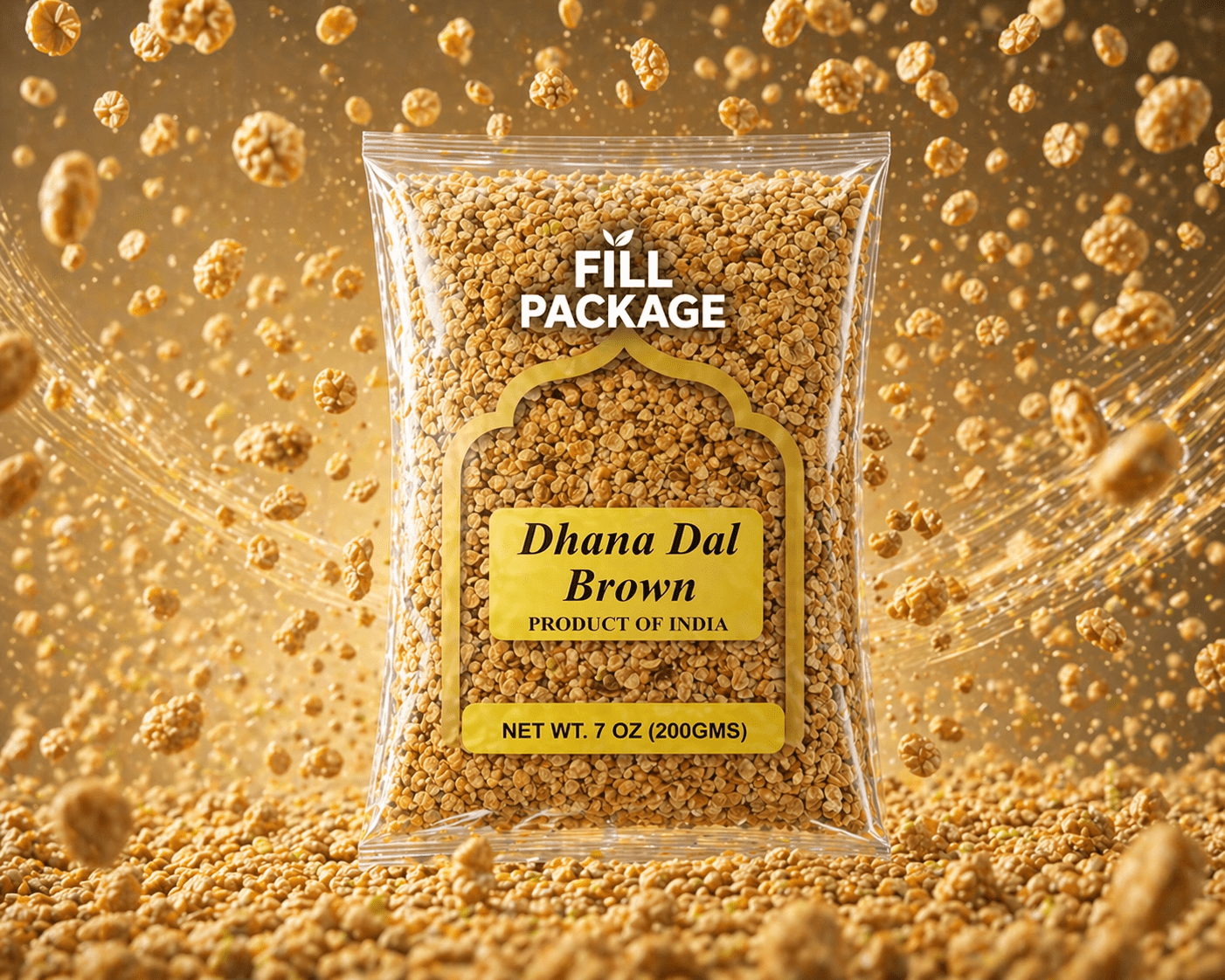
A. Why Precision Matters for Grain & Dal Exporters
Dhana Dal and similar spice granules share a set of physical properties that make them, in packaging terms, both forgiving and demanding at the same time.
On the forgiving side: roasted coriander seeds have relatively consistent bulk density. They do not clump, they do not generate excessive dust, and they flow freely through most standard filling systems. This means you do not need an expensive auger filler or a multi-head weigher for small to mid-range sachet sizes.
On the demanding side: the granules are small, irregular, and slightly oily from the roasting process. Any granule that lands in the seal zone — the narrow strip of film where the horizontal jaw closes to form the top or bottom seal — will prevent a complete heat bond. The result is a micro-leak that is invisible to the naked eye but shortens shelf life from 18 months to 4 or 5. By the time your buyer’s customer notices the stale product, the damage to your brand is already done.
The right filling technology for Dhana Dal: volumetric cup filler
For a product with stable, consistent density like roasted coriander seeds, a volumetric cup filler is the most cost-effective and reliable choice. A rotating disc with precisely machined cups scoops a measured volume of product on each cycle. At the correct fill speed, the discharge trajectory drops the product cleanly into the center of the bag tube — away from the seal zone.
Compared to a multi-head weigher, a cup filler requires significantly less maintenance, has fewer moving parts, and costs a fraction of the price. For a small exporter running 5g to 50g Dhana Dal sachets, it delivers everything you need.
The BY-JLX160Z automatic dal packing machine uses a volumetric cup filler system calibrated for spice granules in exactly this size range. Fill accuracy is within ±2% by volume — sufficient for standard retail sachet requirements and well within the tolerance accepted by most EU and GCC import regulators for spice products.
B. The Round Corner Advantage: Why It Is Now a Non-Negotiable for Export
Walk into any premium supermarket in Europe, the UK, or the Gulf and look at the spice sachet section. Then look at the discount section. The single most reliable visual indicator of which tier a product belongs to is the corner shape of the sachet.
Square corners signal economy. Round corners — smoothly curved at all four corners of a 4-side seal sachet — signal premium. They feel better in the hand, they photograph better for e-commerce listings, and they sit more neatly in display trays and on shelf pegs.
This is not a minor aesthetic point. It is a commercial gate. Many European and GCC private-label buyers now specify round corner sachets as a baseline requirement for new supplier listings. If your sachet has square corners, it is not being evaluated for the premium tier — regardless of what is inside it.
How round corners are produced on the BY-JLX160Z
The machine uses a die-cut blade system integrated into the sealing and cutting station. After the horizontal seal is formed, the cutting mechanism trims all four corners simultaneously using a curved die — producing a consistent, smooth radius on every sachet without a separate post-processing step. The die radius is adjustable to match your buyer’s specification.
The 4-side seal format — two film rolls sealing all four edges — gives the sachet a flat, clean face on both sides. This matters for printed film packaging, where your brand graphics cover the entire face of the sachet without interruption from a back seam.
Square corner vs. round corner: a direct comparison
| Square Corner (Standard) | Round Corner 4-Side Seal | |
| Retail appearance | Economy / commodity tier | Premium / export tier |
| In-hand feel | Sharp edges, industrial feel | Smooth, tactile quality signal |
| E-commerce photography | Less appealing flat lay | Clean, photogenic, brand-ready |
| EU / GCC buyer acceptance | Accepted for commodity | Required for premium listing |
| Shelf display | Inconsistent stacking | Neat, uniform display |
| BY-JLX160Z compatible | Yes (standard die) | Yes (round die — default) |
See full specifications for the round corner format on our BY-JLX160Z product page.
C. Calculating the ROI: When Does a Dhana Dal Packing Machine Pay for Itself?
Manual bagging vs. automatic: a realistic comparison
| Manual (3 workers, 8-hr shift) | BY-JLX160Z (1 operator, 8-hr shift) | |
| Daily output | 7,200 – 9,600 sachets | 25,000 – 28,000 sachets |
| Labour cost | 3× worker wage | 1× operator wage |
| Cost per 1,000 sachets | Baseline | 60–70% lower |
| Seal consistency | Variable — operator dependent | Controlled — machine consistent |
| Round corner capability | Not available | معيار |
| Export-grade appearance | Rarely achievable | Every sachet, every run |
The machine does not just reduce cost per sachet — it raises the volume ceiling of your operation without adding headcount. For an exporter receiving a large retail order, the constraint is no longer how many people you can put on the line.
The listing advantage: the ROI that does not show up in a spreadsheet
There is a harder-to-quantify but commercially significant factor: access to retail channels that require consistent, machine-quality packaging. A hand-sealed sachet, however carefully made, cannot meet the seal strength and dimensional consistency requirements of major supermarket buyers. A machine-packed round corner 4-side seal sachet can.
The revenue difference between being listed with a premium retailer and selling through commodity channels dwarfs the machine cost within the first year for most exporters in the 500kg/month production range.
D. Expert Tips: What to Watch for When Running Spice Granules
1. Static electricity and why it matters
Dry, roasted spice granules — particularly Dhana Dal — generate static charge through friction as they move through the filling system and contact the packaging film. Static causes granules to cling to the inner surface of the film tube, increasing the risk of contamination in the seal zone.
The BY-JLX160Z uses full stainless steel construction with anti-static design on all film-contact surfaces. For particularly dry or fine-ground spice variants, an optional ionizer bar can be specified to neutralize static before the seal jaws close.
2. Film selection for spice export
For Dhana Dal and similar aromatic spice granules, aluminum foil composite laminate is the standard export film — it provides the oxygen and moisture barrier needed to protect the volatile oils that give the spice its aroma and shelf life. Transparent PE film is acceptable for domestic short-shelf-life sales but will not protect aroma over the 12–18 month shelf life required by most export buyers.
The BY-JLX160Z is compatible with all mainstream laminate films from 35mm to 800mm film width — covering everything from a 5g single-serve sachet to a 200g catering-format pouch.
3. The machine runs more than Dhana Dal
One of the most common concerns from small exporters is utilisation — will the machine sit idle when coriander seed season is over? The answer is no. The BY-JLX160Z handles the full range of free-flowing granule products without major changeover:
- Coffee beans — same cup filler, same round corner die
- Whole spices — cumin, mustard seed, fennel, cardamom
- Nuts — peanuts, cashews, almonds (adjust cup size)
- Probiotic granules — same format, GMP-compliant construction
- Candy, sugar, lentils — full dal and grain range covered
Changeover between product types takes under 20 minutes. For a small exporter running multiple product lines on one machine, this versatility is a significant operational advantage.
For the full range of automatic dal packing machine configurations and applications, visit our professional sachet filling and sealing machine overview page.
خاتمة
Choosing a Dhana Dal packing machine is not purely a capital expenditure decision. It is a decision about which tier of the export market you want to compete in — and whether your packaging gives you the credibility to get there.
The combination of a volumetric cup filler (precision at low cost), round corner 4-side seal format (retail-ready presentation), and full stainless steel construction (export compliance and hygiene) makes the BY-JLX160Z the most cost-effective entry point for a small exporter moving from manual or semi-automatic production to a fully automated line.
The automatic dal packing machine format gives you the throughput to fulfil large retail orders, the seal quality to pass buyer audits, and the packaging aesthetics to justify a premium shelf position — without the capital commitment of an industrial-scale line.
Ready to upgrade your grain packaging? Request a free material filling trial for the BY-JLX160Z — send us a sample of your Dhana Dal or spice granule, and we will run it on the machine and send you filled sample sachets with a full trial report. Request a Free Material Filling Trial →
Not sure which configuration fits your product range? زوروا موقعنا BY-JLX160Z Round Corner Granule Packing Machine page for full specifications, film compatibility tables, and customisation options. Or browse all sachet machine types on our sachet packing machines overview page.