

Honey is one of the most commercially attractive products for sachet packaging. It is shelf-stable, high-value, has strong retail demand in single-serve formats, and commands a price premium in sachet form that thin liquid products cannot. A 10 g honey sachet at a coffee shop or bakery sells for significantly more per gram than the same honey in a jar.
It is also one of the most technically demanding products for a sachet liquid filling machine to handle cleanly. Honey’s high viscosity, its tendency to string at the nozzle, its sensitivity to temperature variation, and its exceptional ability to contaminate a seal zone make honey sachet packaging an effective test of how well a sachet filling and sealing machine is actually engineered — not just how well it runs on water during a showroom demonstration.
This guide explains the specific failure modes in honey sachet packaging, how to test for each one properly, and what machine and process parameters to check when testing finds a problem.
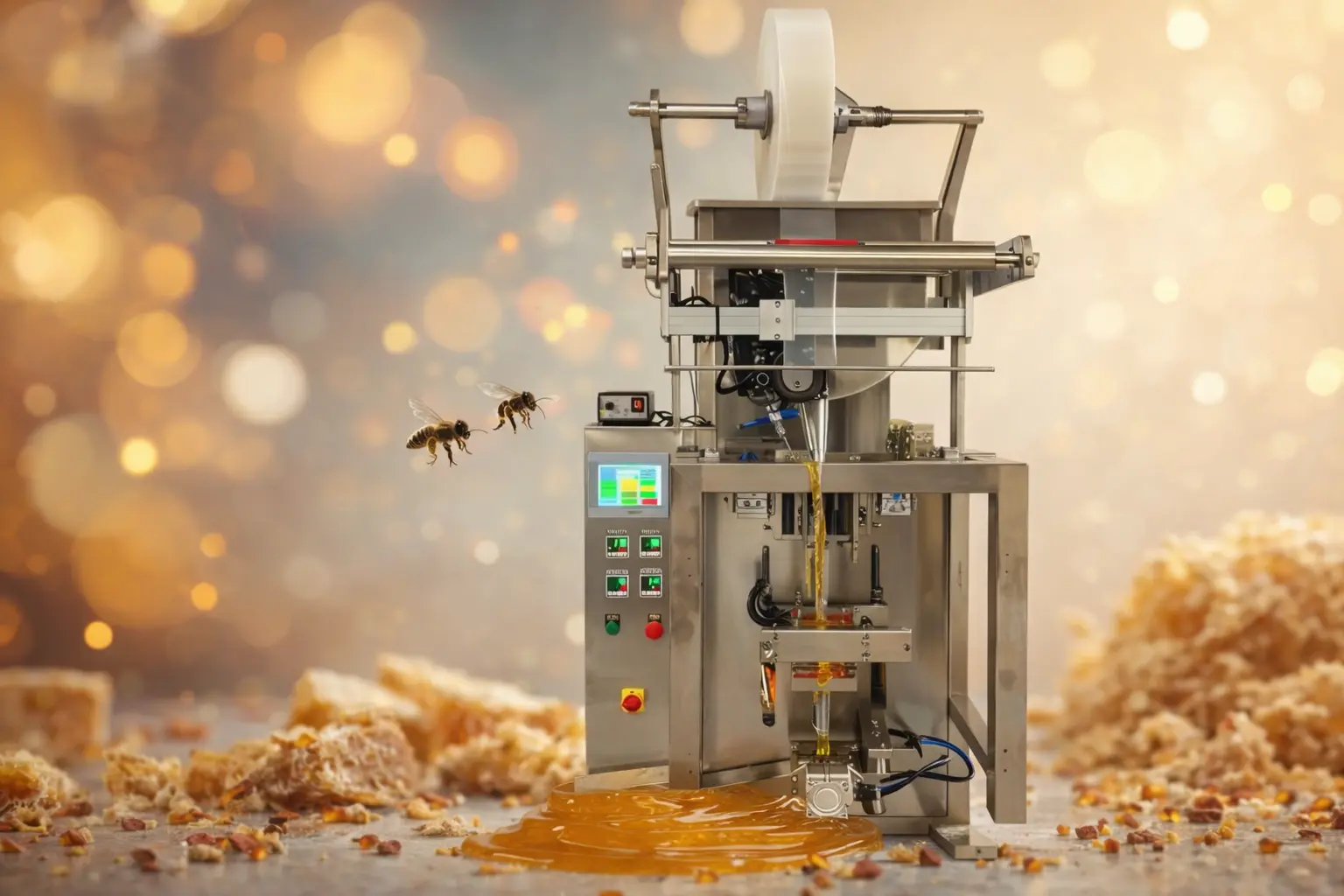
Why honey is different from every other liquid sachet product
Before getting into testing methodology, it is worth being precise about what makes honey technically challenging, because the answer directly shapes which tests matter and in what order.
Viscosity. Honey at 20°C has a viscosity of roughly 2,000–10,000 cP depending on water content and botanical source. This is 2,000–10,000 times thicker than water. At this viscosity, gravity alone does not reliably pull honey away from the filling nozzle at the end of a fill cycle — which means without an active anti-drip mechanism, honey continues to flow from the nozzle after the fill is nominally complete, landing on the film at the seal zone and creating a contaminated seal.
Temperature dependence. Honey’s viscosity is extremely sensitive to temperature. At 40°C, honey is roughly 10 times less viscous than at 20°C. This means the same honey product filling at 9:00 AM, when the hopper has just been loaded with cold product, fills differently than at 2:00 PM, when the hopper has been running for five hours and the product has warmed to ambient temperature in the machine. Without temperature control in the product pathway, fill weight drifts and seal contamination risk increases as the shift progresses.
Stringing. When a high-viscosity liquid like honey is cut off at the nozzle, it does not break cleanly the way water does. It forms a thread — a string of product that connects the nozzle tip to the last-filled pouch as the pouch travels to the sealing jaw. If this string is not broken before the sealing jaw closes, it bridges across the seal zone and creates a product pull-through defect: the seal appears intact but has honey embedded in it, which prevents the film layers from bonding fully. The result is a seal that fails under light pressure.
Sugar crystallisation at the seal. In cold conditions or over time, honey crystallises. A honey sachet that was sealed with trace amounts of honey contamination in the seal zone will have that honey crystallise over weeks, physically breaking the seal bond from the inside. This is a delayed failure — the sachet passes inspection at production but fails at the retailer or in the consumer’s hands.
Each of these failure modes requires a specific response at the machine level. Testing for all four is the foundation of a honey sachet quality assurance programme.
The four tests every honey sachet packing operation needs
Test 1: Fill weight accuracy and consistency — the temperature drift test
What you are testing: Whether fill weight remains consistent from the start to the end of a production shift as product temperature in the hopper changes.
How to run it: At the start of a production run, weigh 10 consecutive sachets immediately after they are produced and record the fill weight of each. Note the product temperature in the hopper at the time of sampling. Repeat the weighing and temperature check at one hour intervals throughout the shift. Plot fill weight against time and hopper temperature.
What you are looking for: Fill weight variation of more than ±2% of target weight indicates a viscosity-driven filling problem. If fill weight drifts consistently in one direction as hopper temperature rises, the machine is not compensating for viscosity change through the shift — either the temperature-controlled product pathway is not fitted, is not set correctly, or is not functioning.
If you find a problem: Check that the product pathway heating is operating and set to the correct temperature for your honey’s viscosity profile. If no temperature control is fitted, this is a machine configuration issue — contact your supplier about the temperature-controlled pathway option for the BY-JLB160Y. A temporary workaround is to pre-warm the honey to a consistent temperature before loading the hopper and to top up with pre-warmed product rather than cold product throughout the shift, though this is operationally less reliable than a properly configured temperature-controlled pathway.
Test 2: Anti-drip performance — the nozzle drip test
What you are testing: Whether the filling nozzle is leaving residual honey at the seal zone after each fill cycle.
How to run it: Run the machine for 50 consecutive fills. After the run, inspect the outer surface of the formed pouches — specifically the area adjacent to the back seal — for any honey residue. Also inspect the inside of the forming tube at the seal zone level for honey deposits. Then open five randomly selected pouches and inspect the inner surface of the back seal for honey contamination between the film layers at the seal line.
What you are looking for: Any honey residue on the outer pouch surface adjacent to the seal indicates nozzle drip-after-fill contamination reaching the film before sealing. Honey contamination on the inner seal surface of opened pouches confirms that contaminated film is being sealed — and that those seals are structurally compromised regardless of whether they look intact from the outside.
If you find a problem: Check the anti-drip suck-back setting on the filling nozzle assembly. The suck-back action should be timed to activate immediately at the end of the fill cycle and should draw back enough product to leave the nozzle tip fully clear. For honey, the suck-back volume typically needs to be set higher than for thinner liquids — most machines require this to be adjusted specifically for each product’s viscosity. If suck-back is already at maximum and drip persists, check that the nozzle tip is the correct geometry for high-viscosity product and that the product temperature is at the specified fill temperature for your honey.
Test 3: Seal integrity — the pressure test and the peel test
What you are testing: Whether the seal has actually bonded fully — not just whether it looks closed.
How to run it (pressure test): Select 20 sachets randomly from a production run. Submerge each sachet in a tray of clean water. Apply firm, even pressure by hand — equivalent to the weight of a full pallet of sachets resting on a single pouch — and hold for 10 seconds. Any sachet that releases bubbles or shows liquid seeping from the seal has a seal failure. Record the number of failures as a percentage of the sample.
How to run it (peel test): Take 10 sachets from the same production run. Cut the pouch open and expose the back seal. Grip the seal between thumb and forefinger on each side and pull sharply perpendicular to the seal line. A properly bonded seal on standard honey sachet film (typically PET/AL/PE or NY/PE laminate) should resist the pull with the film tearing before the seal separates. If the seal peels cleanly and easily without film tearing, the bond is insufficient.
What you are looking for: A zero failure rate on the pressure test and film-tear (not seal-peel) failure mode on the peel test represents a properly sealed sachet. Any seal-peel failure on the peel test, or any pressure test failure, indicates a sealing problem requiring immediate investigation.
If you find a problem: Check sealing temperature against the film supplier’s recommended range for your specific laminate. Check seal jaw dwell time — for honey sachets, a slightly longer dwell time than for water or thin sauce sachets is often required because the product inside the pouch is viscous and exerts sustained pressure against the forming seal during the dwell period. Check seal jaw pressure. Also inspect the seal jaw surface for contamination — even trace honey on the jaw face will reduce seal quality.
Test 4: Delayed failure — the accelerated aging seal test
What you are testing: Whether seals that pass day-one inspection remain intact after the product has been in the sachet for several weeks — accounting for honey crystallisation and the temperature cycling that sachets experience in a real supply chain.
How to run it: Produce a sample batch of 50 sachets under normal production conditions. Divide them into two groups of 25. Store one group at ambient temperature (20–25°C) and one group in a refrigerator (4–8°C) to accelerate crystallisation. After two weeks, run both groups through the pressure test and peel test described above. Compare the failure rate against your day-one baseline.
What you are looking for: A significant increase in seal failure rate in the refrigerated group, or a failure rate increase in the ambient group after two weeks, indicates that honey crystallisation is breaking down the seal bond from the inside — confirming that there was residual honey contamination in the seal at production that was not detected by day-one testing alone.
If you find a problem: The root cause is almost always residual honey in the seal zone at the time of sealing — which brings you back to Tests 1 and 2 (temperature drift and anti-drip performance). Honey crystallisation in the seal is the downstream consequence of poor nozzle drip control and inadequate product temperature management at fill time. Solving those two upstream problems eliminates the delayed failure mode.
Setting up your honey sachet quality control programme
A practical honey sachet quality control programme does not require laboratory equipment or dedicated QC staff. It requires a weighing scale, a tray of water, and the discipline to run the four tests above consistently at the start of every production run and at regular intervals through each shift.
For a commercial honey sachet packing operation, we recommend the following sampling schedule:
At production start (first 20 minutes): run the fill weight test and nozzle drip check before full-speed production begins. Confirm that fill weights are within ±2% of target and that no drip contamination is visible. Do not proceed to full production speed until both checks pass.
Every hour through the shift: weigh 5 consecutive sachets and record against the target. If drift exceeds ±2%, pause and check hopper temperature and nozzle condition before continuing.
End of each production run: run the pressure test on a 20-sachet sample before the batch is released to packaging and distribution.
Once per month (or with each new film roll): run the accelerated aging test on a 50-sachet sample to confirm that delayed seal failures are not developing in product that has already been distributed.
This programme takes less than 30 minutes of operator time per shift and catches every significant failure mode before product reaches the customer.
Machine specification checklist for honey sachet packaging
If you are evaluating a honey sachet packing machine — or assessing whether your existing sachet liquid filling machine is correctly configured for honey — check these five specification points before production begins.
Temperature-controlled product pathway. Mandatory for honey at commercial production volumes. Without it, fill weight drift through the shift is inevitable as honey warms in the hopper.
Anti-drip suck-back nozzle. Mandatory. The suck-back volume must be tunable for high-viscosity product specifically — not just set to the water configuration.
Large inlet diameter option. The 51 mm inlet is the correct choice for honey at standard commercial fill volumes. Smaller inlets create flow restriction that slows fill speed and increases back-pressure at the nozzle, worsening drip and stringing.
Adjustable seal dwell time. The dwell time setting for honey should be independently adjustable from the speed setting — you need to be able to extend dwell time for honey without reducing the machine’s overall production rate.
Food-grade and honey-compatible materials. Stainless steel product contact surfaces throughout. Confirm that any gaskets or seals in the product pathway are rated for food contact with high-sugar, high-viscosity products.
خاتمة
Honey sachet packaging is genuinely achievable at commercial quality — but only with a sachet liquid filling machine that is properly specified for the product’s viscosity characteristics and only with a quality control programme that tests for all four failure modes, including the delayed crystallisation failure that day-one inspection alone will not catch.
The starting point for any new honey sachet packing operation should be a product trial with your specific honey — at your intended fill volume, using your intended film specification — before any purchase commitment is made. A trial conducted under real production conditions, with fill weight data and sample sachets for seal testing, tells you everything you need to know about whether the machine and configuration are right for your product.
If you are currently experiencing leakage issues in an existing honey sachet operation, work through the four tests above in sequence. In the majority of cases, the root cause is either nozzle drip-after-fill or product temperature drift through the shift — both of which have clear machine-level solutions.
[Request a Honey Sachet Filling Trial →]
[View BY-JLB160Y Liquid Sachet Machine Specifications →]
[Talk to a Liquid Packaging Engineer →]
[Read next: Start your business with a Water Sachet Machine — Profitability Analysis 2026 →]