

The $100,000 Problem Hiding on Your Production Floor
Walk into almost any kimchi or ready-meal packaging facility, and you will see the same scene: a multihead weigher running, and two workers standing beside it, gloved hands constantly pushing product into the feeder. Management calls this “automation.” The P&L calls it something else entirely.
| 💸 The Hidden Cost of “Human-Assisted” Automation Every worker permanently stationed to push product represents $25,000–$35,000 in annual wages alone — before benefits, insurance, retraining, or the food safety liability of bare hands in the product zone. A standard two-person push team costs $60,000+/year. At that rate, a complete screw feeder system upgrade typically pays back in under 14 months. |

But wages are only the most visible layer. The full cost picture looks like this:
| فئات التكلفة | Source | Annual Impact |
| Manual pusher wages | 2 workers × $30,000/yr | $60,000 / year — direct, unavoidable |
| Weighing inaccuracy | Avg ±4g overfill on 200g packs | ~$28,000/yr product giveaway (3 shifts) |
| HACCP audit exposure | Hand contact = CCP violation | Potential facility suspension or recall |
| Bridging downtime | 3–5 stoppages per shift | ~45 min lost/shift = $81 revenue/shift |
| Staff turnover | High-repetition push work | $4,500 replacement + retraining per worker |
| Total hidden annual cost (1 line) | $95,000–$140,000 — before any incident cost |
The question is not whether to automate. The question is why the standard weigher didn’t work — and the answer is almost always: wrong machine for the product. That’s a machine selection problem, not an automation problem.
Why Standard Weighers Fail: The Adsorption Effect Explained
Standard multihead weighers operate on a single physical mechanism: vibration. Vibrating linear feeder pans carry product to weigh hoppers. For dry, free-flowing material — chips, nuts, frozen peas — this works perfectly. Sticky materials expose the fundamental flaw.
Two forces that defeat vibration on sticky lines:
- Surface Adsorption Film: Kimchi brine, cooking oil, and soy-sauce marinades form a nanometre-thin liquid film between the product surface and the stainless steel pan. This film creates an adsorption bond — similar in mechanism to a suction cup — that vibration at low amplitude cannot break. Increasing vibration amplitude doesn’t help: it bounces product chaotically rather than moving it forward, generating inaccurate hopper fills and sensor errors.
- Fibre Bridging & Clump Formation: Kimchi strands, shredded pork, and seaweed filaments mechanically interlock across the tray outlet. One piece bonds to the surface; the mass behind it stops. The hopper starves. The weigher’s combination logic cycles with empty buckets, producing underweight bags. At 60 bags/min, a single starved hopper reduces effective accuracy across all combinations that would have included it.
| 💡 The Golden Rule of Automated Weighing Accuracy is not won at the weighing stage. It is won or lost at the feeding stage. A machine cannot calculate an accurate combination if its hoppers are receiving chaotic, unpredictable weights. For sticky materials, the only engineering solution is not improved vibration — it is the complete replacement of vibration with Forced Mechanical Displacement via a rotating screw auger. |
Three Products, Three Failure Modes — One Engineering Answer
These three product categories account for the majority of sticky-material packaging failures we encounter on kimchi and ready-meal lines. Each has a specific failure mode on standard equipment:
| منتج | ❌ Standard Weigher Failure Mode | ✅ Screw Feeder + Scraper Solution |
| 🥬 Kimchi & Fermented Vegetables | Long fibrous strands tangle into rope-like masses. Brine + salt weight means product won’t move at any vibration level. Workers must manually separate strands every 8–12 min. High salt content corrodes standard 304SS within months. | Wide-pitch screw auger separates strands progressively — like a slow-turning mixer. Brine drains away from the feed zone. Full 316SS resists salt corrosion. Zero manual intervention across 6+ hour runs. |
| 🍲 Oily Ready Meals (Red-braised Pork, Curry Chicken) | Thick sauce creates a partial vacuum seal between product and hopper wall when the door closes. At 60 bags/min, 2–6g of sauce stays behind every cycle. Over a 10-hour shift this systematic drift adds up to 120–360g of mis-weighed product per hour. | Double-door scraper hoppers: as the door opens, integrated blades sweep the interior wall in one motion — every gram falls. Memory hoppers compensate for sauce weight variation. Accuracy held at ±1g throughout full shift. |
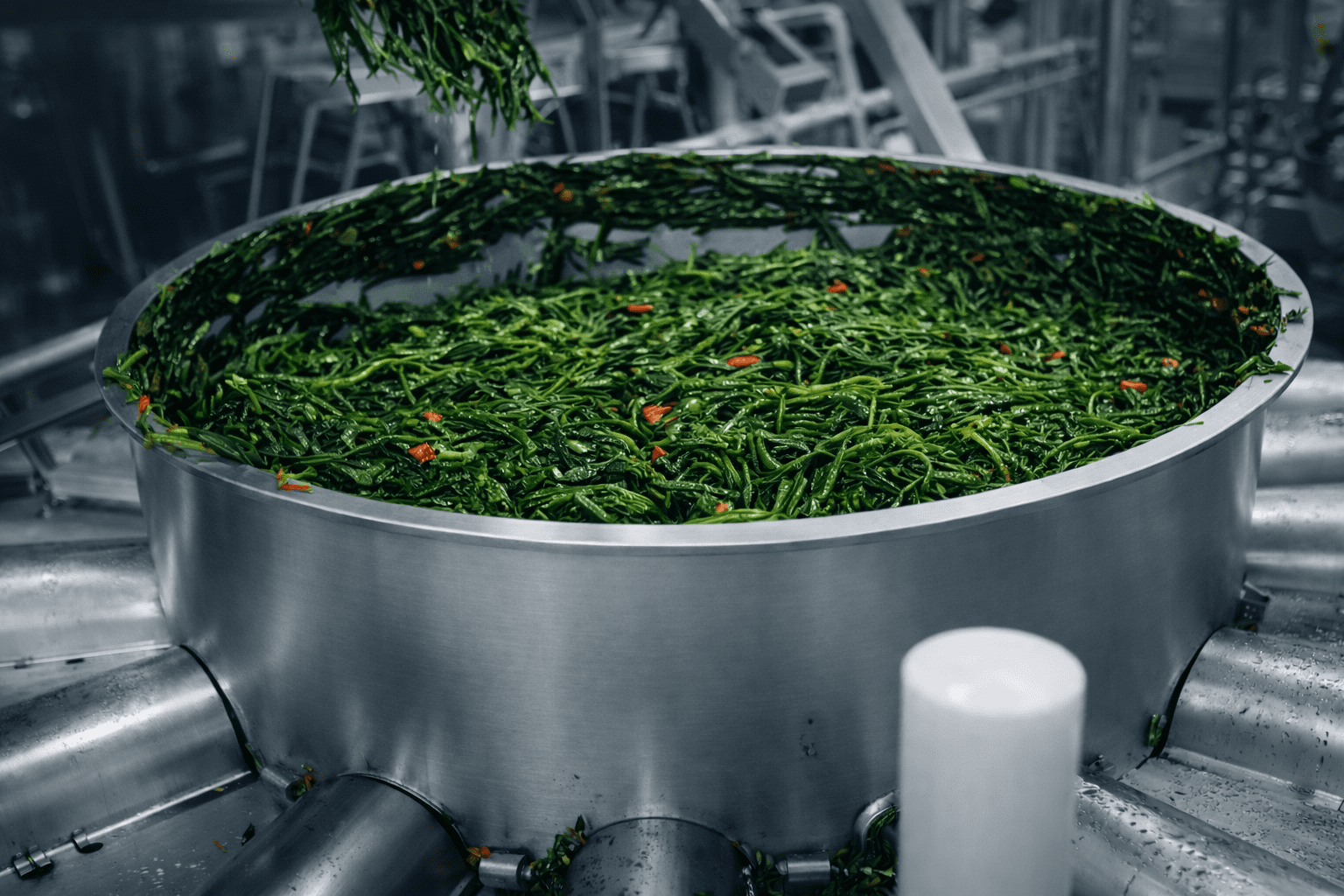
| 🌿 Wet Seaweed / Oyster Mushrooms / Fresh Chicken Breast | Thin, fragile, long strands shred under standard vibration. Fresh chicken breast fillets are large and irregular — vibration pans can’t move them without bouncing, causing muscle fibre damage and drip loss. Hoppers receive chaotic, variable weights. | Low-RPM screw (adjustable 8–30 RPM via VFD) provides gentle progressive transport. Low drop-height architecture limits fall distance to <80mm, protecting texture. U-shaped troughs align strands in feed direction without breakage. |
| 🎥 Visual / Video Recommendation CRITICAL VIDEO ASSET: Embed the split-screen demonstration video (https://www.youtube.com/watch?v=m478vk2zfxk) here, showing fresh chicken breast (or similar sticky protein) on the left side being handled without manual intervention by the screw feeder, vs. the standard weigher scenario on the right. This is your highest-converting visual for this article — industrial buyers respond to seeing the product move without human hands. Add caption: ‘Watch how screw-driven feeding handles fresh meat without a single manual touch.’ |
The Engineering Stack: Screw Feeder with Scraper Hoppers
The screw feeder multihead weigher with scraper hoppers doesn’t attempt to improve vibration — it replaces the entire feeding mechanism. Rotating helical augers physically drive product into weigh hoppers at a controlled, adjustable rate. Here is how each component contributes specifically to kimchi and ready-meal lines:
| عنصر | How It Works — Detail for Kimchi & Ready Meal Lines | Primary Application |
| Double-Door Scraper Hopper | The most critical component for sauced/oily materials. As the hopper door opens to release product, integrated scraper blades simultaneously sweep the interior walls in a single wiper motion. No sauce accumulation between cycles. No systematic weight drift. At 60 bags/min over a 10-hour shift, eliminating 3g/hopper residue prevents 108g/hour of mis-weighed product — equivalent to freeing 1,296g of product per hopper per shift from accumulation error. | Red-braised pork, curry chicken, honey-glazed items, any sauce-coated product |
| Screw Frequency Control (VFD) | Each screw channel has independently adjustable rotation speed via Variable Frequency Drive. Kimchi: 18–22 RPM. Delicate mushrooms: 8–12 RPM. Marinated meat: 25–30 RPM. Chicken breast: 15–20 RPM. You set the feed rate to match your product’s viscosity and piece size — not the other way around. Switchable between product programs in < 90 seconds. | All sticky, fibrous, delicate, or high-moisture materials |
| U-Shaped Feed Troughs | The U-profile constrains product laterally during screw transport. No lateral spreading, no queue disorder. Trough interior is electropolished to Ra ≤0.8μm, reducing adhesion on transport surfaces by ~35% vs. standard finish. No dead corners for oil or brine to accumulate between wash cycles. Critical for HACCP compliance on kimchi lines. | Kimchi, oily ready meals, wet seaweed, any liquid-containing product |
| Modular VFFS / Rotary Bagger Interface | Standard 24V PLC trigger signal output — compatible with all major VFFS bag makers (ULMA, Ishida, Ilapak, domestic brands) and rotary pre-made pouch machines. PLC stores up to 100 product programs. Switch between kimchi and curry chicken SKUs in under 90 seconds. No custom integration engineer required. | Multi-SKU ready meal and condiment facilities |
| IP67 Full-Enclosure Washdown | All motors, PCB enclosures, junction boxes, and sensor housings sealed to IP67 (full-immersion rated). Kimchi brine and cooking oils are among the most corrosive environments in food processing. Standard IP54 equipment begins failing within 3–6 months on these lines. IP67 eliminates the primary failure pathway: water ingress during daily sanitisation. | All wet-food environments with daily pressure-wash requirement |
| Teflon (PTFE) Coating on Chutes (Optional) | Food-grade PTFE coating on discharge chutes reduces the coefficient of friction by ~60% vs. bare stainless steel. Most effective for materials where adhesion is primarily surface-tension based: kimchi brine, cooking oil, sweet glazes, soy-sauce marinades. Paired with scraper hoppers, effectively reaches zero-residue discharge. | Brine-heavy, oil-heavy, or sugar-coated products |
| 🎥 Visual / Video Recommendation Insert close-up photograph of the Double-Door Scraper Hopper showing the scraper blade in its sweep position against the hopper wall. Macro lens recommended. This is the single component that most visibly differentiates the product from competitors. |
2026 Market Context: Why Zero-Contact Packaging Is Now a Trade Requirement
The ready-meal and kimchi export market has changed structurally in 2026. Three forces are converging to make “zero-contact” automated packaging a non-negotiable entry requirement for export-oriented facilities:
- Retail chain audit standards (BRCGS Issue 9 / SQF Edition 9): Both standards now explicitly flag manual product intervention at automated weighing stations as a Category 2 non-conformance — meaning a potential audit failure that can block export certification.
- Ready-meal export standardisation: Korean, Chinese, and Southeast Asian ready-meal exporters supplying EU and North American retail chains now face packaging-line inspection requirements that include proof of zero manual product contact. “Human-assisted automation” no longer meets the standard.
- Labour cost trajectory: In every major food-processing economy, the labour cost of manual feeding roles has increased 8–15% year-on-year since 2022. The payback period on automation investment is shorter in 2026 than it has ever been.
The facilities that are upgrading now are not doing so because their current manual process is broken. They’re doing so because their export customers and auditors are telling them it doesn’t meet 2026 standards. The window to upgrade proactively — before an audit failure — is closing.
The Numbers: Manual vs. Automated — What Your Line Actually Looks Like
| متري | Manual / Standard Weigher | Screw Feeder + Scraper System |
| Throughput (bags/min) | 8–15 (manual push line) | 45–65 (screw feeder line) |
| Workers at weighing station | 3–5 | 1 (QC monitoring only) |
| Weight accuracy (300g target) | ±5–10g | ±0.5–1g |
| Downtime per 8-hr shift | 90–140 min (bridging + clears) | < 10 min (scheduled checks only) |
| HACCP hand-contact incidents | Frequent | Zero (fully enclosed feed path) |
| Daily washdown time | 60–90 min | < 12 min (tool-less IP67 design) |
| Annual wage cost at station | $60,000–$90,000 | $0 (no dedicated feeder staff) |
| Typical ROI payback period | — | 10–16 months |
| 📊 From 15 Bags/Min to 45+ Bags/Min: The Throughput Calculation A line moving from manual push (15 bags/min) to screw feeder automation (50 bags/min) gains 35 bags/min. Over a 10-hour shift: 35 × 600 = 21,000 additional bags. At $0.35 margin per bag, that is $7,350 of additional output per shift — before accounting for the $60,000 annual wage saving. Combined, a two-shift operation generates over $200,000 per year in combined cost saving + production uplift from a single line upgrade. |
Go Deeper: Related Guides
For a technical deep-dive into why sticky materials bridge and how the physics of forced mechanical displacement compares to vibration across 12 product categories: Solving the “Sticky” Problem: Why Your Packaging Line Clogs and How to Fix It (Blog #88)
For a direct comparison of standard multihead weigher vs. screw feeder performance on marinated meat and poultry applications, including head count selection and accuracy benchmarks: Standard Multihead Weigher vs. Screw Feeder: Which is Best for Sticky Meat? (Blog #144)
For the full poultry-specific application guide including boneless chicken feet, marinated breast, and HACCP compliance requirements: Automated Packaging for Fresh & Marinated Poultry: From Chicken Wings to Boneless Feet (Blog #12)
Next Step: Free Automation Feasibility Assessment
Sticky product lines vary enormously. A kimchi line at 80 bags/min in a Korean export facility has different screw geometry, trough sizing, and hopper configuration requirements from a red-braised pork ready-meal line at 30 bags/min in a UK retail-pack operation. We don’t send catalogs. We send engineering recommendations.
| Ready to end manual pushing on your line? Send us a photo or short video of your current product and line setup. Our engineers will provide a free Automation Feasibility Assessment — specifying the right screw geometry, scraper hopper configuration, and control integration for your exact material and throughput target. No obligation, no generic catalog response. |
Our engineers will review your product photos or video, assess your current line layout, specify the correct screw pitch and RPM for your material viscosity, and provide a full integration layout from infeed conveyor to bag maker — with projected accuracy, OEE uplift, and ROI payback timeline.