


مقدمة
In international market development, the hardest thing to control is often not the product or the price—it’s time. Clients cancel meetings due to unexpected events. They repeatedly decline with “I’m too busy.” But when you’re facing a client with enormous potential, the reluctance to leave without meeting them face-to-face can drive you to make unconventional decisions.
My business mentor once said something I’ll never forget: “Treat your client like someone you’re pursuing romantically—do whatever it takes to win them over.“ It sounds extreme, but in B2B field sales, this kind of persistence often creates unexpected breakthroughs.
The story of this Vietnamese client is the perfect example.

Part 1: The Beginning of Rejection—”I Don’t Have Time”
From the very first email, this client’s response was always the same three words: “I don’t have time.”
When I arrived in Vietnam and tried to schedule a meeting again, I received the same polite but firm rejection. Once, twice, three times… Every attempt met the same response.
Most people would have given up. But I couldn’t let it go.
Why?
My preliminary research showed this company was substantial. They were a local Vietnamese manufacturer of PVC أنظمة النقل, primarily serving the seafood packaging industry. The factory was sizable, the inventory was abundant, and their client base was stable. If we could partner with them, this would be a long-term, stable account.
So I made a decision: I would visit them unannounced.
Part 2: The Risky Decision—Showing Up at Their Door
In my previous article, “Vietnam Market Development (Part 1),” I mentioned that many Vietnamese companies list addresses online that aren’t their actual office locations—they’re registered addresses or virtual offices. But this company’s address seemed legitimate after multiple checks.
So on our last afternoon in Vietnam, we rented a car and drove directly to the address on Google Maps.
I must emphasize this point: Language is the biggest barrier in client communication. If you can’t commit to learning the local language, an experienced translator is essential. Otherwise, you’ll waste time just trying to find your way around.
We circled the industrial area several times and took a few wrong turns before finally finding our destination. I later learned from the owner that he had purchased all these factory buildings rather than renting them, which explained why the address was accurate.
Part 3: The Unexpected Encounter—Surprise and a Smile
When our car pulled up to the factory gate, we happened to run into the owner himself.
His expression is etched in my memory:
- Complete surprise—he clearly hadn’t expected me to show up unannounced
- A smile—a good sign
He asked me, “How did you find this place?“
I replied, “I followed Google Maps.”
“Didn’t I tell you I don’t have time?”
I smiled and said, “I won’t take much of your time. I just want to understand your company and do some market research. I’m not here pushing for an order.”
He paused, then said, “You’re lucky. This is the only day this week I’m at the factory, and you showed up.”
I responded, “Then perhaps fate arranged this meeting.”
He smiled and said, “Come in.“
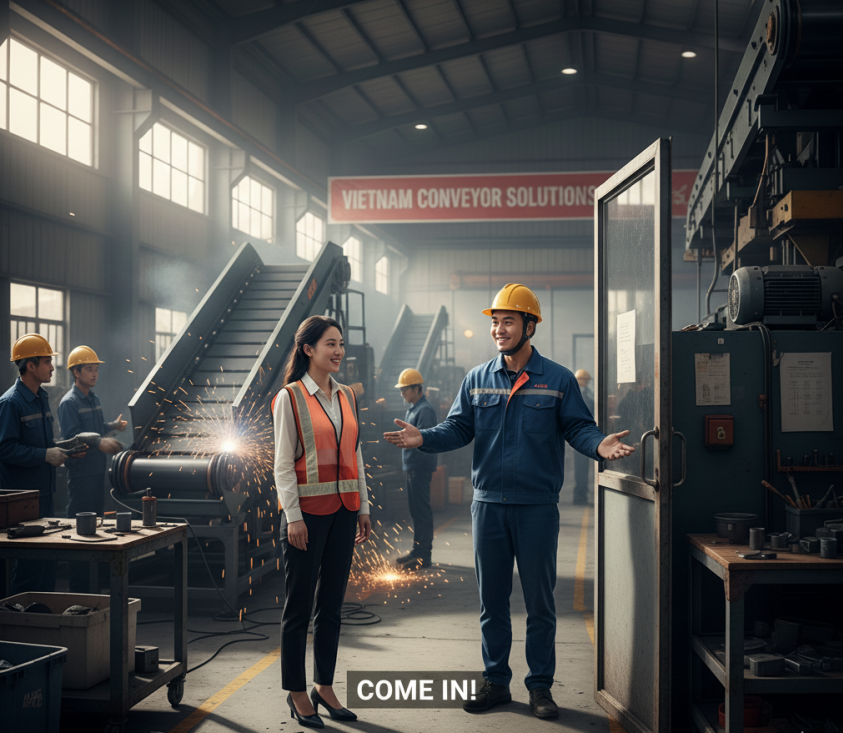
Part 4: The Factory Tour—A Substantial Local Manufacturer
In Vietnam, showing up unannounced without permission is generally considered impolite and often results in immediate rejection. But this time, we were genuinely fortunate—this owner was very open-minded.
He gave us a tour of the office and factory floor. This was a substantial local manufacturer:
- Core Business: PVC conveyor system manufacturing
- Client Base: Primarily serving the seafood packaging industry
- حجم الإنتاج: Abundant inventory with large PVC conveyor belt reserves
- Facilities: This was just one factory; another facility was located farther away
- Assets: All factory buildings were purchased, not leased
These details revealed a quality client with long-term planning, stable cash flow, and ongoing procurement needs.
Part 5: The Client’s Pain Point—Abandoned by a Supplier
After the tour, we sat down to talk. I asked him, “Why won’t you consider our products?“
His answer revealed a problem that’s widespread in our industry.
Several years ago, one of our main competitors (let’s call them “Company A”) entered the Vietnamese market and approached him. At the time, this client enthusiastically agreed to become one of Company A’s first distributors. He even trained a dedicated sales team and invested significant time and resources to promote the brand.
Company A’s brand quickly gained traction in the Vietnamese market.
But then came the price competition.
As Company A’s distributor and agent network grew, they began tiering their clients, pricing based on sales volume. The result? This client—one of the original promoters who helped open the market—ended up with higher prices than newer clients because his volume couldn’t match some of the larger accounts that came later.
He felt betrayed.
He told me: “I helped them open the market, and then I ended up with the highest prices. I don’t want to help new suppliers promote their products anymore. I’m afraid of doing all the work for someone else’s benefit. I’m afraid of being used.”
This was his pain point.
Part 6: The Solution—OEM + Custom Tooling to Help the Client Profit
After hearing his concerns, I didn’t rush to pitch our products. Instead, I addressed his pain points with two solutions:
Solution 1: OEM Manufacturing—Build Your Own Brand
I said, “We can manufacture under your brand. You’ll be promoting your own market and products. No one else will compete with you on price.”
Solution 2: Custom Larger Molds to Reduce Costs and Pass Savings to You
I continued, “For the products you use most frequently, we can create larger molds to reduce production costs and pass those savings directly to you. This means you can sell your own brand at lower prices, which significantly boosts your market competitiveness.”
Of course, this solution would require a certain order volume to be viable.
His eyes lit up.
The meeting went very well. I could tell he was genuinely interested in this partnership model.
Part 7: Reflection—What’s Wrong with Our Partnership Models?
Beyond the lesson about persistence in field sales, this story raises a deeper question:
Are our partnership models truly fair?
Company A’s approach represents a common problem among Chinese suppliers:
1. Pricing by volume, not by partnership duration
Long-term clients who help you open markets and invest significant time and resources end up with worse pricing than new large-volume clients.
2. Not investigating why long-term clients’ volumes decline
Is the market more competitive? Are the products no longer suitable? Are prices uncompetitive? Are there promotional challenges?
3. Short-term thinking—favoring bigger new clients over loyal existing ones
This is human nature, but it’s also shortsighted. Long-term clients’ loyalty and stability are often more valuable than new clients.
4. Flooding the market with identical products, forcing distributors into price warsEventually, all distributors are trapped in price competition. The supplier gets trapped too. Nobody profits.
What should we do instead?
1. Provide more support to long-term clients
Not just pricing, but also marketing support, technical assistance, and customization services.
2. Help long-term clients build their own brands
Through OEM and customized products, give long-term clients their own competitive moat instead of having all distributors sell the same brand and compete against each other.
3. Communicate regularly to understand clients’ real needs and challenges
Don’t wait until clients stop ordering to ask “why.”
4. Build long-term partnerships
Not “whoever orders the most gets the best price,” but “whoever grows with us gets the best support.”
Part 8: Conclusion—Persistence Rooted in Respect
This Vietnamese client’s story taught me two important lessons:
Lesson 1: Persistence in field sales isn’t blind—it’s informed
Persistence requires sufficient understanding of the client and recognition of their value. The right approach respects the client, doesn’t force the issue, but also doesn’t give up easily.
Lesson 2: Fair partnership models create lasting relationships
Clients aren’t tools or disposable resources. Clients are partners and allies in growth. Only when clients profit can we profit.
Finally, I want to say:
In international trade, persistence matters—but what matters even more is respect.
Respect for clients’ time, respect for their contributions, respect for their trust.
Only then can we go the distance.
About the Author
I’m a 20-year veteran in the packaging equipment industry, having developed clients across India, Vietnam, Indonesia, Brazil, the Middle East, and beyond. I’ve experienced countless successes and failures. Through these authentic stories, I hope to share the lessons and insights from my journey in international trade.
If you have any needs related to packaging equipment, multihead weighers, VFFS machines, or conveyor systems, please contact me:
•بريد إلكتروني: info@fill-package.com
•WhatsApp: +86-13536680274
Related Articles:
 Arabic
  English
  Portuguese
  Russian
  Spanish
  Turkish
  Hindi
Hindi  Vietnamese